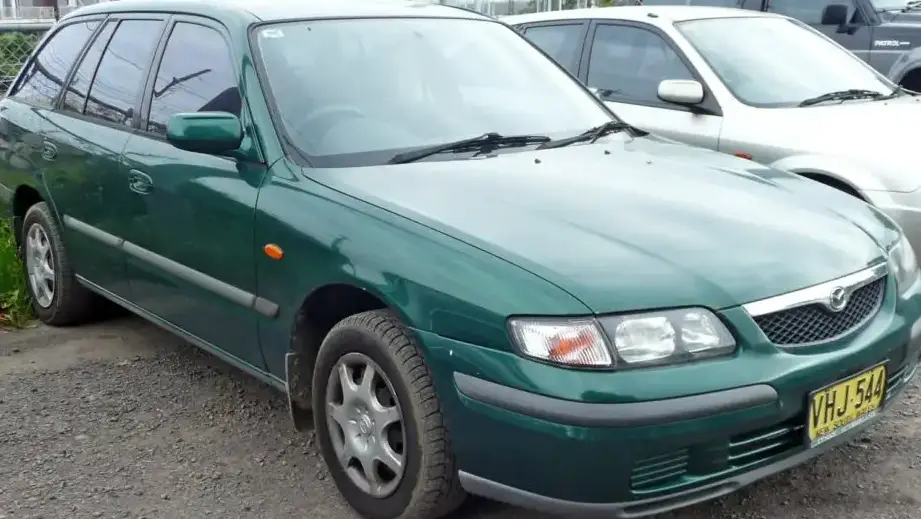
The Mazda 626 V Station Wagon, specifically the GF/GW generation produced between 1998 and 2000, represented Mazda’s entry into the competitive mid-size wagon segment. This variant, equipped with the 2.0-liter FS engine producing 116 horsepower, occupied a middle ground within the 626 lineup, offering a balance between affordability, practicality, and reasonable performance. It was primarily marketed in Europe and other international markets, where station wagons maintained significant popularity. The GF/GW series was a significant redesign for the 626, moving away from the boxier styling of previous generations towards a more aerodynamic and contemporary aesthetic.
Technical Specifications
| Brand | Mazda |
| Model | 626 |
| Generation | 626 V Station Wagon (GF,GW) |
| Type (Engine) | 2.0 (116 Hp) |
| Start of production | 1998 |
| End of production | 2000 |
| Powertrain Architecture | Internal Combustion engine |
| Body type | Station wagon (estate) |
| Seats | 5 |
| Doors | 5 |
| Fuel consumption (urban) | 10.8 l/100 km (21.8 US mpg) |
| Fuel consumption (extra urban) | 6.7 l/100 km (35.1 US mpg) |
| Fuel Type | Petrol (Gasoline) |
| Acceleration 0 – 100 km/h | 10.6 sec |
| Acceleration 0 – 62 mph | 10.6 sec |
| Acceleration 0 – 60 mph | 10.1 sec |
| Maximum speed | 192 km/h (119.3 mph) |
| Weight-to-power ratio | 11 kg/Hp |
| Weight-to-torque ratio | 7.4 kg/Nm |
| Power | 116 Hp @ 6000 rpm |
| Torque | 173 Nm @ 4500 rpm (127.6 lb.-ft. @ 4500 rpm) |
| Engine layout | Front, Transverse |
| Engine Model/Code | FS |
| Engine displacement | 1991 cm3 (121.5 cu. in.) |
| Number of cylinders | 4 |
| Engine configuration | Inline |
| Cylinder Bore | 83 mm (3.27 in.) |
| Piston Stroke | 92 mm (3.62 in.) |
| Compression ratio | 9.7:1 |
| Number of valves per cylinder | 4 |
| Fuel injection system | Multi-port manifold injection |
| Engine aspiration | Naturally aspirated |
| Engine oil capacity | 3.5 l (3.7 US qt | 3.08 UK qt) |
| Coolant capacity | 7.5 l (7.93 US qt | 6.6 UK qt) |
| Kerb Weight | 1280 kg (2821.92 lbs.) |
| Max. weight | 1840 kg (4056.51 lbs.) |
| Max load | 560 kg (1234.59 lbs.) |
| Trunk (boot) space – minimum | 540 l (19.07 cu. ft.) |
| Trunk (boot) space – maximum | 1677 l (59.22 cu. ft.) |
| Fuel tank capacity | 64 l (16.91 US gal | 14.08 UK gal) |
| Length | 4660 mm (183.46 in.) |
| Width | 1710 mm (67.32 in.) |
| Height | 1515 mm (59.65 in.) |
| Wheelbase | 2670 mm (105.12 in.) |
| Front track | 1465 mm (57.68 in.) |
| Rear track | 1470 mm (57.87 in.) |
| Drivetrain Architecture | Front wheel drive |
| Number of gears | 5 |
| Gearbox type | Manual transmission |
| Front suspension | Spring Strut |
| Rear suspension | Wishbone |
| Front brakes | Ventilated discs |
| Rear brakes | Disc |
| Assisting systems | ABS (Anti-lock braking system) |
| Steering type | Steering rack and pinion |
| Power steering | Hydraulic |
| Tires size | 185/65 R15 |
| Wheel rims size | 6J x 15 |
Powertrain & Engine Architecture
The heart of this 626 variant was the Mazda FS engine, a 1.991-liter inline-four cylinder gasoline engine. This engine utilized a multi-port fuel injection system, delivering fuel directly into the intake ports, optimizing combustion efficiency. The FS engine featured a double overhead camshaft (DOHC) valvetrain, operating four valves per cylinder, enhancing volumetric efficiency and contributing to the engine’s power output. The compression ratio was set at 9.7:1, a common figure for naturally aspirated engines of this era. The engine was transversely mounted in the front of the vehicle, driving the front wheels. The five-speed manual transmission was the standard offering, providing a balance between fuel economy and driver control. The gear ratios were tuned for everyday usability, prioritizing smooth acceleration rather than outright performance.
Driving Characteristics
The 116 horsepower and 127.6 lb-ft of torque delivered by the 2.0-liter engine provided adequate, but not exhilarating, performance. Acceleration from 0 to 60 mph took approximately 10.1 seconds, and the top speed was around 119 mph. Compared to the higher-output engines available in the 626 range, such as the V6 options, this variant felt noticeably less powerful. However, it offered a more relaxed driving experience, particularly suited for long journeys and everyday commuting. The manual transmission allowed for a degree of driver engagement, but the gear ratios were spaced to prioritize fuel efficiency over sporty acceleration. The engine was generally smooth and refined, with a linear power delivery that made it easy to modulate.
Equipment & Trim Levels
The 2.0-liter 626 V Station Wagon typically came with a reasonable level of standard equipment. This included power windows, central locking, and an AM/FM radio. Air conditioning was often standard, but could be optional depending on the specific market. Interior upholstery was typically cloth, with a durable and practical design. Higher trim levels offered upgrades such as alloy wheels, a sunroof, and upgraded audio systems. The dashboard layout was functional and ergonomically designed, with easy-to-read gauges and intuitive controls. Safety features included ABS anti-lock brakes, which were becoming increasingly common on vehicles of this class.
Chassis & Braking
The 626 V Station Wagon utilized a front-engine, front-wheel-drive layout. The front suspension employed a MacPherson strut design, while the rear suspension featured a multi-link setup. This combination provided a comfortable ride quality and reasonable handling characteristics. The braking system consisted of ventilated discs on the front wheels and solid discs on the rear. The ABS system helped to prevent wheel lockup during hard braking, enhancing safety and control. The steering was rack-and-pinion, providing precise and responsive steering feel. The vehicle’s weight of approximately 2822 lbs contributed to its manageable handling characteristics.
Market Reception & Comparison
The 2.0-liter 626 V Station Wagon was generally well-received by automotive critics as a practical and affordable family vehicle. It offered a good balance of space, comfort, and fuel economy. However, it was often criticized for its lack of outright performance compared to some of its rivals. Compared to other trims in the 626 lineup, such as the V6 models, the 2.0-liter variant offered lower running costs and a more accessible price point. Fuel economy was a strong point, with combined fuel consumption averaging around 30 mpg. Reliability was generally good, although some owners reported minor issues with the fuel injection system.
Legacy
The Mazda 626 V Station Wagon, particularly the 2.0-liter variant, has developed a reputation as a reliable and durable vehicle. Many examples are still on the road today, testament to their build quality and longevity. The FS engine is known for its robustness, and with proper maintenance, can provide many years of service. In the used car market, these vehicles are often sought after by those looking for an affordable and practical family wagon. While not a particularly collectible model, the 626 V Station Wagon represents a significant chapter in Mazda’s history, showcasing their commitment to building well-engineered and dependable vehicles.