
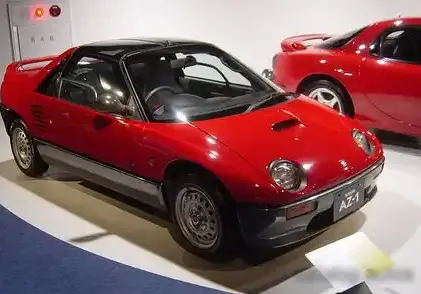
The Mazda Az-1, a Kei-class sports car produced between 1992 and 1998, represents a unique and ambitious effort by Mazda to create a lightweight, mid-engined coupe for the Japanese domestic market. Distinctive for its gullwing doors, the Az-1 was a product of Mazda’s “Always Zooming” philosophy, aiming to deliver an engaging driving experience in a small package. The 0.7-liter (64 hp) variant, while the base model, offered a compelling entry point into the world of affordable sports cars, particularly within the constraints of Japan’s Kei car regulations. It was part of the broader Autozam lineup, a brand used by Mazda to market Kei cars.
Technical Specifications
| Brand | Mazda |
| Model | Az-1 |
| Generation | Az-1 |
| Type (Engine) | 0.7 (64 Hp) |
| Start of production | 1992 |
| End of production | 1998 |
| Powertrain Architecture | Internal Combustion engine |
| Body type | Coupe |
| Seats | 2 |
| Doors | 2 |
| Fuel consumption (combined) | 4.4 l/100 km (53.5 US mpg, 64.2 UK mpg, 22.7 km/l) |
| Fuel Type | Petrol (Gasoline) |
| Maximum speed | 160 km/h (99.42 mph) |
| Weight-to-power ratio | 11.3 kg/Hp, 88.9 Hp/tonne |
| Weight-to-torque ratio | 8.5 kg/Nm, 118.1 Nm/tonne |
| Power | 64 Hp @ 6500 rpm |
| Power per litre | 97.4 Hp/l |
| Torque | 85 Nm @ 4000 rpm (62.69 lb.-ft. @ 4000 rpm) |
| Engine layout | Middle, Transverse |
| Engine displacement | 657 cm3 (40.09 cu. in.) |
| Number of cylinders | 3 |
| Engine configuration | Inline |
| Cylinder Bore | 65 mm (2.56 in.) |
| Piston Stroke | 66 mm (2.6 in.) |
| Compression ratio | 8.3:1 |
| Number of valves per cylinder | 4 |
| Fuel injection system | Multi-port manifold injection |
| Engine aspiration | Turbocharger |
| Valvetrain | DOHC |
| Kerb Weight | 720 kg (1587.33 lbs.) |
| Fuel tank capacity | 30 l (7.93 US gal | 6.6 UK gal) |
| Length | 3295 mm (129.72 in.) |
| Width | 1395 mm (54.92 in.) |
| Height | 1150 mm (45.28 in.) |
| Wheelbase | 2235 mm (87.99 in.) |
| Front track | 1200 mm (47.24 in.) |
| Rear track | 1195 mm (47.05 in.) |
| Drivetrain Architecture | Rear wheel drive |
| Drive wheel | Rear wheel drive |
| Number of gears and type of gearbox | 5 gears, manual transmission |
| Front suspension | Wishbone |
| Rear suspension | Coil spring |
| Front brakes | Disc |
| Rear brakes | Disc |
| Assisting systems | ABS (Anti-lock braking system) |
| Steering type | Steering rack and pinion |
| Tires size | 155/65 R13 |
Powertrain & Engine Architecture
The heart of the Az-1 0.7 is the Mazda B3DE, a 657cc inline-three cylinder engine. This engine, specifically designed to meet Kei car regulations, featured a single overhead camshaft (SOHC) and multi-point fuel injection. Crucially, it was turbocharged, allowing Mazda to extract a relatively high 64 horsepower from such a small displacement. The turbocharger was a small unit, designed for quick spool-up and to provide a boost in low-end torque. The engine’s design prioritized efficiency and responsiveness over outright power. The engine was transversely mounted in the mid-engine layout, contributing to the car’s balanced handling. The five-speed manual transmission was the only gearbox option, providing direct control over the engine’s power delivery.
Driving Characteristics
The Az-1 0.7, despite its modest power output, offered a surprisingly engaging driving experience. The mid-engine layout and lightweight construction (720 kg / 1587 lbs) resulted in neutral handling and quick cornering ability. The turbocharger provided a noticeable boost in acceleration, although it wasn’t a dramatic surge. The 64 horsepower was sufficient for spirited driving on winding roads, but overtaking on highways required careful planning. Compared to the later, slightly more powerful versions, the 0.7 felt less urgent, but its lighter weight and more manageable power delivery made it accessible to a wider range of drivers. The five-speed gearbox was well-matched to the engine’s characteristics, allowing drivers to keep the engine in its optimal power band.
Equipment & Trim Levels
The Az-1 0.7 was relatively sparsely equipped, reflecting its position as an affordable sports car. Standard features included basic instrumentation, cloth seats, and power steering. Air conditioning was often an optional extra. The interior design was functional and minimalist, prioritizing driver focus. The distinctive gullwing doors were a defining feature, but they also presented practical challenges in tight parking spaces. Interior trim options were limited, typically consisting of different cloth patterns and color combinations. The focus was on providing a pure driving experience rather than luxurious amenities.
Chassis & Braking
The Az-1’s chassis was a monocoque construction, utilizing a space frame design to maximize rigidity while minimizing weight. The suspension consisted of wishbone suspension at the front and a coil spring setup at the rear. Disc brakes were fitted on all four wheels, providing adequate stopping power for the car’s weight and performance. An anti-lock braking system (ABS) was included as standard, enhancing safety. The relatively narrow tires (155/65 R13) contributed to the car’s nimble handling, but also limited grip in wet conditions.
Market Reception & Comparison
The Mazda Az-1 received generally positive reviews in Japan, praised for its unique design, engaging handling, and affordability. Critics noted the limited interior space and the challenges posed by the gullwing doors. Compared to other Kei sports cars of the era, such as the Suzuki Cappuccino and the Honda Beat, the Az-1 stood out for its mid-engine layout and distinctive styling. The Cappuccino and Beat offered a more raw and visceral driving experience, while the Az-1 prioritized a more refined and balanced approach. Fuel economy was a strong point, averaging around 53.5 US mpg, making it an economical choice for daily commuting.
Legacy
The Mazda Az-1, despite its limited production run, has gained a cult following among automotive enthusiasts. Its unique design and engaging driving dynamics have made it a sought-after collectible. The 0.7-liter variant, while not the most powerful version, remains a popular choice due to its affordability and accessibility. The B3DE engine, while relatively simple, has proven to be reasonably reliable, although regular maintenance is essential. Today, well-maintained examples of the Az-1 0.7 command a premium in the used car market, reflecting its status as a unique and iconic Japanese sports car. Its influence can be seen in subsequent lightweight sports car designs, and it continues to be celebrated as a testament to Mazda’s engineering creativity.
