
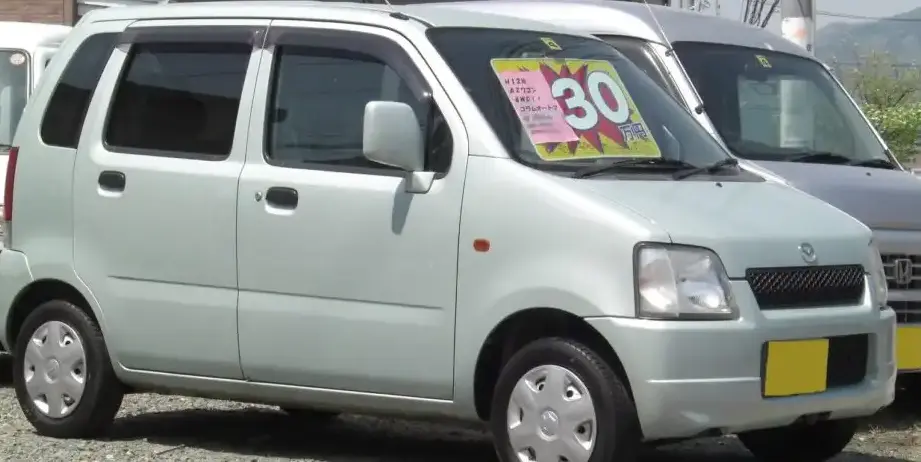
The Mazda Az-Wagon II 0.7 12V (52 hp) was a compact, entry-level minivan produced by Mazda between 1998 and 2000. Positioned as an affordable and practical vehicle, it was primarily sold in the Japanese domestic market (JDM) as a “kei car,” a category of vehicles with specific size and engine restrictions offering tax and insurance benefits. The Az-Wagon II represented the second generation of the Az-Wagon, building upon the success of the original with updated styling and minor mechanical improvements. This particular 0.7-liter variant served as the base model, offering a balance of economy and usability for urban commuters and small families.
Technical Specifications
| Brand | Mazda |
| Model | Az-wagon |
| Generation | Az-wagon II |
| Type (Engine) | 0.7 12V (52 Hp) |
| Start of production | 1998 year |
| End of production | 2000 year |
| Powertrain Architecture | Internal Combustion engine |
| Body type | Minivan |
| Seats | 5 |
| Doors | 3/5 |
| Fuel consumption (urban) | 8 l/100 km (29.4 US mpg, 35.3 UK mpg, 12.5 km/l) |
| Fuel consumption (extra urban) | 4 l/100 km (58.8 US mpg, 70.6 UK mpg, 25 km/l) |
| Fuel Type | Petrol (Gasoline) |
| Maximum speed | 125 km/h (77.67 mph) |
| Weight-to-power ratio | 14.4 kg/Hp, 69.3 Hp/tonne |
| Weight-to-torque ratio | 12.5 kg/Nm, 80 Nm/tonne |
| Power | 52 Hp @ 6500 rpm |
| Power per litre | 79.1 Hp/l |
| Torque | 60 Nm @ 4000 rpm (44.25 lb.-ft. @ 4000 rpm) |
| Engine layout | Front, Transverse |
| Engine displacement | 657 cm3 (40.09 cu. in.) |
| Number of cylinders | 3 |
| Engine configuration | Inline |
| Cylinder Bore | 65 mm (2.56 in.) |
| Piston Stroke | 66 mm (2.6 in.) |
| Compression ratio | 10.5:1 |
| Number of valves per cylinder | 4 |
| Fuel injection system | Multi-port manifold injection |
| Engine aspiration | Naturally aspirated engine |
| Valvetrain | OHC |
| Kerb Weight | 750 kg (1653.47 lbs.) |
| Fuel tank capacity | 30 l (7.93 US gal | 6.6 UK gal) |
| Length | 3395 mm (133.66 in.) |
| Width | 1475 mm (58.07 in.) |
| Height | 1690 mm (66.54 in.) |
| Wheelbase | 2360 mm (92.91 in.) |
| Front track | 1290 mm (50.79 in.) |
| Rear track | 1290 mm (50.79 in.) |
| Minimum turning circle | 8.4 m (27.56 ft.) |
| Drivetrain Architecture | The Internal combustion engine (ICE) drives the front wheels of the vehicle. |
| Drive wheel | Front wheel drive |
| Number of gears and type of gearbox | 5 gears, manual transmission |
| Front suspension | Spring Strut |
| Rear suspension | Coil spring |
| Front brakes | Disc |
| Rear brakes | Drum |
| Assisting systems | ABS (Anti-lock braking system) |
| Steering type | Steering rack and pinion |
| Tires size | 155/65 R13 |
Powertrain & Engine Architecture
The heart of the Az-Wagon II 0.7 was a 657cc inline-three cylinder engine, typically designated with engine codes like F6A. This engine featured a single overhead camshaft (OHC) and four valves per cylinder, utilizing a multi-port fuel injection system for improved efficiency and responsiveness. The 12-valve configuration (four valves per cylinder) was a key feature, contributing to a relatively high power output for its displacement. The engine was designed for smooth, low-end torque, prioritizing drivability in urban environments. The 5-speed manual transmission was the standard offering, chosen for its simplicity and contribution to fuel economy. The engine’s compact size and lightweight construction were crucial for meeting the kei car regulations.
Driving Characteristics
With only 52 horsepower, the Az-Wagon II 0.7 was not designed for outright speed. Acceleration was modest, and highway merging required careful planning. However, the lightweight nature of the vehicle – tipping the scales at around 750 kg (1653 lbs) – meant that it felt reasonably sprightly in city traffic. The 5-speed manual transmission allowed drivers to keep the engine in its optimal power band, maximizing performance. Compared to potential higher-spec versions (if offered in certain markets) with larger engines, this 0.7L variant prioritized fuel efficiency and ease of driving over performance. The gear ratios were tuned for quick acceleration from a standstill, making it well-suited for navigating congested urban areas.
Equipment & Trim Levels
The base-level Az-Wagon II 0.7 was typically equipped with basic amenities. Standard features generally included power steering, air conditioning (often optional), and a basic audio system. Interior upholstery was typically cloth, with a functional, no-frills design. Higher trim levels, if available, might have added features like power windows, central locking, and upgraded interior trim. The focus was on providing essential features at an affordable price point. Safety features were relatively basic for the time, typically including seatbelts and an anti-lock braking system (ABS) as optional equipment.
Chassis & Braking
The Az-Wagon II utilized a front-engine, front-wheel-drive layout. Suspension consisted of a MacPherson strut setup at the front and a coil spring arrangement at the rear. The braking system featured disc brakes on the front wheels and drum brakes on the rear, a common configuration for vehicles in this class to manage costs. The relatively light weight of the vehicle helped to compensate for the less sophisticated rear braking system. The steering was a rack and pinion system, providing reasonably precise handling for a kei car.
Market Reception & Comparison
The Mazda Az-Wagon II 0.7 was well-received in Japan as an affordable and practical kei car. Critics praised its fuel efficiency, compact size, and ease of maneuverability. Compared to other kei cars of the time, such as the Suzuki Wagon R or the Daihatsu Mira, the Az-Wagon offered a slightly more refined driving experience and a more stylish interior. However, its performance was generally considered to be on par with its competitors. The 0.7-liter engine provided adequate power for city driving, but it was less suitable for long highway journeys. Reliability was generally good, with the engine proving to be durable and relatively maintenance-free.
Legacy
The Mazda Az-Wagon II, and specifically the 0.7-liter variant, remains a popular choice among used car buyers in Japan. Its reputation for reliability, fuel efficiency, and affordability has ensured its continued demand. While not typically exported in large numbers, examples can occasionally be found in other markets through grey import channels. The powertrain, while simple, proved to be robust and capable of handling high mileage with proper maintenance. Today, the Az-Wagon II represents a practical and economical option for those seeking a small, reliable vehicle for urban commuting.
