
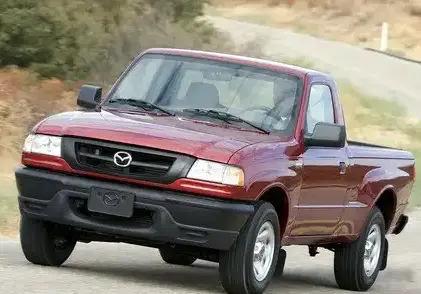
The Mazda B-Series VI, produced from 1997 to 2006, represented Mazda’s entry into the compact pickup truck market, primarily aimed at buyers in North America and Australia. This generation, a collaborative effort with Ford (sharing many components with the Ford Ranger), offered a range of engine and trim options. The 2.3-liter, 143 horsepower variant occupied a middle ground in the lineup, providing a balance between affordability, capability, and fuel efficiency. It served as a step up from the base engine, appealing to buyers who needed more power for towing or hauling without the expense of the larger V6 options.
Technical Specifications
| Brand | Mazda |
| Model | B-Series |
| Generation | B-Series VI |
| Type (Engine) | 2.3 (143 Hp) |
| Start of production | 1997 |
| End of production | 2006 |
| Powertrain Architecture | Internal Combustion engine |
| Body type | Pick-up |
| Seats | 2 |
| Doors | 2 |
| Fuel Type | Petrol (Gasoline) |
| Power | 143 Hp @ 5250 rpm |
| Power per litre | 63.3 Hp/l |
| Torque | 290 Nm @ 3750 rpm |
| Torque (lb-ft) | 213.89 lb.-ft. @ 3750 rpm |
| Engine layout | Front, Longitudinal |
| Engine displacement | 2260 cm3 |
| Engine displacement (cu. in.) | 137.91 cu. in. |
| Number of cylinders | 4 |
| Engine configuration | Inline |
| Number of valves per cylinder | 4 |
| Fuel injection system | Multi-port manifold injection |
| Engine aspiration | Naturally aspirated engine |
| Fuel tank capacity | 63 l |
| Fuel tank capacity (US gal) | 16.64 US gal |
| Fuel tank capacity (UK gal) | 13.86 UK gal |
| Length | 4763 mm |
| Length (in.) | 187.52 in. |
| Width | 1763 mm |
| Width (in.) | 69.41 in. |
| Height | 1648 mm |
| Height (in.) | 64.88 in. |
| Wheelbase | 2835 mm |
| Wheelbase (in.) | 111.61 in. |
| Front track | 1488 mm |
| Front track (in.) | 58.58 in. |
| Rear track | 1488 mm |
| Rear track (in.) | 58.58 in. |
| Drivetrain Architecture | Rear wheel drive |
| Front suspension | Wishbone |
| Rear suspension | Transverse stabilizer |
| Front brakes | Ventilated discs |
| Rear brakes | Drum |
| Tires size | 225/70 R15 |
| Wheel rims size | 15 |
Powertrain & Engine Architecture
The heart of the B-Series VI 2.3 was the Mazda-engineered, Ford-built 2.3-liter inline-four cylinder engine. This engine, internally designated with various codes depending on the specific market and year, was a naturally aspirated powerplant utilizing a multi-port fuel injection system. The engine featured a single overhead camshaft (SOHC) design with four valves per cylinder, contributing to its respectable power output for its displacement. The 2.3-liter engine was longitudinally mounted in the engine bay, driving the rear wheels. While not a high-performance engine, it was known for its durability and relatively simple maintenance requirements. The transmission paired with this engine was typically a four-speed automatic, although a five-speed manual transmission was also available. The automatic transmission was chosen by many buyers for its ease of use, particularly in city driving and for towing applications.
Driving Characteristics
The 2.3-liter engine, coupled with the four-speed automatic transmission, provided adequate, though not exhilarating, performance. Acceleration was reasonable for everyday driving, but passing maneuvers required planning. The automatic transmission’s gear ratios were tuned for fuel economy and towing capability rather than outright speed. Compared to the available 3.0-liter V6 engine, the 2.3-liter offered significantly less power and torque, resulting in slower acceleration and reduced towing capacity. However, it provided a noticeable improvement in fuel economy. The manual transmission version of the 2.3-liter offered slightly better performance and fuel economy due to the reduced drivetrain losses, but the automatic was favored by many buyers for its convenience.
Equipment & Trim Levels
The B-Series VI 2.3 typically came in base and mid-level trim configurations. Standard features generally included air conditioning, a basic audio system, and vinyl or cloth upholstery. Higher trim levels added features such as power windows and locks, upgraded audio systems, and alloy wheels. Interior appointments were functional and durable, reflecting the truck’s work-oriented nature. Optional extras included a towing package, cruise control, and a sliding rear window. The interior design was relatively simple and straightforward, prioritizing practicality over luxury.
Chassis & Braking
The B-Series VI utilized a body-on-frame construction, providing a robust and durable platform. The front suspension consisted of independent wishbones, while the rear suspension employed a leaf spring setup with a transverse stabilizer bar. This suspension configuration provided a comfortable ride quality, although it wasn’t particularly sporty. Braking duties were handled by ventilated discs at the front and drum brakes at the rear. The braking system was adequate for most driving conditions, but it lacked the stopping power of more modern braking systems. The 15-inch wheels were typically fitted with 225/70 R15 tires, providing a good balance between ride comfort and handling.
Market Reception & Comparison
The Mazda B-Series VI 2.3 was generally well-received as a practical and affordable pickup truck. Critics praised its durability and fuel efficiency, but noted its lack of refinement compared to some of its competitors. Compared to the Ford Ranger, with which it shared many components, the Mazda B-Series often offered a slightly more affordable price point. The 2.3-liter engine provided a good balance between power and fuel economy, making it a popular choice for buyers who didn’t require the extra power of the V6 engine. However, some reviewers found the automatic transmission to be somewhat sluggish and unresponsive.
Legacy
The Mazda B-Series VI 2.3 has proven to be a relatively reliable and durable vehicle. The 2.3-liter engine is known for its longevity, and the automatic transmission, while not particularly sophisticated, is generally dependable. In the used car market, these trucks are often sought after by buyers looking for an affordable and practical pickup truck. Maintenance costs are generally reasonable, and parts availability is good, thanks to the shared components with the Ford Ranger. While not a collector’s item, the B-Series VI 2.3 remains a viable option for those seeking a dependable and capable pickup truck.

