
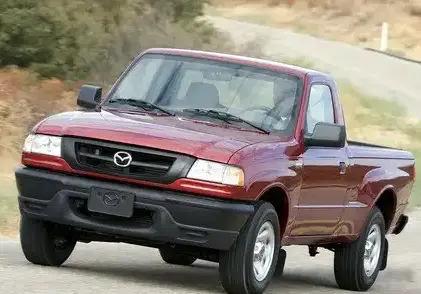
The Mazda B-Series VI 2.5 TD 4WD, produced between 2002 and 2006, represents Mazda’s entry into the mid-size pickup truck market, primarily aimed at buyers needing a robust and capable work vehicle. This variant, powered by a 2.5-liter turbocharged diesel engine producing 109 horsepower, was positioned as a practical, all-wheel-drive option within the B-Series VI range. It served as a more affordable and fuel-efficient alternative to the gasoline-powered models, and a work-oriented choice compared to more comfort-focused trims. The B-Series VI itself was a rebadged version of the Ford Ranger, a result of a collaborative agreement between the two manufacturers.
Technical Specifications
| Brand | Mazda |
| Model | B-series |
| Generation | B-Series VI |
| Type (Engine) | 2.5 TD 4WD (109 Hp) |
| Start of production | 2002 year |
| End of production | 2006 year |
| Powertrain Architecture | Internal Combustion engine |
| Body type | Pick-up |
| Seats | 4 |
| Doors | 4 |
| Fuel Type | Diesel |
| Maximum speed | 130 km/h (80.78 mph) |
| Weight-to-power ratio | 11.1 kg/Hp, 90.5 Hp/tonne |
| Weight-to-torque ratio | 4.5 kg/Nm, 220.7 Nm/tonne |
| Power | 109 Hp @ 3500 rpm |
| Power per litre | 43.6 Hp/l |
| Torque | 266 Nm @ 2000 rpm (196.19 lb.-ft. @ 2000 rpm) |
| Engine layout | Front, Longitudinal |
| Engine Model/Code | WL-T |
| Engine displacement | 2499 cm3 (152.5 cu. in.) |
| Number of cylinders | 4 |
| Engine configuration | Inline |
| Cylinder Bore | 93 mm (3.66 in.) |
| Piston Stroke | 92 mm (3.62 in.) |
| Compression ratio | 20.1:1 |
| Number of valves per cylinder | 3 |
| Fuel injection system | Precombustion chamber injection |
| Engine aspiration | Turbocharger, Intercooler |
| Valvetrain | OHC |
| Engine oil capacity | 6.3 l (6.66 US qt | 5.54 UK qt) |
| Kerb Weight | 1205 kg (2656.57 lbs.) |
| Max. weight | 1725 kg (3802.97 lbs.) |
| Max load | 520 kg (1146.4 lbs.) |
| Fuel tank capacity | 70 l (18.49 US gal | 15.4 UK gal) |
| Length | 5020 mm (197.64 in.) |
| Width | 1695 mm (66.73 in.) |
| Height | 1740 mm (68.5 in.) |
| Wheelbase | 2835 mm (111.61 in.) |
| Front track | 1488 mm (58.58 in.) |
| Rear (Back) track | 1455 mm (57.28 in.) |
| Drive wheel | All wheel drive (4×4) |
| Number of gears and type of gearbox | 5 gears, manual transmission |
| Front suspension | Wishbone |
| Rear suspension | Transverse stabilizer |
| Front brakes | Disc |
| Rear brakes | Disc |
| Tires size | 205/80 R16 |
| Wheel rims size | 16 |
Powertrain & Engine Architecture
The heart of the B-Series VI 2.5 TD 4WD is the WL-T engine, a 2.5-liter inline-four cylinder diesel. This engine utilizes a precombustion chamber injection system, a common technology in diesel engines of the era, designed to improve combustion efficiency and reduce noise. A turbocharger with an intercooler is employed to boost power output, bringing the engine’s peak output to 109 horsepower at 3500 rpm and 266 Nm (196 lb-ft) of torque at 2000 rpm. The engine’s robust construction and relatively low compression ratio of 20.1:1 contribute to its durability. The 5-speed manual transmission was the standard offering for this variant, providing a direct connection between the engine and the wheels. The transmission’s gear ratios were tuned for work-oriented tasks, prioritizing low-end torque and towing capacity over outright acceleration.
Driving Characteristics
The 2.5 TD 4WD, with its 109 horsepower, wasn’t designed for speed. Acceleration was modest, and highway passing required careful planning. However, the engine’s strong low-end torque made it well-suited for hauling loads and navigating challenging terrain. The all-wheel-drive system provided enhanced traction in slippery conditions, making it a capable work truck. Compared to the gasoline-powered B-Series models, the diesel offered significantly better fuel economy, but at the expense of refinement and responsiveness. The manual transmission allowed for precise control, but the shift quality could be somewhat notchy. The 4WD system, while effective, added weight and slightly reduced on-road handling compared to the 2WD versions.
Equipment & Trim Levels
The 2.5 TD 4WD typically came with a fairly basic level of equipment, reflecting its work-truck focus. Standard features generally included air conditioning, a basic audio system, and vinyl or cloth upholstery. Power windows and locks were often optional extras. The interior was functional and durable, designed to withstand the rigors of daily use. Trim levels were relatively limited, with most variations revolving around optional packages that added features like upgraded audio systems, alloy wheels, and exterior trim enhancements. The emphasis was on practicality rather than luxury.
Chassis & Braking
The B-Series VI utilized a body-on-frame construction, providing a robust and durable chassis. The front suspension featured a wishbone design, while the rear suspension employed a transverse stabilizer. This setup offered a reasonable balance between ride comfort and load-carrying capacity. Braking duties were handled by disc brakes on all four wheels, providing adequate stopping power for the vehicle’s weight class. The 4WD system typically employed a part-time system, allowing the driver to switch between two-wheel drive and four-wheel drive as needed.
Market Reception & Comparison
The Mazda B-Series VI 2.5 TD 4WD was generally well-received by buyers seeking a practical and affordable pickup truck. Critics praised its fuel efficiency, durability, and all-wheel-drive capability. However, it was often criticized for its lack of refinement and modest performance. Compared to the gasoline-powered B-Series models, the diesel offered better fuel economy but less power. Compared to other mid-size pickups of the era, such as the Toyota Tacoma and Nissan Frontier, the B-Series VI was often seen as a more budget-friendly option, but with fewer features and a less refined driving experience.
Legacy
The Mazda B-Series VI 2.5 TD 4WD has proven to be a relatively reliable vehicle, with many examples still on the road today. The WL-T diesel engine, while not particularly powerful, is known for its durability and longevity. However, like any older diesel engine, it requires regular maintenance to prevent issues. The availability of parts can be a concern, as the B-Series VI is no longer in production. In the used car market, these trucks are often sought after by buyers looking for a capable and affordable work vehicle. Their simplicity and ruggedness make them appealing to those who prioritize functionality over frills. The B-Series VI, and specifically the 2.5 TD 4WD variant, represents a practical and dependable option for those needing a no-nonsense pickup truck.

