
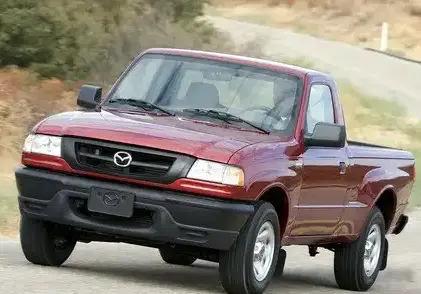
The Mazda B-Series VI 2.5 TD 4WD, manufactured between 1997 and 2006, represents Mazda’s offering in the competitive mid-size pickup truck segment. This variant, equipped with a 2.5-liter turbocharged diesel engine producing 78 horsepower, was positioned as a no-frills, utilitarian work truck. It was born from a joint venture with Ford, sharing its platform with the Ford Ranger. The 2.5 TD 4WD model found particular favor in regions where diesel fuel was accessible and where off-road capability was a significant requirement for work or recreation.
Technical Specifications
| Brand | Mazda |
| Model | B-series |
| Generation | B-Series VI |
| Type (Engine) | 2.5 TD 4WD (78 Hp) |
| Start of production | 1997 year |
| End of production | 2006 year |
| Powertrain Architecture | Internal Combustion engine |
| Body type | Pick-up |
| Seats | 2 |
| Doors | 4 |
| Fuel Type | Diesel |
| Maximum speed | 130 km/h (80.78 mph) |
| Weight-to-power ratio | 15.4 kg/Hp, 64.7 Hp/tonne |
| Weight-to-torque ratio | 7.2 kg/Nm, 139.4 Nm/tonne |
| Power | 78 Hp @ 4100 rpm |
| Power per litre | 31.2 Hp/l |
| Torque | 168 Nm @ 2500 rpm (123.91 lb.-ft. @ 2500 rpm) |
| Engine layout | Front, Longitudinal |
| Engine Model/Code | MD25NA |
| Engine displacement | 2499 cm3 (152.5 cu. in.) |
| Number of cylinders | 4 |
| Engine configuration | Inline |
| Cylinder Bore | 93 mm (3.66 in.) |
| Piston Stroke | 92 mm (3.62 in.) |
| Compression ratio | 21.9:1 |
| Number of valves per cylinder | 3 |
| Fuel injection system | Precombustion chamber injection |
| Engine aspiration | Turbocharger |
| Engine oil capacity | 6.3 l (6.66 US qt | 5.54 UK qt) |
| Kerb Weight | 1205 kg (2656.57 lbs.) |
| Max. weight | 1725 kg (3802.97 lbs.) |
| Max load | 520 kg (1146.4 lbs.) |
| Fuel tank capacity | 70 l (18.49 US gal | 15.4 UK gal) |
| Length | 5020 mm (197.64 in.) |
| Width | 1695 mm (66.73 in.) |
| Height | 1740 mm (68.5 in.) |
| Wheelbase | 2835 mm (111.61 in.) |
| Front track | 1488 mm (58.58 in.) |
| Rear (Back) track | 1455 mm (57.28 in.) |
| Drive wheel | All wheel drive (4×4) |
| Number of gears and type of gearbox | 5 gears, manual transmission |
| Front suspension | Wishbone |
| Rear suspension | Transverse stabilizer |
| Front brakes | Disc |
| Rear brakes | Disc |
| Tires size | 205/80 R16 |
| Wheel rims size | 16 |
Powertrain & Engine Architecture
The Mazda B-Series VI 2.5 TD 4WD is powered by the MD25NA engine, a 2.5-liter inline-four cylinder diesel. This engine employed a precombustion chamber injection system, a common feature in diesel engines of that era, designed to enhance combustion efficiency and reduce engine noise. A turbocharger was added to increase power output to 78 horsepower – a modest figure by today’s standards, but adequate for the truck’s intended purpose. The engine’s robust construction and relatively simple design contributed to its reputation for longevity. The sole transmission option for this variant was a 5-speed manual gearbox, chosen for its durability and ability to effectively manage the engine’s torque output under demanding conditions. This direct connection between the engine and wheels was favored for work applications.
Driving Characteristics
The 2.5 TD 4WD offered a decidedly utilitarian driving experience. Acceleration was slow, and the engine necessitated frequent gear changes to maintain momentum, particularly when carrying a load. The turbocharger provided a noticeable power boost at higher RPMs, but the engine felt strained when pushed aggressively. The 4WD system delivered excellent traction in off-road conditions, making it well-suited for navigating challenging terrain and inclement weather. The suspension, while sufficient for general use, was tuned primarily for load-carrying capacity rather than ride comfort. Compared to gasoline-powered B-Series models, the 2.5 TD offered significantly improved fuel economy and superior low-end torque, making it ideal for towing and hauling tasks. The manual transmission, while requiring more driver involvement, provided a more direct feel and better control in off-road situations.
Equipment & Trim Levels
The 2.5 TD 4WD trim level was generally the base model, prioritizing functionality over luxury. Standard equipment typically included basic steel wheels, vinyl or cloth upholstery, a simple dashboard layout, and manual windows and locks. Air conditioning and a basic audio system were often offered as optional extras. The interior was designed for durability and ease of cleaning, reflecting the truck’s work-oriented nature. Higher trim levels, available with gasoline engines, featured amenities such as power windows, upgraded audio systems, and more comfortable seating. The focus on simplicity and durability meant that this variant lacked many of the convenience features found in more upscale pickups.
Chassis & Braking
The B-Series VI chassis utilized a traditional body-on-frame construction, providing a robust and durable platform. The front suspension employed a wishbone design, while the rear suspension incorporated a transverse stabilizer bar to enhance handling and minimize body roll. Braking was handled by disc brakes on all four wheels, providing adequate stopping power for the truck’s weight. The 4WD system featured a part-time transfer case, allowing the driver to seamlessly switch between two-wheel drive and four-wheel drive as needed, optimizing fuel efficiency and traction depending on the driving conditions.
Market Reception & Comparison
The Mazda B-Series VI 2.5 TD 4WD was generally well-received by buyers seeking a reliable and affordable pickup truck. Critics praised its durability, fuel efficiency, and off-road capabilities. However, the engine’s modest power output and basic interior were frequently cited as drawbacks. Compared to other diesel-powered pickups of the time, such as the mechanically similar Ford Ranger 2.5 TD, the Mazda offered a comparable level of performance and reliability. Gasoline-powered B-Series models provided more power and refinement, but at the expense of fuel economy and low-end torque. The Mazda’s value proposition lay in its practicality and affordability.
Legacy
The Mazda B-Series VI 2.5 TD 4WD has proven to be a remarkably reliable vehicle, with a significant number of examples still in service today. The MD25NA engine, while not particularly powerful, is renowned for its durability and longevity. Common maintenance concerns include turbocharger wear and potential issues with the fuel injection system. In the used car market, these trucks are often sought after by buyers looking for a simple, affordable, and capable work vehicle. Their rugged construction and readily available parts contribute to relatively easy maintenance and repair. While not a vehicle of significant collector interest, the B-Series VI 2.5 TD 4WD stands as a testament to Mazda’s commitment to building durable and practical vehicles, offering a dependable solution for those needing a robust and economical pickup truck.

