
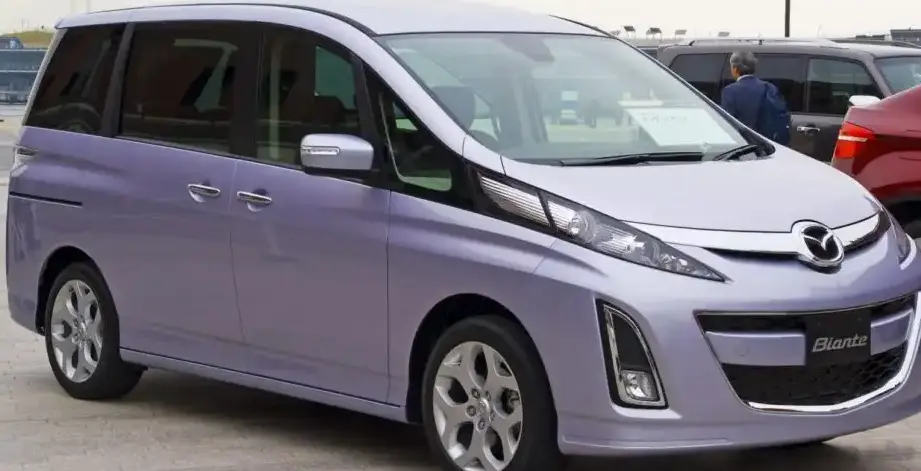
The Mazda Biante 2.0 (144 hp) 4WD Automatic is a minivan produced by Mazda between 2008 and 2018. Positioned as a family-oriented vehicle, the Biante aimed to provide a spacious and comfortable interior with practical features. This particular variant, equipped with the 2.0-liter LF-VD engine and a four-speed automatic transmission coupled with all-wheel drive, represented a mid-range offering within the Biante lineup, balancing affordability with enhanced traction and convenience. The Biante was primarily marketed in Japan and other Asian markets, where minivans hold a significant share of the automotive landscape.
Technical Specifications
| Brand | Mazda |
| Model | Biante |
| Generation | Biante |
| Type | 2.0 (144 Hp) 4WD Automatic |
| Start of production | 2008 |
| End of production | 2018 |
| Powertrain Architecture | Internal Combustion engine |
| Body type | Minivan |
| Seats | 8 |
| Doors | 5 |
| Fuel consumption (combined) | 9.4 l/100 km (25 US mpg, 30.1 UK mpg, 10.6 km/l) |
| Fuel Type | Petrol (Gasoline) |
| Power | 144 Hp @ 6200 rpm |
| Power per litre | 72.1 Hp/l |
| Torque | 184 Nm @ 4500 rpm (135.71 lb.-ft. @ 4500 rpm) |
| Engine layout | Front, Transverse |
| Engine Model/Code | LF-VD |
| Engine displacement | 1998 cm3 (121.93 cu. in.) |
| Number of cylinders | 4 |
| Engine configuration | Inline |
| Cylinder Bore | 87.5 mm (3.44 in.) |
| Piston Stroke | 83.1 mm (3.27 in.) |
| Compression ratio | 11.2:1 |
| Number of valves per cylinder | 4 |
| Fuel injection system | Direct injection |
| Engine aspiration | Naturally aspirated engine |
| Valvetrain | DOHC |
| Engine oil capacity | 4.3 l (4.54 US qt | 3.78 UK qt) |
| Coolant | 8.3 l (8.77 US qt | 7.3 UK qt) |
| Length | 4715 mm (185.63 in.) |
| Width | 1770 mm (69.69 in.) |
| Height | 1855 mm (73.03 in.) |
| Wheelbase | 2850 mm (112.2 in.) |
| Front track | 1530 mm (60.24 in.) |
| Rear track | 1530 mm (60.24 in.) |
| Minimum turning circle | 10.8 m (35.43 ft.) |
| Drive wheel | All wheel drive (4×4) |
| Number of gears | 4 |
| Gearbox type | Automatic transmission |
| Front suspension | Independent, type McPherson with coil spring and anti-roll bar |
| Rear suspension | Transverse stabilizer |
| Front brakes | Ventilated discs |
| Assisting systems | ABS (Anti-lock braking system) |
| Steering type | Steering rack and pinion |
Powertrain & Engine Architecture
The heart of the Biante 2.0 4WD Automatic is the LF-VD engine, a 1.998-liter inline-four cylinder gasoline engine. This engine utilizes direct injection technology, contributing to improved fuel efficiency and power output. The LF-VD features a double overhead camshaft (DOHC) valvetrain with four valves per cylinder, optimizing airflow for enhanced performance. The engine produces 144 horsepower at 6,200 rpm and 184 Nm (135.71 lb-ft) of torque at 4,500 rpm. The engine’s compression ratio is 11.2:1. The engine is transversely mounted in the front of the vehicle. The four-speed automatic transmission was chosen for its smooth operation and ease of use, catering to the target demographic of family drivers. While not offering the sportiness of a manual transmission, it provided convenient shifting and reduced driver fatigue.
Driving Characteristics
The Biante 2.0 4WD Automatic delivers adequate performance for everyday driving. The 144 hp engine, while not exceptionally powerful, provides sufficient acceleration for merging onto highways and navigating city streets. The four-speed automatic transmission, while somewhat dated by modern standards, offers smooth gear changes. The all-wheel-drive system enhances traction, particularly in inclement weather conditions, providing a more secure driving experience. Compared to the base 2.0-liter front-wheel-drive model, the 4WD variant offers improved stability and handling. However, it does come with a slight penalty in fuel economy due to the added weight and drivetrain complexity. The gear ratios are tuned for fuel efficiency and comfortable cruising rather than outright acceleration.
Equipment & Trim Levels
The Biante 2.0 4WD Automatic typically came equipped with a range of standard features designed to enhance comfort and convenience. These included power windows and locks, air conditioning, a basic audio system, and comfortable seating for up to eight passengers. Higher trim levels offered additional features such as alloy wheels, a more advanced audio system with navigation, leather upholstery, and automatic climate control. The interior design prioritized practicality and spaciousness, with ample storage compartments and flexible seating arrangements. Optional extras often included a sunroof, rear-view camera, and parking sensors.
Chassis & Braking
The Biante utilizes an independent McPherson strut suspension system at the front, providing a comfortable ride and responsive handling. The rear suspension employs a transverse stabilizer, contributing to stability during cornering. The braking system consists of ventilated discs at the front and drums at the rear. Anti-lock braking system (ABS) is standard, enhancing safety by preventing wheel lockup during emergency braking. The steering system is a rack and pinion type, offering precise and predictable steering response. The chassis was designed to prioritize ride comfort and interior space, rather than sporty handling characteristics.
Market Reception & Comparison
The Mazda Biante 2.0 4WD Automatic was generally well-received in its target markets. Critics praised its spacious interior, comfortable ride, and practical features. The all-wheel-drive system was seen as a valuable asset for drivers in regions with harsh weather conditions. However, some reviewers noted that the engine could feel underpowered when fully loaded with passengers and luggage. Compared to other minivans in the same class, the Biante offered a good balance of features, performance, and fuel economy. Its fuel consumption of 9.4 l/100 km was competitive, but not class-leading. Reliability was generally considered good, with few major issues reported.
Legacy
The Mazda Biante, while not a global bestseller, established itself as a popular choice for families in Asia. The 2.0-liter LF-VD engine and four-speed automatic transmission proved to be relatively reliable, with proper maintenance. In the used car market, the Biante 2.0 4WD Automatic remains a viable option for those seeking a spacious, practical, and affordable minivan. Its all-wheel-drive system continues to be a desirable feature, particularly in regions prone to snow or rain. While newer minivans offer more advanced technology and features, the Biante’s simplicity and durability have contributed to its enduring appeal.
