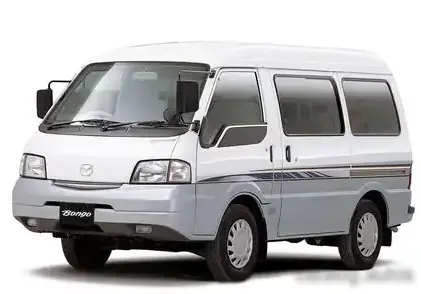
The Mazda Bongo, specifically the 2.0-liter (82 hp) variant, was produced between 1990 and 1999. This generation of the Bongo, known internally as the EE series, represented a significant shift in Mazda’s light commercial vehicle offerings. Primarily marketed in Japan and other Asian markets, the Bongo served as a versatile people carrier and light-duty van, competing with vehicles like the Toyota Town Ace and Mitsubishi Delica. The 2.0-liter engine, paired with an automatic transmission, positioned this trim as a middle-ground option, offering a balance between affordability and usability for families and small businesses. It was a popular choice for those needing a spacious vehicle without the expense of higher-performance or luxury trims.
Technical Specifications
| Brand | Mazda |
| Model | Bongo |
| Generation | Bongo (EE Series) |
| Type (Engine) | 2.0 (82 Hp) |
| Start of production | 1990 |
| End of production | 1999 |
| Powertrain Architecture | Internal Combustion engine |
| Body type | Minivan |
| Doors | 4 |
| Fuel Type | Petrol (Gasoline) |
| Power | 82 Hp @ 5000 rpm |
| Power per litre | 41 Hp/l |
| Torque | 152 Nm @ 2500 rpm / 112.11 lb.-ft. @ 2500 rpm |
| Engine Model/Code | FE |
| Engine displacement | 1998 cm3 / 121.93 cu. in. |
| Number of cylinders | 4 |
| Engine configuration | Inline |
| Cylinder Bore | 86 mm / 3.39 in. |
| Piston Stroke | 86 mm / 3.39 in. |
| Compression ratio | 8:1 |
| Number of valves per cylinder | 2 |
| Engine aspiration | Naturally aspirated engine |
| Valvetrain | OHC |
| Max. weight | 1310 kg / 2888.06 lbs. |
| Fuel tank capacity | 48 l / 12.68 US gal | 10.56 UK gal |
| Length | 4230 mm / 166.54 in. |
| Width | 1630 mm / 64.17 in. |
| Height | 1970 mm / 77.56 in. |
| Wheelbase | 2220 mm / 87.4 in. |
| Front track | 1415 mm / 55.71 in. |
| Rear (Back) track | 1370 mm / 53.94 in. |
| Drivetrain Architecture | The Internal combustion engine (ICE) drives the rear wheels of the vehicle. |
| Drive wheel | Rear wheel drive |
| Front brakes | Ventilated discs |
| Rear brakes | Disc |
Powertrain & Engine Architecture
The heart of the Bongo 2.0 was the Mazda FE engine, a 1.998-liter inline-four cylinder gasoline engine. This engine utilized a single overhead camshaft (OHC) valvetrain, operating two valves per cylinder. Fuel delivery was managed by a multi-point fuel injection system, a relatively standard feature for the time, contributing to improved fuel efficiency and smoother operation compared to carbureted engines. The 8:1 compression ratio was a compromise between performance and the ability to run on the readily available fuel grades in its target markets. The FE engine, while not known for its high output, was praised for its durability and relative simplicity. The automatic transmission paired with this engine was typically a four-speed unit, designed for smooth, if not particularly sporty, shifts. It was chosen for its ease of use, making the Bongo appealing to a wider range of drivers.
Driving Characteristics
The 82 horsepower output of the 2.0-liter engine, coupled with the four-speed automatic transmission, resulted in a driving experience focused on practicality rather than performance. Acceleration was modest, and the Bongo was not designed for rapid overtaking. However, the engine provided sufficient power for everyday driving, particularly in urban and suburban environments. The automatic transmission’s gear ratios were optimized for fuel economy and ease of driving, rather than maximizing acceleration. Compared to the manual transmission versions of the Bongo, the automatic offered less driver engagement but greater convenience. It also lagged behind higher-spec Bongo models equipped with larger engines, which offered significantly more power and torque. The rear-wheel-drive configuration provided a stable platform, but handling was generally considered unremarkable.
Equipment & Trim Levels
The 2.0-liter automatic Bongo typically came with a fairly basic level of equipment, reflecting its position as a mid-range offering. Standard features generally included cloth upholstery, a basic instrument cluster, and manual windows and door locks. Air conditioning was often an optional extra, as were power windows and upgraded audio systems. Interior trim was functional and durable, prioritizing practicality over luxury. The dashboard layout was straightforward and easy to use, with clearly labeled controls. Depending on the market, some versions included features like a tilt steering wheel and a rear wiper. The Bongo’s interior was designed to be easily cleaned and maintained, making it suitable for family use or commercial applications.
Chassis & Braking
The Bongo’s chassis was a body-on-frame construction, providing a robust and durable platform. The suspension consisted of independent front suspension with coil springs and a rigid rear axle with leaf springs. This setup prioritized load-carrying capacity and ride comfort over sporty handling. The front brakes were ventilated discs, providing adequate stopping power, while the rear brakes were typically solid discs. The steering was a recirculating ball system, offering a relatively direct feel. Stabilizer bars were often omitted on the base models to keep costs down, contributing to a slightly more pronounced body roll in corners. The overall chassis design was geared towards providing a comfortable and reliable ride, even when fully loaded.
Market Reception & Comparison
The Mazda Bongo 2.0 (82 hp) automatic was generally well-received in its target markets. Critics praised its spacious interior, practicality, and affordability. However, the engine’s modest power output and the automatic transmission’s lack of responsiveness were often cited as drawbacks. Compared to the manual transmission versions, the automatic offered less fuel economy and slower acceleration. It also lagged behind higher-spec Bongo models with larger engines in terms of performance. However, the 2.0-liter automatic struck a good balance between price, usability, and fuel efficiency, making it a popular choice for families and small businesses. Its reliability was also a key selling point, contributing to its strong reputation in the used car market.
Legacy
The Mazda Bongo 2.0 (82 hp) automatic has proven to be a remarkably durable and reliable vehicle. Many examples are still on the road today, testament to the quality of its construction and the robustness of the FE engine. In the used car market, these Bongos are often sought after for their affordability, spaciousness, and practicality. While maintenance costs can increase with age, parts availability remains relatively good, particularly in regions where the Bongo was widely sold. The FE engine is known for its longevity, and with proper maintenance, it can continue to provide reliable service for many years. The Bongo 2.0 automatic represents a practical and dependable choice for those seeking a spacious and affordable people carrier or light-duty van.