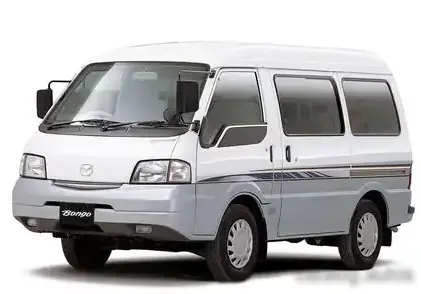
The Mazda Bongo, specifically the 2.0 D variant producing 71 horsepower, was a popular choice in the Japanese domestic market (JDM) and export markets from 1990 to 1999. Falling within the broader third generation of the Bongo lineage (though often referred to as the second generation in some regions), this iteration represented a shift towards a more practical and versatile minivan design. The Bongo catered to a need for compact, yet spacious, people carriers and commercial vehicles, particularly appealing to families and small businesses. This 2.0 D model occupied a middle ground in the Bongo lineup, offering a balance between affordability, fuel economy, and usability, sitting below the more powerful gasoline engine options and above the smaller displacement diesel variants.
Technical Specifications
| Brand | Mazda |
| Model | Bongo |
| Generation | Bongo |
| Type (Engine) | 2.0 D (71 Hp) |
| Start of production | 1990 year |
| End of production | 1999 year |
| Powertrain Architecture | Internal Combustion engine |
| Body type | Minivan |
| Doors | 4 |
| Fuel Type | Diesel |
| Power | 71 Hp @ 4500 rpm |
| Power per litre | 35.5 Hp/l |
| Torque | 128 Nm @ 3000 rpm |
| Torque (lb.-ft.) | 94.41 lb.-ft. @ 3000 rpm |
| Engine layout | Front, Longitudinal |
| Engine displacement | 1998 cm3 |
| Engine displacement (cu. in.) | 121.93 cu. in. |
| Number of cylinders | 4 |
| Engine configuration | Inline |
| Cylinder Bore | 86 mm |
| Cylinder Bore (in.) | 3.39 in. |
| Piston Stroke | 86 mm |
| Piston Stroke (in.) | 3.39 in. |
| Compression ratio | 21.7:1 |
| Number of valves per cylinder | 2 |
| Fuel injection system | Precombustion chamber injection |
| Engine aspiration | Naturally aspirated engine |
| Valvetrain | OHC |
| Max. weight | 1310 kg |
| Max. weight (lbs.) | 2888.06 lbs. |
| Fuel tank capacity | 48 l |
| Fuel tank capacity (US gal) | 12.68 US gal |
| Fuel tank capacity (UK gal) | 10.56 UK gal |
| Length | 4230 mm |
| Length (in.) | 166.54 in. |
| Width | 1630 mm |
| Width (in.) | 64.17 in. |
| Height | 1970 mm |
| Height (in.) | 77.56 in. |
| Wheelbase | 2220 mm |
| Wheelbase (in.) | 87.4 in. |
| Front track | 1415 mm |
| Front track (in.) | 55.71 in. |
| Rear (Back) track | 1370 mm |
| Rear (Back) track (in.) | 53.94 in. |
| Drivetrain Architecture | The Internal combustion engine (ICE) drives the rear wheels of the vehicle. |
| Drive wheel | Rear wheel drive |
| Front brakes | Ventilated discs |
| Rear brakes | Disc |
Powertrain & Engine Architecture
The heart of the Bongo 2.0 D was the Mazda RF diesel engine. This 1998cc inline-four cylinder engine utilized a precombustion chamber injection system, a common technology for diesel engines of the era. This system involved injecting fuel into a precombustion chamber, where it partially ignited before being transferred to the main combustion chamber for complete combustion. This design aided in smoother combustion and reduced engine noise compared to direct injection systems of the time. The engine featured an overhead camshaft (OHC) valvetrain operating two valves per cylinder. The relatively high compression ratio of 21.7:1 was typical for diesel engines, contributing to their efficiency. While 71 horsepower might seem modest by modern standards, it was considered adequate for the Bongo’s intended purpose, prioritizing fuel economy and durability over outright performance. The engine was mounted longitudinally in the front of the vehicle.
Driving Characteristics
The Bongo 2.0 D with its automatic transmission offered a comfortable, if not particularly exhilarating, driving experience. The automatic transmission, typically a four-speed unit, was geared for economy rather than rapid acceleration. Acceleration was predictably slow, with the focus on providing sufficient power for everyday driving and carrying loads. The rear-wheel-drive configuration provided a stable platform, especially when loaded, but also meant that handling was not as sharp as front-wheel-drive alternatives. The automatic transmission smoothed out power delivery, making it easy to drive in urban environments, but it did detract from overall fuel efficiency compared to the available manual transmission options. Compared to the gasoline-powered Bongo variants, the 2.0 D offered significantly better fuel economy, but at the cost of performance.
Equipment & Trim Levels
The Bongo 2.0 D typically came with a fairly basic level of equipment, reflecting its positioning as a practical and affordable vehicle. Standard features generally included cloth upholstery, a simple dashboard layout, and manual windows and door locks. Air conditioning was often an optional extra, as were power windows and upgraded audio systems. Trim levels varied depending on the market, but generally offered incremental improvements in interior comfort and convenience features. The focus was on functionality and durability rather than luxury. The interior was designed to be easily cleaned and maintained, catering to the needs of families and commercial users.
Chassis & Braking
The Bongo 2.0 D utilized a body-on-frame construction, providing a robust and durable chassis. The front suspension consisted of independent double wishbones, while the rear suspension employed a rigid axle with leaf springs. This setup prioritized load-carrying capacity and durability over sophisticated handling. Braking was provided by ventilated discs on the front wheels and solid discs on the rear. The braking system was adequate for the vehicle’s weight and performance, but lacked the advanced features found on more modern vehicles. The rear-wheel-drive layout and relatively simple suspension design contributed to the Bongo’s reputation for reliability and ease of maintenance.
Market Reception & Comparison
The Mazda Bongo 2.0 D was well-received in its target markets, particularly in Japan and countries where compact minivans were popular. Critics praised its practicality, fuel efficiency, and durability. However, the engine’s modest power output and the somewhat dated automatic transmission were often cited as drawbacks. Compared to the gasoline-powered Bongo variants, the 2.0 D offered superior fuel economy but lacked the same level of performance. Compared to other minivans in its class, the Bongo offered a good balance of features and affordability, making it a popular choice for budget-conscious buyers. The diesel engine’s longevity and relatively low maintenance costs also contributed to its appeal.
Legacy
The Mazda Bongo 2.0 D has developed a loyal following among enthusiasts and practical vehicle owners. The RF diesel engine, while not known for its high performance, is generally considered to be reliable and durable, provided it receives regular maintenance. Today, well-maintained examples of the Bongo 2.0 D can still be found on the used car market, often prized for their simplicity, practicality, and affordability. The vehicle’s robust construction and relatively simple mechanicals make it a relatively easy vehicle to maintain and repair. While it may not offer the same level of refinement or technology as modern minivans, the Bongo 2.0 D remains a testament to Mazda’s commitment to building practical and reliable vehicles.