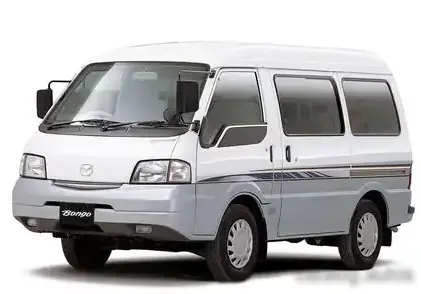
The Mazda Bongo Friendee 2.0, produced between 1995 and 2001, represents a significant iteration of Mazda’s popular cabover minivan. Positioned within the broader Bongo Friendee range (which included various engine and drivetrain configurations), the 2.0-liter variant with 105 horsepower served as a mainstream offering, balancing affordability with practicality for families and commercial users. This generation, internally designated as the third generation of the Bongo, was primarily aimed at the Japanese domestic market (JDM) but also saw limited export sales, particularly in Australia and New Zealand. The Friendee distinguished itself with a focus on interior space and versatility, catering to the needs of a growing demographic seeking multi-purpose vehicles.
Technical Specifications
| Brand | Mazda |
| Model | Bongo |
| Generation | Bongo Friendee |
| Type (Engine) | 2.0 (105 Hp) |
| Start of production | 1995 |
| End of production | 2001 |
| Powertrain Architecture | Internal Combustion engine |
| Body type | Minivan |
| Doors | 4 |
| Fuel Type | Petrol (Gasoline) |
| Power | 105 Hp @ 5000 rpm |
| Power per litre | 52.6 Hp/l |
| Torque | 162 Nm @ 4000 rpm |
| Torque (lb.-ft.) | 119.49 lb.-ft. @ 4000 rpm |
| Engine Model/Code | FE-E |
| Engine displacement | 1998 cm3 |
| Engine displacement (cu. in.) | 121.93 cu. in. |
| Number of cylinders | 4 |
| Engine configuration | Inline |
| Cylinder Bore | 86 mm |
| Cylinder Bore (in.) | 3.39 in. |
| Piston Stroke | 86 mm |
| Piston Stroke (in.) | 3.39 in. |
| Number of valves per cylinder | 2 |
| Fuel injection system | Multi-port manifold injection |
| Engine aspiration | Naturally aspirated engine |
| Valvetrain | OHC |
| Fuel tank capacity | 65 l |
| Fuel tank capacity (US gal) | 17.17 US gal |
| Fuel tank capacity (UK gal) | 14.3 UK gal |
| Length | 4585 mm |
| Length (in.) | 180.51 in. |
| Width | 1690 mm |
| Width (in.) | 66.54 in. |
| Height | 1960 mm |
| Height (in.) | 77.17 in. |
| Wheelbase | 2920 mm |
| Wheelbase (in.) | 114.96 in. |
| Front track | 1465 mm |
| Front track (in.) | 57.68 in. |
| Rear track | 1440 mm |
| Rear track (in.) | 56.69 in. |
| Minimum turning circle | 11 m |
| Minimum turning circle (ft.) | 36.09 ft. |
| Drivetrain | Rear wheel drive |
| Tire size | 195/70 R15; 215/65 R15 |
| Wheel rim size | 15 |
Powertrain & Engine Architecture
The heart of the Bongo Friendee 2.0 is the Mazda FE-E engine, a 1.998-liter inline four-cylinder gasoline engine. This engine utilizes a single overhead camshaft (OHC) valvetrain with two valves per cylinder. The FE-E engine employs multi-port fuel injection, a common technology in the mid-1990s, which delivers fuel directly into the intake ports for improved combustion efficiency. The 105 horsepower output is achieved at 5000 rpm, while peak torque of 162 Nm (119.49 lb-ft) arrives at 4000 rpm. The engine is known for its relatively simple design and robust construction. Paired with this engine was typically a four-speed automatic transmission, designed for smooth operation and ease of use. This transmission was not particularly advanced, prioritizing reliability and cost-effectiveness over outright performance. The rear-wheel-drive configuration was standard for this variant.
Driving Characteristics
The 2.0-liter automatic Bongo Friendee offered a comfortable, if not particularly exhilarating, driving experience. The four-speed automatic transmission, while smooth, resulted in relatively leisurely acceleration. The gear ratios were optimized for fuel economy and everyday usability rather than sporty performance. Compared to the available manual transmission options, the automatic version sacrificed some responsiveness. The 105 hp engine provided adequate power for typical driving conditions, including highway cruising and city traffic, but struggled when fully loaded with passengers and cargo. The rear-wheel-drive layout contributed to a stable feel, but also meant that traction in slippery conditions could be a concern. The suspension was tuned for comfort, absorbing bumps and irregularities in the road surface effectively.
Equipment & Trim Levels
The Bongo Friendee 2.0 typically came equipped with a reasonable level of standard features, reflecting its position as a mainstream family vehicle. Interior appointments generally included cloth upholstery, a basic audio system, and manual air conditioning. Power windows and door locks were often included, but could vary depending on the specific trim level. Optional extras included upgraded audio systems, alloy wheels, and a sunroof. The interior design prioritized functionality and space, with a focus on maximizing passenger and cargo capacity. The dashboard layout was straightforward and easy to use, with clearly labeled controls. Higher trim levels might have featured woodgrain accents and more comfortable seating materials.
Chassis & Braking
The Bongo Friendee’s chassis was a body-on-frame construction, a common design for vans and light trucks of the era. This provided a robust and durable platform, but also contributed to a higher center of gravity. The suspension consisted of independent front suspension with MacPherson struts and a rigid axle rear suspension with leaf springs. Braking was typically accomplished with disc brakes on the front wheels and drum brakes on the rear. The braking system was adequate for the vehicle’s weight and performance, but lacked the sophistication of more modern systems. Stabilizer bars were often included to reduce body roll during cornering.
Market Reception & Comparison
The Mazda Bongo Friendee 2.0 was generally well-received in its target market. Critics praised its spacious interior, practical design, and relatively affordable price. However, the automatic transmission was sometimes criticized for its lack of responsiveness. Compared to other trims in the Bongo Friendee lineup, such as the diesel-powered versions, the 2.0-liter gasoline model offered a quieter and smoother driving experience, but at the expense of fuel economy. The diesel models were favored by those prioritizing fuel efficiency and towing capacity. The 2.0-liter variant competed with other Japanese minivans, such as the Toyota Estima and Honda Odyssey, offering a compelling combination of features and value.
Legacy
The Mazda Bongo Friendee 2.0, particularly the FE-E engine and four-speed automatic transmission combination, has proven to be reasonably reliable over the long term. While not without its quirks, the engine is known for its durability and relatively simple maintenance requirements. The automatic transmission, while not a performance standout, has generally held up well with proper servicing. Today, the Bongo Friendee 2.0 can be found in the used car market, often appealing to those seeking an affordable and spacious vehicle for family or recreational use. Its JDM origins and unique styling have also contributed to a growing enthusiast following, particularly in regions where JDM vehicles are popular. Parts availability can be a challenge in some markets, but a dedicated community of owners and online resources help to keep these vans on the road.