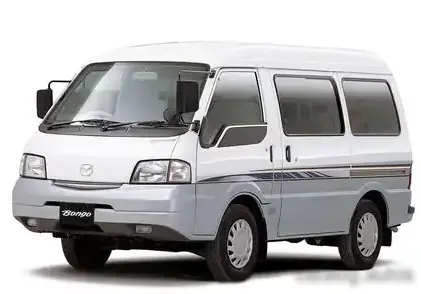
The Mazda Bongo Friendee 2.5 i, produced between 1995 and 2001, represents a significant iteration of Mazda’s popular Bongo van series. This particular variant, characterized by its 2.5-liter V6 engine producing 160 horsepower, occupied a mid-to-upper position within the Friendee lineup. The Bongo Friendee, and its twin the Mitsubishi Delica, were primarily marketed in Japan as versatile, multi-purpose vehicles, catering to families and outdoor enthusiasts. Its rear-wheel-drive layout and spacious interior made it a popular choice for those needing a practical and capable vehicle, though it saw limited official import into markets outside of Japan and Australia. The Friendee was built on the platform code Bongo Friendee.
Technical Specifications
| Brand | Mazda |
| Model | Bongo |
| Generation | Bongo Friendee |
| Type (Engine) | 2.5 i (160 Hp) |
| Start of production | 1995 |
| End of production | 2001 |
| Powertrain Architecture | Internal Combustion engine |
| Body type | Minivan |
| Doors | 4 |
| Fuel Type | Petrol (Gasoline) |
| Power | 160 Hp @ 6000 rpm |
| Power per litre | 64.2 Hp/l |
| Torque | 211 Nm @ 3500 rpm |
| Torque (lb-ft) | 155.63 lb.-ft. @ 3500 rpm |
| Engine layout | Front, Longitudinal |
| Engine displacement | 2494 cm3 |
| Engine displacement (cu. in.) | 152.19 cu. in. |
| Number of cylinders | 6 |
| Engine configuration | V-engine |
| Cylinder Bore | 82.7 mm |
| Cylinder Bore (in.) | 3.26 in. |
| Piston Stroke | 77.4 mm |
| Piston Stroke (in.) | 3.05 in. |
| Compression ratio | 9:1 |
| Number of valves per cylinder | 4 |
| Fuel injection system | Multi-port manifold injection |
| Engine aspiration | Naturally aspirated engine |
| Valvetrain | DOHC |
| Fuel tank capacity | 65 l |
| Fuel tank capacity (US gal) | 17.17 US gal |
| Fuel tank capacity (UK gal) | 14.3 UK gal |
| Length | 4585 mm |
| Length (in.) | 180.51 in. |
| Width | 1690 mm |
| Width (in.) | 66.54 in. |
| Height | 1960 mm |
| Height (in.) | 77.17 in. |
| Wheelbase | 2920 mm |
| Wheelbase (in.) | 114.96 in. |
| Front track | 1465 mm |
| Front track (in.) | 57.68 in. |
| Rear track | 1440 mm |
| Rear track (in.) | 56.69 in. |
| Minimum turning circle | 11 m |
| Minimum turning circle (ft.) | 36.09 ft. |
| Drivetrain | Rear wheel drive |
| Tire size | 195/70 R15; 215/65 R15 |
| Wheel rim size | 15 |
Powertrain & Engine Architecture
The heart of the Bongo Friendee 2.5 i is the Mazda JE-ZE 2.5-liter V6 engine. This engine, part of Mazda’s JE series, is a naturally aspirated, 24-valve (DOHC) powerplant. It utilizes a multi-port fuel injection system to deliver fuel to the cylinders, optimizing combustion efficiency. The 90-degree V6 configuration contributes to a relatively smooth and balanced operation. The engine’s 9:1 compression ratio was a compromise between performance and the fuel quality typically available in the Japanese market. While a four-speed automatic transmission was the most common pairing for this engine, a five-speed manual was also offered, though less frequently seen. The automatic transmission was designed for smooth, comfortable shifts, prioritizing ease of use over outright performance.
Driving Characteristics
The 160 horsepower and 211 Nm (155.63 lb-ft) of torque provided by the 2.5-liter V6 offered a reasonable level of performance for the Bongo Friendee, especially considering its size and weight. Acceleration was adequate for everyday driving, but it wasn’t a particularly sporty vehicle. The automatic transmission, while smooth, did contribute to some power loss compared to the manual version. The rear-wheel-drive layout provided a more engaging driving experience than front-wheel-drive alternatives, offering better handling balance, particularly when loaded with passengers or cargo. The gear ratios in the automatic transmission were tuned for fuel efficiency and comfortable cruising, rather than rapid acceleration. Compared to the smaller 1.8-liter engine options, the 2.5 i offered significantly more power and torque, making it better suited for highway driving and carrying heavier loads.
Equipment & Trim Levels
The 2.5 i trim level of the Bongo Friendee typically included features such as power windows, power steering, air conditioning, and an upgraded audio system. Interior upholstery was generally cloth, with optional leather available as an upgrade. Dashboard configurations varied slightly depending on the year and specific sub-trim level, but generally featured a functional and straightforward layout. Optional extras included features like a sunroof, upgraded speakers, and alloy wheels. Higher-spec versions often featured woodgrain interior trim and more advanced audio systems. The Friendee was also known for its versatile seating arrangements, with options for multiple configurations to maximize passenger and cargo space.
Chassis & Braking
The Bongo Friendee utilized a body-on-frame construction, providing a robust and durable chassis. The suspension consisted of independent front suspension with coil springs and a rigid rear axle with leaf springs. This setup prioritized load-carrying capacity and durability over outright handling precision. Braking systems varied depending on the year and trim level. Earlier models often featured drum brakes on the rear wheels, while later models upgraded to disc brakes all around. Stabilizer bars were typically fitted to both the front and rear axles to reduce body roll during cornering. The steering was typically a recirculating ball system, providing a relatively direct feel.
Market Reception & Comparison
The Mazda Bongo Friendee 2.5 i was generally well-received in the Japanese market for its practicality, spaciousness, and comfortable ride. Critics praised the V6 engine for its smooth operation and adequate power. However, some noted that the automatic transmission could feel sluggish at times. Compared to other vans in its class, such as the Toyota HiAce and the Mitsubishi Delica, the Bongo Friendee offered a good balance of features and affordability. Fuel economy was reasonable for a vehicle of its size and engine displacement, but it wasn’t a class leader. Reliability was generally good, with the V6 engine proving to be a durable and long-lasting unit.
Legacy
The Mazda Bongo Friendee 2.5 i has developed a cult following among enthusiasts, particularly those seeking a unique and versatile vehicle. The 2.5-liter V6 engine is considered a reliable and relatively easy-to-maintain powerplant. Parts availability can be a challenge outside of Japan, but a growing aftermarket support network is emerging. Today, well-maintained examples of the Bongo Friendee 2.5 i command a premium in the used car market, particularly those with low mileage and desirable features. Its rear-wheel-drive layout and spacious interior continue to appeal to those seeking a practical and capable vehicle for both everyday use and recreational activities.