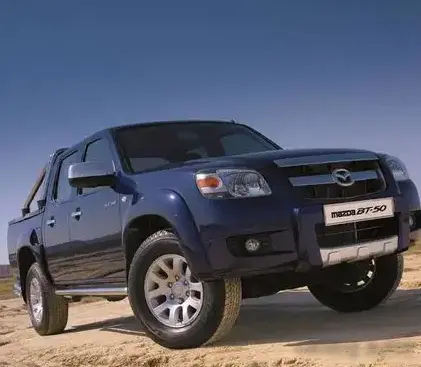
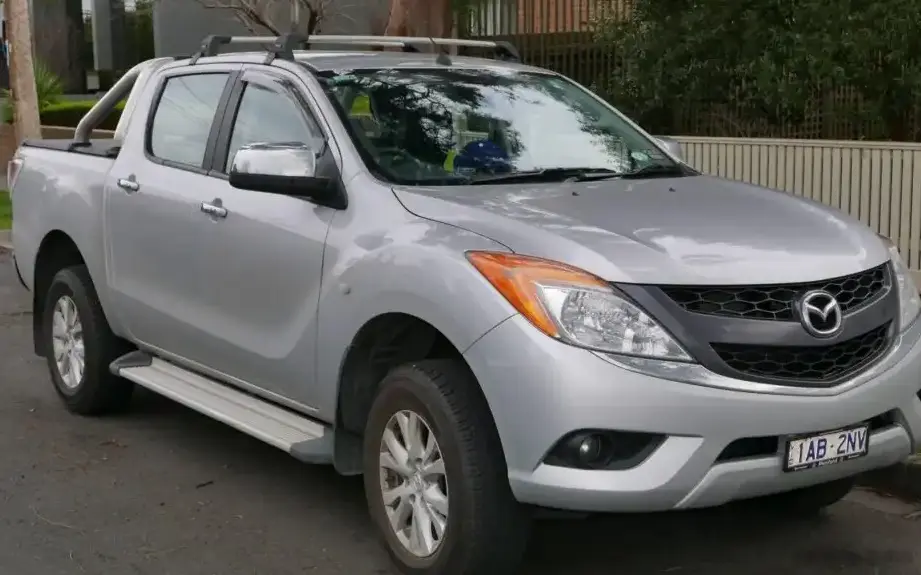
The Mazda BT-50 Freestyle Cab I 2.5 TD (143 hp) 4×4 was a mid-size pickup truck produced by Mazda from 2006 to 2008. This variant occupied a key position in the BT-50 lineup, offering a balance between capability, fuel efficiency, and affordability. It was primarily marketed towards buyers needing a versatile workhorse with four-wheel drive for both on and off-road duties. The Freestyle Cab configuration, featuring extended rear seats, aimed to provide a degree of passenger comfort not typically found in standard single-cab pickups. This model was a product of Mazda’s partnership with Ford, sharing many components with the contemporary Ford Ranger.
Technical Specifications
| Brand | Mazda |
| Model | BT-50 |
| Generation | BT-50 Freestyle Cab I |
| Type (Engine) | 2.5 TD (143 Hp) 4×4 |
| Start of production | 2006 |
| End of production | 2008 |
| Powertrain Architecture | Internal Combustion engine |
| Body type | Pick-up |
| Seats | 4 |
| Doors | 4 |
| Fuel consumption (urban) | 10.9 l/100 km (21.6 US mpg) |
| Fuel consumption (extra urban) | 7.8 l/100 km (30.2 US mpg) |
| Fuel consumption (combined) | 8.9 l/100 km (26.4 US mpg) |
| CO2 emissions | 244 g/km |
| Fuel Type | Diesel |
| Acceleration 0 – 100 km/h | 12.5 sec |
| Acceleration 0 – 62 mph | 12.5 sec |
| Acceleration 0 – 60 mph | 11.9 sec |
| Maximum speed | 158 km/h (98.18 mph) |
| Emission standard | Euro 4 |
| Weight-to-power ratio | 12.4 kg/Hp |
| Weight-to-torque ratio | 5.4 kg/Nm |
| Power | 143 Hp @ 3500 rpm |
| Torque | 330 Nm @ 1800 rpm (243.4 lb.-ft. @ 1800 rpm) |
| Engine layout | Front, Longitudinal |
| Engine Model/Code | WLAA |
| Engine displacement | 2499 cm3 (152.5 cu. in.) |
| Number of cylinders | 4 |
| Engine configuration | Inline |
| Cylinder Bore | 93 mm (3.66 in.) |
| Piston Stroke | 92 mm (3.62 in.) |
| Compression ratio | 18:1 |
| Number of valves per cylinder | 4 |
| Fuel injection system | Diesel Commonrail |
| Engine aspiration | Turbocharger, Intercooler |
| Engine oil capacity | 7 l (7.4 US qt | 6.16 UK qt) |
| Coolant | 8.8 l (9.3 US qt | 7.74 UK qt) |
| Kerb Weight | 1780 kg (3924.23 lbs.) |
| Max. weight | 3030 kg (6680.01 lbs.) |
| Max load | 1250 kg (2755.78 lbs.) |
| Fuel tank capacity | 70 l (18.49 US gal | 15.4 UK gal) |
| Permitted trailer load with brakes (12%) | 3000 kg (6613.87 lbs.) |
| Length | 5075 mm (199.8 in.) |
| Width | 1805 mm (71.06 in.) |
| Height | 1755-1760 mm (69.09 – 69.29 in.) |
| Wheelbase | 3000 mm (118.11 in.) |
| Front track | 1445 mm (56.89 in.) |
| Rear (Back) track | 1440 mm (56.69 in.) |
| Ride height (ground clearance) | 207 mm (8.15 in.) |
| Minimum turning circle (turning diameter) | 12.6 m (41.34 ft.) |
| Drivetrain Architecture | All wheel drive (4×4) |
| Number of gears and type of gearbox | 5 gears, manual transmission |
| Front suspension | Double wishbone |
| Rear suspension | Leaf spring |
| Front brakes | Ventilated discs |
| Rear brakes | Drum |
| Assisting systems | ABS (Anti-lock braking system) |
| Power steering | Hydraulic Steering |
| Tires size | 235/75 R15 |
| Wheel rims size | 6.5J x 15 |
INTRODUCTION
The Mazda BT-50 Freestyle Cab I 2.5 TD (143 hp) 4×4, produced between 2006 and 2008, represented Mazda’s entry into the increasingly popular mid-size pickup truck segment. Built in collaboration with Ford, it shared its platform and many mechanical components with the Ford Ranger. The “Freestyle Cab” designation indicated an extended cab configuration, offering limited rear seating and increased interior storage compared to the standard single-cab models. This variant was designed to appeal to customers who required a practical and durable vehicle for work and leisure, with the added benefit of four-wheel drive for enhanced traction in challenging conditions. It was positioned as a more affordable and fuel-efficient alternative to larger, more powerful pickup trucks.
Powertrain & Engine Architecture
At the heart of the BT-50 2.5 TD 4×4 lies the WLAA 2.5-liter inline-four cylinder diesel engine. This engine utilized a common rail direct injection system, delivering fuel directly into the combustion chamber at extremely high pressure for improved efficiency and reduced emissions. The engine was turbocharged and intercooled, boosting power output to 143 horsepower at 3500 rpm and 330 Nm (243 lb-ft) of torque at 1800 rpm. The high torque figure, available at relatively low engine speeds, made it well-suited for hauling and towing. The engine featured a compression ratio of 18:1 and four valves per cylinder. The engine was longitudinally mounted, and power was transmitted to all four wheels through a five-speed manual transmission. This transmission was chosen for its durability and relative simplicity, prioritizing reliability over outright performance.
Driving Characteristics
The BT-50 2.5 TD 4×4, with its 143 hp and 330 Nm of torque, offered adequate, but not exceptional, performance. Acceleration from 0 to 60 mph took around 11.9 seconds, and the top speed was approximately 98 mph. The engine’s torque delivery was its strong suit, providing sufficient pulling power for most everyday tasks. However, the five-speed manual transmission, while robust, had relatively wide gear ratios, which could result in noticeable engine strain when accelerating or climbing hills. Compared to higher-output versions of the BT-50, such as those equipped with more powerful diesel engines, this variant felt less responsive. The 4×4 system provided excellent traction on loose surfaces, making it capable off-road, but the leaf spring rear suspension could result in a somewhat bumpy ride when unladen.
Equipment & Trim Levels
The BT-50 Freestyle Cab I 2.5 TD 4×4 typically came equipped with a relatively basic level of standard features. These included power steering, ABS brakes, and a durable interior trim. The Freestyle Cab configuration offered rear seats, although they were best suited for occasional use due to limited legroom. Air conditioning was often an optional extra, as were features like power windows and a radio/CD player. The interior was generally functional and utilitarian, designed to withstand the rigors of work-related use. The dashboard layout was straightforward and easy to use, with clearly labeled controls.
Chassis & Braking
The BT-50’s chassis was a robust ladder-frame construction, providing a solid foundation for both on and off-road driving. The front suspension utilized a double wishbone setup, while the rear suspension employed leaf springs. This combination offered a good balance between ride comfort and load-carrying capacity. The braking system consisted of ventilated discs at the front and drum brakes at the rear. While adequate for most driving situations, the drum brakes at the rear were less effective than disc brakes, particularly under heavy braking. The vehicle’s curb weight of 1780 kg contributed to its stable handling characteristics.
Market Reception & Comparison
The Mazda BT-50 Freestyle Cab I 2.5 TD 4×4 was generally well-received by critics as a practical and affordable pickup truck. It was praised for its fuel efficiency, durability, and four-wheel drive capability. However, some reviewers noted that its performance was somewhat lacking compared to more powerful competitors. Compared to the higher-spec BT-50 models, this variant offered a more economical entry point into the range, but at the expense of performance and refinement. Against rivals like the Toyota Hilux and Nissan Navara, the BT-50 offered a competitive price point and a comparable level of functionality.
Legacy
The Mazda BT-50 Freestyle Cab I 2.5 TD (143 hp) 4×4 has proven to be a relatively reliable vehicle in the used car market. The WLAA engine, while not known for being particularly refined, is generally durable and capable of high mileage with proper maintenance. Common issues include wear and tear on suspension components and potential problems with the fuel injection system. However, parts availability is generally good, and repair costs are relatively reasonable. Today, these vehicles are often sought after by those looking for a dependable and affordable workhorse pickup truck.