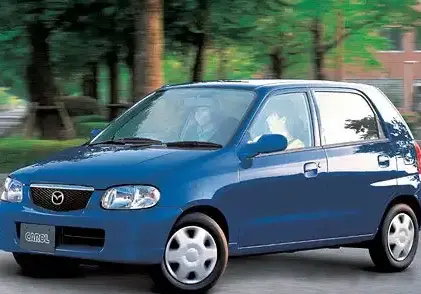
The Mazda Carol II 0.7 12V (46 hp) is a kei car produced by Mazda between 1998 and 2001. Representing the second generation of the Carol, this variant occupied the entry-level position within the lineup, offering affordable and economical transportation primarily targeted at the Japanese domestic market. The Carol II, built on a shared platform with Suzuki, was designed to meet the stringent regulations for kei cars, focusing on compact dimensions and fuel efficiency. This particular 0.7-liter, 46 horsepower version was notable for its simplicity and practicality, appealing to buyers seeking basic mobility.
Technical Specifications
| Brand | Mazda |
| Model | Carol |
| Generation | Carol II |
| Type (Engine) | 0.7 12V (46 Hp) |
| Start of production | 1998 |
| End of production | 2001 |
| Powertrain Architecture | Internal Combustion engine |
| Body type | Hatchback |
| Seats | 4 |
| Doors | 3/5 |
| Fuel Type | Petrol (Gasoline) |
| Weight-to-power ratio | 14.8 kg/Hp, 67.6 Hp/tonne |
| Weight-to-torque ratio | 11.9 kg/Nm, 83.8 Nm/tonne |
| Power | 46 Hp @ 5800 rpm |
| Power per litre | 70 Hp/l |
| Torque | 57 Nm @ 4500 rpm, 42.04 lb.-ft. @ 4500 rpm |
| Engine layout | Front, Transverse |
| Engine displacement | 657 cm3, 40.09 cu. in. |
| Number of cylinders | 3 |
| Engine configuration | Inline |
| Cylinder Bore | 68 mm, 2.68 in. |
| Piston Stroke | 60.4 mm, 2.38 in. |
| Compression ratio | 10.5:1 |
| Number of valves per cylinder | 4 |
| Fuel injection system | Multi-port manifold injection |
| Engine aspiration | Naturally aspirated engine |
| Valvetrain | DOHC |
| Kerb Weight | 680 kg, 1499.14 lbs |
| Max. weight | 900 kg, 1984.16 lbs |
| Max load | 220 kg, 485.02 lbs |
| Fuel tank capacity | 30 l, 7.93 US gal | 6.6 UK gal |
| Length | 3395 mm, 133.66 in. |
| Width | 1475 mm, 58.07 in. |
| Height | 1450 mm, 57.09 in. |
| Wheelbase | 2360 mm, 92.91 in. |
| Front track | 1295 mm, 50.98 in. |
| Rear (Back) track | 1290 mm, 50.79 in. |
| Minimum turning circle | 8.4 m, 27.56 ft. |
| Drivetrain Architecture | The Internal combustion engine (ICE) drives the front wheels of the vehicle. |
| Drive wheel | Front wheel drive |
| Number of gears and type of gearbox | 5 gears, manual transmission |
| Front suspension | Spring Strut |
| Rear suspension | Coil spring |
| Front brakes | Disc |
| Rear brakes | Disc |
| Assisting systems | ABS (Anti-lock braking system) |
| Steering type | Steering rack and pinion |
| Power steering | Hydraulic Steering |
| Tires size | 155/65 R13 75 S |
| Wheel rims size | 4J x 13 ET 45 |
Powertrain & Engine Architecture
The heart of the Carol II 0.7 was a 657cc inline-three cylinder engine, designated as a 12-valve unit. This engine, often found in other kei cars of the era, utilized a multi-port fuel injection system to optimize fuel delivery. The double overhead camshaft (DOHC) valvetrain contributed to improved breathing and, consequently, a slightly higher power output for its displacement. The engine’s relatively high compression ratio of 10.5:1 further aided in extracting maximum energy from each combustion cycle. The engine was transversely mounted in the front of the vehicle, driving the front wheels. The 5-speed manual transmission was the standard offering, providing a reasonable level of control for the limited power available. The engine was designed for simplicity and reliability, prioritizing fuel economy over outright performance.
Driving Characteristics
With only 46 horsepower on tap, the Carol II 0.7 was not designed for spirited driving. Acceleration was modest, and overtaking required careful planning. However, within the confines of urban environments, the Carol II proved to be surprisingly nimble and easy to maneuver. The 5-speed manual transmission allowed drivers to keep the engine in its optimal power band, maximizing available torque. The gear ratios were relatively tall, prioritizing fuel efficiency over rapid acceleration. Compared to potential higher-spec variants (if offered), this 0.7L version would have felt significantly slower, but it offered a more economical and accessible entry point into Mazda ownership.
Equipment & Trim Levels
The Carol II 0.7 was typically equipped with basic amenities, reflecting its position as an entry-level vehicle. Standard features generally included power steering, front disc brakes, and an anti-lock braking system (ABS), which was becoming increasingly common even on kei cars. The interior was functional and spartan, with cloth upholstery and a simple dashboard layout. Optional extras could include air conditioning, power windows, and a basic audio system. Trim levels were generally limited, with the focus being on providing a cost-effective transportation solution.
Chassis & Braking
The Carol II featured a relatively simple chassis design, utilizing a spring strut front suspension and a coil spring rear suspension. This setup provided a comfortable ride quality, albeit with limited handling capabilities. The front and rear brakes were both disc brakes, offering adequate stopping power for the vehicle’s weight and performance. The steering was rack and pinion, providing precise and responsive steering feel. The relatively lightweight construction of the Carol II contributed to its nimble handling characteristics.
Market Reception & Comparison
The Mazda Carol II 0.7 was well-received in the Japanese market as an affordable and practical kei car. Critics praised its fuel efficiency and ease of driving, but noted its limited performance. Compared to other kei cars of the time, such as the Suzuki Alto or the Daihatsu Mira, the Carol II offered a similar level of practicality and economy. However, some competitors offered slightly more refined interiors or a wider range of optional features. The Carol II’s strength lay in its simplicity and reliability, making it a popular choice for first-time car buyers and those seeking a basic, no-frills transportation solution.
Legacy
The Mazda Carol II 0.7, while not a performance icon, represents an important chapter in Mazda’s history as a manufacturer of affordable and efficient vehicles. The powertrain, while simple, proved to be relatively reliable, and many examples are still on the road today. In the used car market, these vehicles are valued for their low running costs and ease of maintenance. The Carol II 0.7 serves as a reminder of a time when kei cars were primarily focused on providing basic mobility to the masses, rather than offering luxury features or high performance.