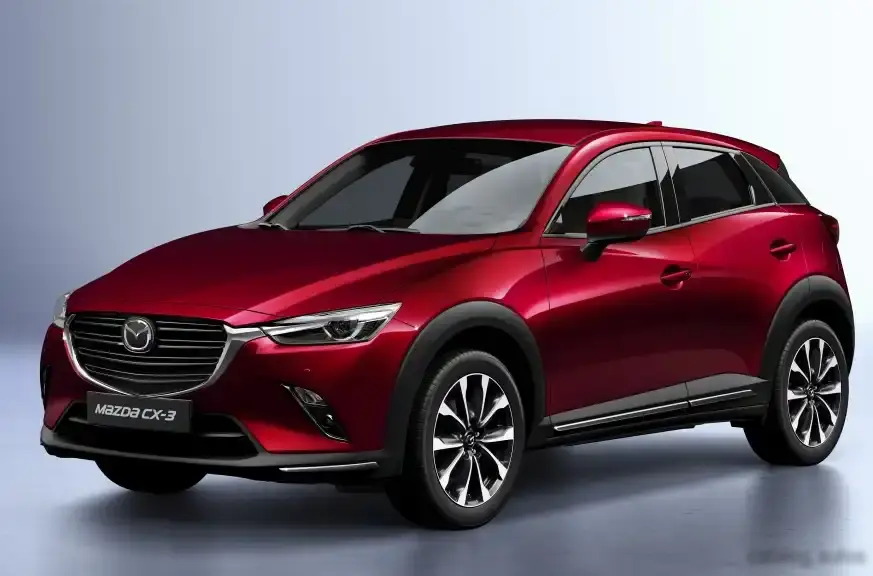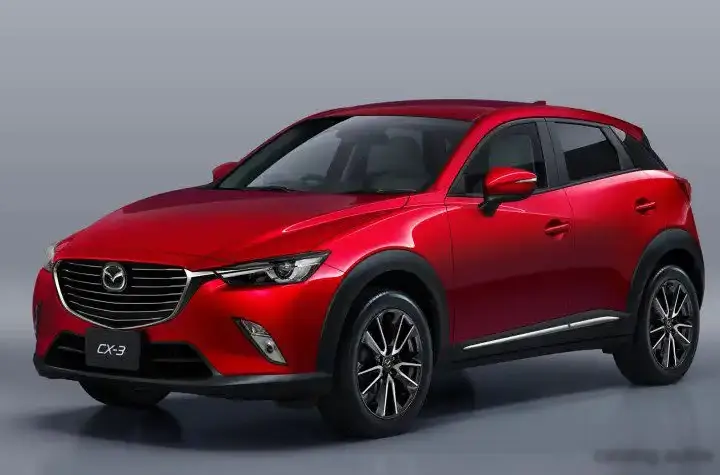
The Mazda CX-3 1.5d (105 hp) 4×4 Automatic was a compact crossover SUV produced by Mazda from 2015 to 2018. Positioned as a more premium offering within the CX-3 range, this variant combined a fuel-efficient diesel engine with the convenience of an automatic transmission and the added capability of all-wheel drive. It was primarily marketed in Europe and other regions where diesel-powered compact SUVs were popular, offering a balance between economy, practicality, and a slightly more upscale driving experience compared to lower-trim models.
Technical Specifications
| Brand | Mazda |
| Model | CX-3 |
| Generation | CX-3 |
| Type (Engine) | 1.5d (105 Hp) 4×4 Automatic |
| Start of production | 2015 |
| End of production | 2018 |
| Powertrain Architecture | Internal Combustion engine |
| Body type | SUV |
| Seats | 5 |
| Doors | 5 |
| Fuel consumption (urban) | 5.6 l/100 km (42 US mpg, 50.4 UK mpg, 17.9 km/l) |
| Fuel consumption (extra urban) | 4.9 l/100 km (48 US mpg, 57.6 UK mpg, 20.4 km/l) |
| Fuel consumption (combined) | 5.2 l/100 km (45.2 US mpg, 54.3 UK mpg, 19.2 km/l) |
| CO2 emissions | 136 g/km |
| Fuel Type | Diesel |
| Acceleration 0 – 100 km/h | 11.9 sec |
| Acceleration 0 – 62 mph | 11.9 sec |
| Acceleration 0 – 60 mph | 11.3 sec |
| Maximum speed | 172 km/h (106.88 mph) |
| Emission standard | Euro 6 |
| Weight-to-power ratio | 12.3 kg/Hp, 81.1 Hp/tonne |
| Weight-to-torque ratio | 4.8 kg/Nm, 208.5 Nm/tonne |
| Power | 105 Hp @ 4000 rpm |
| Power per litre | 70 Hp/l |
| Torque | 270 Nm @ 1600-2500 rpm (199.14 lb.-ft. @ 1600-2500 rpm) |
| Engine layout | Front, Transverse |
| Engine Model/Code | S5Y2, S5Y5, S5Y7, S5Y9 |
| Engine displacement | 1499 cm3 (91.47 cu. in.) |
| Number of cylinders | 4 |
| Engine configuration | Inline |
| Cylinder Bore | 76 mm (2.99 in.) |
| Piston Stroke | 82.6 mm (3.25 in.) |
| Compression ratio | 14.8:1 |
| Number of valves per cylinder | 4 |
| Fuel injection system | Diesel Commonrail |
| Engine aspiration | Turbocharger, Intercooler |
| Engine oil capacity | 5.1 l (5.39 US qt | 4.49 UK qt) |
| Coolant | 6.8 l (7.19 US qt | 5.98 UK qt) |
| Kerb Weight | 1295 kg (2854.99 lbs.) |
| Max. weight | 1815 kg (4001.39 lbs.) |
| Max load | 520 kg (1146.4 lbs.) |
| Trunk (boot) space – minimum | 350 l (12.36 cu. ft.) |
| Trunk (boot) space – maximum | 1260 l (44.5 cu. ft.) |
| Fuel tank capacity | 44 l (11.62 US gal | 9.68 UK gal) |
| Max. roof load | 50 kg (110.23 lbs.) |
| Permitted trailer load with brakes (8%) | 1200 kg (2645.55 lbs.) |
| Permitted trailer load with brakes (12%) | 1200 kg (2645.55 lbs.) |
| Permitted trailer load without brakes | 675 kg (1488.12 lbs.) |
| Permitted towbar download | 75 kg (165.35 lbs.) |
| Length | 4275 mm (168.31 in.) |
| Width | 1765 mm (69.49 in.) |
| Width including mirrors | 2049 mm (80.67 in.) |
| Height | 1535 mm (60.43 in.) |
| Wheelbase | 2570 mm (101.18 in.) |
| Front track | 1523 mm (59.96 in.) |
| Rear (Back) track | 1521 mm (59.88 in.) |
| Ride height (ground clearance) | 155 mm (6.1 in.) |
| Minimum turning circle (turning diameter) | 10.6 m (34.78 ft.) |
| Drive wheel | All wheel drive (4×4) |
| Number of gears and type of gearbox | 6 gears, automatic transmission |
| Front brakes | Ventilated discs |
| Rear brakes | Disc |
INTRODUCTION
The Mazda CX-3, launched in 2015, represented Mazda’s entry into the burgeoning subcompact crossover segment. Built on the 1HX0/A3 platform shared with the Mazda3, the CX-3 aimed to offer a more stylish and engaging driving experience than many of its competitors. The 1.5d (105 hp) 4×4 Automatic variant, produced between 2015 and 2018, was a key part of the lineup, particularly in European markets. It catered to buyers seeking a blend of fuel efficiency, all-weather capability, and the convenience of an automatic gearbox. This trim level typically sat in the mid-range of the CX-3 offerings, positioned above the base models but below the higher-specification petrol variants.
Powertrain & Engine Architecture
The heart of the CX-3 1.5d 4×4 Automatic is the Skyactiv-D 1.5-liter inline-four diesel engine, specifically coded S5Y2, S5Y5, S5Y7, or S5Y9 depending on the specific market and emissions regulations. This engine utilizes a common-rail direct injection system, delivering fuel at extremely high pressure for optimized combustion. A turbocharger with an intercooler is employed to boost power and torque, providing 105 horsepower at 4000 rpm and 270 Nm (199 lb-ft) of torque between 1600 and 2500 rpm. The engine features a relatively high compression ratio of 14.8:1, contributing to its efficiency. The engine is transversely mounted in the front of the vehicle. The automatic transmission is a conventional six-speed unit, chosen for its smooth operation and ease of use. While not a dual-clutch transmission, it was well-matched to the engine’s torque characteristics.
Driving Characteristics
The CX-3 1.5d Automatic offers a comfortable and refined driving experience. While not particularly quick – achieving 0-62 mph in around 11.9 seconds – the engine provides ample torque for everyday driving situations. The automatic transmission shifts smoothly, although it can sometimes feel hesitant during quick acceleration. The all-wheel-drive system provides enhanced traction in slippery conditions, making it a capable vehicle for year-round use. Compared to the higher-output petrol versions of the CX-3, the 1.5d Automatic prioritizes fuel economy over outright performance. The gear ratios are tuned for efficiency, meaning the engine doesn’t rev as freely as in the petrol models. Manual transmission versions of the 1.5d offered a more engaging driving experience, but the automatic appealed to a wider audience seeking convenience.
Equipment & Trim Levels
The CX-3 1.5d 4×4 Automatic typically came equipped with a reasonable level of standard features. These included air conditioning, power windows and mirrors, a touchscreen infotainment system with Bluetooth connectivity, and alloy wheels. Higher trim levels added features such as a sunroof, leather upholstery, heated seats, and advanced safety systems like lane departure warning and automatic emergency braking. Interior upholstery was generally cloth on the base trims, with leather options available on higher-spec models. Dashboard configuration was consistent across the range, featuring a minimalist design with a focus on driver ergonomics.
Chassis & Braking
The CX-3’s chassis is based on the Mazda3 platform, providing a good balance of ride comfort and handling. The suspension consists of MacPherson struts at the front and a torsion beam setup at the rear. The 4×4 system utilizes a multi-plate clutch to distribute torque between the front and rear axles as needed. Braking duties are handled by ventilated discs at the front and solid discs at the rear. Anti-lock Braking System (ABS) is standard. The weight distribution is fairly balanced, contributing to the car’s stable handling characteristics. Stabilizer bars are fitted front and rear to reduce body roll during cornering.
Market Reception & Comparison
The Mazda CX-3 1.5d 4×4 Automatic was generally well-received by automotive critics. It was praised for its stylish design, comfortable interior, and fuel-efficient engine. However, some reviewers noted that the engine could feel underpowered, particularly when fully loaded. Compared to other diesel-powered compact crossovers, the CX-3 offered a more premium feel and a more engaging driving experience. Fuel economy was competitive, averaging around 5.2 l/100 km (45.2 US mpg). Reliability was generally good, although some owners reported minor issues with the diesel particulate filter (DPF).
Legacy
The Mazda CX-3 1.5d 4×4 Automatic has proven to be a relatively reliable vehicle in the used car market. The Skyactiv-D engine, while requiring regular maintenance (including DPF regeneration), is generally durable. The automatic transmission has also proven to be dependable. Today, these models represent a good value proposition for buyers seeking a fuel-efficient and stylish compact crossover. However, potential buyers should be aware of the potential for DPF issues and ensure that the vehicle has been properly maintained. The CX-3 helped establish Mazda as a serious player in the competitive crossover segment, paving the way for future models like the CX-5 and CX-30.