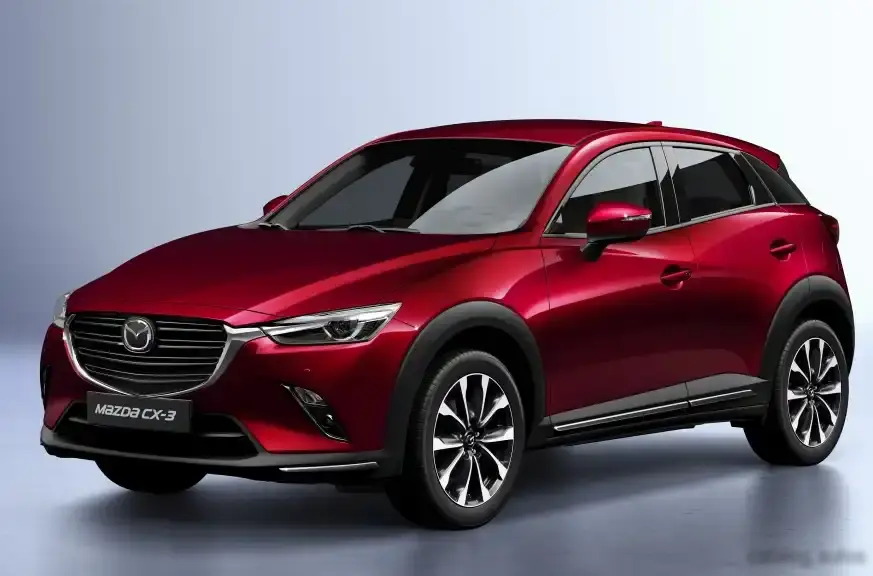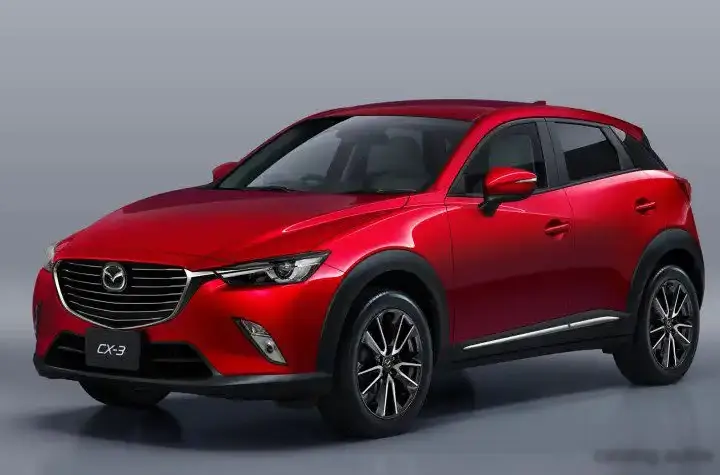
The Mazda CX-3 2.0i i-Eloop 4×4 Automatic, produced from 2015 to 2018, represents a key variant within the first generation (CX-3) of Mazda’s subcompact crossover SUV. Positioned as a mid-range offering, it aimed to balance fuel efficiency, all-weather capability, and a relatively engaging driving experience within the increasingly popular small SUV segment. This model was primarily marketed in Europe, Australia, and Asia, though limited numbers were available in North America. It served as a more premium alternative to base models, offering all-wheel drive and Mazda’s fuel-saving i-Eloop system, while remaining more accessible than the top-tier trims.
Technical Specifications
| Brand | Mazda |
| Model | CX-3 |
| Generation | CX-3 |
| Type | 2.0i (150 Hp) i-Eloop 4×4 Automatic |
| Start of production | 2015 |
| End of production | 2018 |
| Powertrain Architecture | Internal Combustion engine |
| Body type | SUV |
| Seats | 5 |
| Doors | 5 |
| Fuel consumption (urban) | 7.8 l/100 km (30.2 US mpg) |
| Fuel consumption (extra urban) | 5.5 l/100 km (42.8 US mpg) |
| Fuel consumption (combined) | 6.3 l/100 km (37.3 US mpg) |
| CO2 emissions | 146 g/km |
| Fuel Type | Petrol (Gasoline) |
| Acceleration 0 – 100 km/h | 9.6 sec |
| Acceleration 0 – 62 mph | 9.6 sec |
| Acceleration 0 – 60 mph | 9.1 sec |
| Maximum speed | 195 km/h (121.17 mph) |
| Emission standard | Euro 6 |
| Weight-to-power ratio | 10.3 kg/Hp |
| Weight-to-torque ratio | 7.6 kg/Nm |
| Power | 150 Hp @ 6000 rpm |
| Torque | 204 Nm @ 2800 rpm (150.46 lb.-ft. @ 2800 rpm) |
| Engine layout | Front, Transverse |
| Engine Model/Code | PEX3, PEXB, PEXT |
| Engine displacement | 1998 cm3 (121.93 cu. in.) |
| Number of cylinders | 4 |
| Engine configuration | Inline |
| Cylinder Bore | 83.5 mm (3.29 in.) |
| Piston Stroke | 91.2 mm (3.59 in.) |
| Compression ratio | 14:1 |
| Number of valves per cylinder | 4 |
| Fuel injection system | Direct injection |
| Engine oil capacity | 4.2 l (4.44 US qt | 3.7 UK qt) |
| Coolant capacity | 5.8 l (6.13 US qt | 5.1 UK qt) |
| Kerb Weight | 1550 kg (3417.17 lbs.) |
| Max. weight | 2070 kg (4563.57 lbs.) |
| Max load | 520 kg (1146.4 lbs.) |
| Trunk (boot) space – minimum | 350 l (12.36 cu. ft.) |
| Trunk (boot) space – maximum | 1260 l (44.5 cu. ft.) |
| Fuel tank capacity | 44 l (11.62 US gal | 9.68 UK gal) |
| Max. roof load | 50 kg (110.23 lbs.) |
| Permitted trailer load with brakes (8%) | 1200 kg (2645.55 lbs.) |
| Permitted trailer load with brakes (12%) | 1200 kg (2645.55 lbs.) |
| Permitted trailer load without brakes | 660 kg (1455.05 lbs.) |
| Permitted towbar download | 75 kg (165.35 lbs.) |
| Length | 4275 mm (168.31 in.) |
| Width | 1765 mm (69.49 in.) |
| Width including mirrors | 2049 mm (80.67 in.) |
| Height | 1535 mm (60.43 in.) |
| Wheelbase | 2570 mm (101.18 in.) |
| Front track | 1523 mm (59.96 in.) |
| Rear track | 1521 mm (59.88 in.) |
| Ride height (ground clearance) | 155 mm (6.1 in.) |
| Minimum turning circle | 10.6 m (34.78 ft.) |
| Drive wheel | All wheel drive (4×4) |
| Number of gears | 6 |
| Gearbox type | Automatic transmission |
| Front brakes | Ventilated discs |
| Rear brakes | Disc |
| Steering type | Steering rack and pinion |
| Power steering | Electric |
INTRODUCTION
The Mazda CX-3 2.0i i-Eloop 4×4 Automatic, launched in 2015, was a significant addition to Mazda’s lineup, embodying the company’s “KODO – Soul of Motion” design philosophy and commitment to driving dynamics. Built on the 1HX0/A3 platform shared with the Mazda3, it aimed to offer a more stylish and engaging alternative to more utilitarian compact SUVs. The i-Eloop system, a capacitor-based regenerative braking system, was a key feature, designed to improve fuel economy by storing energy typically lost during deceleration. The all-wheel-drive configuration provided enhanced traction and stability, particularly appealing to drivers in regions with inclement weather.
Powertrain & Engine Architecture
At the heart of the CX-3 2.0i i-Eloop 4×4 Automatic lies the PE-VPH engine, a 1.998-liter (2.0-liter) inline-four cylinder gasoline engine. Engine codes PEX3, PEXB, and PEXT were used depending on the specific market and emissions regulations. This engine utilizes direct injection, maximizing combustion efficiency and contributing to improved power output and fuel economy. The engine boasts a high compression ratio of 14:1, further enhancing thermal efficiency. The i-Eloop system, a unique feature of this variant, captures kinetic energy during braking and stores it in a capacitor, providing a boost during acceleration and reducing the load on the alternator. The engine is paired with a six-speed automatic transmission, offering smooth and responsive gear changes. This transmission was specifically tuned to work in harmony with the engine’s characteristics, providing a balance between performance and fuel efficiency.
Driving Characteristics
The CX-3 2.0i i-Eloop 4×4 Automatic delivers a respectable, though not exhilarating, driving experience. With 150 horsepower and 204 Nm (150 lb-ft) of torque, acceleration from 0 to 60 mph takes approximately 9.1 seconds. The automatic transmission, while smooth, can sometimes feel hesitant during quick overtaking maneuvers. The all-wheel-drive system provides confident handling in various conditions, enhancing stability and grip, especially on slippery surfaces. Compared to the base 2.0-liter front-wheel-drive models, the 4×4 variant offers improved traction but comes with a slight penalty in fuel economy. The gear ratios are optimized for everyday driving, prioritizing fuel efficiency over outright performance. The i-Eloop system is largely transparent to the driver, subtly contributing to improved fuel consumption in stop-and-go traffic.
Equipment & Trim Levels
The 2.0i i-Eloop 4×4 Automatic trim typically included features such as automatic climate control, a touchscreen infotainment system with Bluetooth connectivity, and a rearview camera. Standard safety equipment included ABS, stability control, and multiple airbags. Interior upholstery was typically cloth, with options for leather upgrades. Higher trim levels offered features like a premium sound system, heated front seats, and a sunroof. The dashboard layout was clean and modern, with a focus on ergonomics and ease of use. Optional extras included navigation systems, adaptive front lighting, and a blind-spot monitoring system.
Chassis & Braking
The CX-3 2.0i i-Eloop 4×4 Automatic utilizes a MacPherson strut front suspension and a torsion beam rear suspension. The suspension was tuned to provide a comfortable ride while maintaining good handling characteristics. The all-wheel-drive system adds weight, necessitating slightly stiffer spring rates compared to front-wheel-drive models. Braking duties are handled by ventilated discs at the front and solid discs at the rear. ABS (Anti-lock Braking System) is standard, providing enhanced braking performance and stability. The steering is electrically assisted, offering a light and precise feel.
Market Reception & Comparison
The Mazda CX-3 2.0i i-Eloop 4×4 Automatic was generally well-received by automotive critics. It was praised for its stylish design, engaging driving dynamics, and fuel-efficient engine. However, some reviewers noted that the interior space was somewhat limited compared to competitors. Compared to the base 2.0-liter front-wheel-drive model, the 4×4 variant offered superior traction and stability but at a higher price point and with slightly reduced fuel economy. The i-Eloop system was seen as a worthwhile addition, contributing to improved real-world fuel consumption. Compared to rivals like the Honda HR-V and Nissan Juke, the CX-3 offered a more premium feel and a more engaging driving experience.
Legacy
The Mazda CX-3 2.0i i-Eloop 4×4 Automatic has proven to be a relatively reliable vehicle. The PE-VPH engine is known for its durability, and the six-speed automatic transmission is generally trouble-free. The i-Eloop system has also demonstrated good long-term reliability. On the used car market, these models hold their value reasonably well, particularly those in good condition with low mileage. Common maintenance items include regular oil changes, brake pad replacements, and tire rotations. The CX-3’s combination of style, efficiency, and all-wheel-drive capability continues to make it an attractive option for buyers seeking a compact crossover SUV.