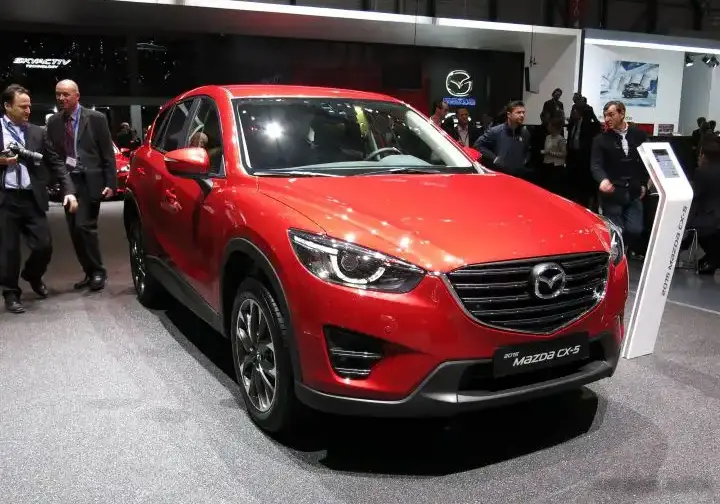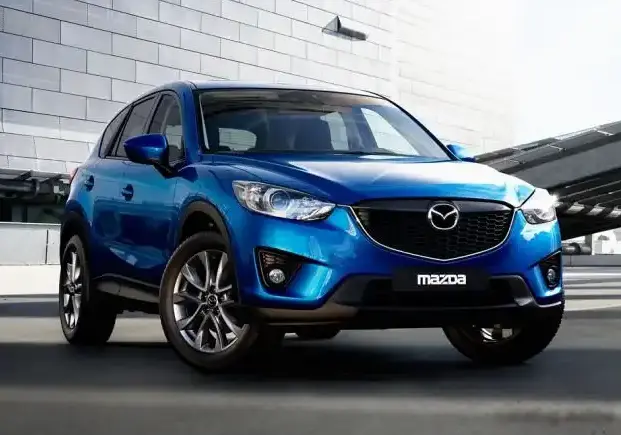
The Mazda CX-5 2.0 SKYACTIV-G (160 Hp) AWD Automatic was a popular configuration of Mazda’s compact crossover SUV, produced from 2012 to 2015. Positioned as a mid-range offering within the first generation (KE series) CX-5 lineup, it aimed to balance fuel efficiency with all-weather capability. This variant played a significant role in establishing the CX-5 as a key model for Mazda, particularly in markets where all-wheel drive was highly valued. It was built on the Mazda’s SKYACTIV technology platform, emphasizing lightweight construction, efficient engines, and responsive handling.
Technical Specifications
| Brand | Mazda |
| Model | CX-5 |
| Generation | CX-5 |
| Type (Engine) | 2.0 SKYACTIV-G (160 Hp) AWD Automatic |
| Start of production | 2012 |
| End of production | 2015 |
| Powertrain Architecture | Internal Combustion engine |
| Body type | SUV |
| Seats | 5 |
| Doors | 5 |
| Fuel consumption (economy) – urban (NEDC) | 8.1 l/100 km (29 US mpg, 34.9 UK mpg, 12.3 km/l) |
| Fuel consumption (economy) – extra urban (NEDC) | 5.8 l/100 km (40.6 US mpg, 48.7 UK mpg, 17.2 km/l) |
| Fuel consumption (economy) – combined (NEDC) | 6.6 l/100 km (35.6 US mpg, 42.8 UK mpg, 15.2 km/l) |
| CO2 emissions (NEDC) | 155 g/km |
| Fuel Type | Petrol (Gasoline) |
| Acceleration 0 – 100 km/h | 9.2 sec |
| Acceleration 0 – 62 mph | 9.2 sec |
| Acceleration 0 – 60 mph | 8.7 sec |
| Maximum speed | 187 km/h (116.2 mph) |
| Emission standard | Euro 5 |
| Weight-to-power ratio | 8.8 kg/Hp, 113.9 Hp/tonne |
| Weight-to-torque ratio | 6.8 kg/Nm, 148 Nm/tonne |
| Power | 160 Hp @ 6000 rpm |
| Power per litre | 80.1 Hp/l |
| Torque | 208 Nm @ 4000 rpm (153.41 lb.-ft. @ 4000 rpm) |
| Engine layout | Front, Transverse |
| Engine Model/Code | PEY6, PEY7 |
| Engine displacement | 1998 cm3 (121.93 cu. in.) |
| Number of cylinders | 4 |
| Engine configuration | Inline |
| Cylinder Bore | 83.5 mm (3.29 in.) |
| Piston Stroke | 91.2 mm (3.59 in.) |
| Compression ratio | 14:1 |
| Number of valves per cylinder | 4 |
| Fuel injection system | Direct injection |
| Engine aspiration | Naturally aspirated engine |
| Valvetrain | DOHC |
| Engine oil capacity | 4.2 l (4.44 US qt | 3.7 UK qt) |
| Coolant | 7.3 l (7.71 US qt | 6.42 UK qt) |
| Kerb Weight | 1405-1518 kg (3097.49 – 3346.62 lbs.) |
| Max. weight | 2030 kg (4475.38 lbs.) |
| Max load | 512-625 kg (1128.77 – 1377.89 lbs.) |
| Trunk (boot) space – minimum | 503 l (17.76 cu. ft.) |
| Trunk (boot) space – maximum | 1620 l (57.21 cu. ft.) |
| Fuel tank capacity | 58 l (15.32 US gal | 12.76 UK gal) |
| Max. roof load | 50 kg (110.23 lbs.) |
| Permitted trailer load with brakes (8%) | 2000 kg (4409.25 lbs.) |
| Permitted trailer load with brakes (12%) | 1800 kg (3968.32 lbs.) |
| Permitted trailer load without brakes | 735 kg (1620.4 lbs.) |
| Permitted towbar download | 88 kg (194.01 lbs.) |
| Length | 4555 mm (179.33 in.) |
| Width | 1840 mm (72.44 in.) |
| Height | 1710 mm (67.32 in.) |
| Wheelbase | 2700 mm (106.3 in.) |
| Front track | 1585 mm (62.4 in.) |
| Rear (Back) track | 1590 mm (62.6 in.) |
| Ride height (ground clearance) | 210 mm (8.27 in.) |
| Drag coefficient (Cd) | 0.33 |
| Minimum turning circle (turning diameter) | 11.7 m (38.39 ft.) |
| Drivetrain Architecture | The Internal combustion engine (ICE) drives the front wheels permanently, and the rear wheels are driven through an electrically or mechanically operated clutch if necessary. |
| Drive wheel | All wheel drive (4×4) |
| Number of gears and type of gearbox | 6 gears, automatic transmission |
| Front suspension | Independent, type McPherson with coil spring and anti-roll bar |
| Rear suspension | Independent multi-link spring suspension with stabilizer |
| Front brakes | Ventilated discs, 297 mm |
| Rear brakes | Disc, 303 mm |
| Assisting systems | ABS (Anti-lock braking system) |
| Steering type | Steering rack and pinion |
| Power steering | Electric Steering |
| Tires size | 225/65 R17; 225/55 R19 |
| Wheel rims size | 7J x 17; 7J x 19 |
INTRODUCTION
The Mazda CX-5 2.0 SKYACTIV-G AWD Automatic, launched in 2012, represented Mazda’s entry into the burgeoning compact SUV segment. It was the first vehicle to fully embody Mazda’s new SKYACTIV technology philosophy, focusing on maximizing efficiency without sacrificing driving pleasure. The 2.0-liter engine paired with a six-speed automatic transmission and all-wheel drive was designed to appeal to buyers seeking a practical, fuel-efficient, and capable vehicle for daily use and occasional adventures. This trim level sat in the middle of the CX-5 range, offering a step up from the base 2.0-liter models while remaining more accessible than the higher-performance 2.5-liter variants.
Powertrain & Engine Architecture
At the heart of the CX-5 2.0 SKYACTIV-G was the PE-VPH engine, a 1998cc inline-four cylinder gasoline engine. This engine was a key component of Mazda’s SKYACTIV technology, featuring a high compression ratio of 14:1 – a significant achievement for a gasoline engine without requiring premium fuel. This was accomplished through advancements in combustion control and engine design. The engine utilized direct injection, optimizing fuel delivery and improving efficiency. The valvetrain employed a dual overhead camshaft (DOHC) configuration with four valves per cylinder, enhancing breathing and power output. The six-speed automatic transmission was specifically tuned to work in harmony with the engine’s characteristics, providing smooth and responsive shifts. Unlike some conventional automatics, this transmission featured a torque converter lock-up clutch that engaged across a wider range of speeds, further improving fuel economy.
Driving Characteristics
The 2.0-liter engine, producing 160 horsepower and 153 lb-ft of torque, delivered adequate performance for everyday driving. Acceleration from 0-60 mph took approximately 8.7 seconds, which was competitive within its class but noticeably slower than the 2.5-liter CX-5 models. The automatic transmission was generally smooth, but could sometimes feel hesitant during quick acceleration or when attempting to downshift for passing maneuvers. The all-wheel-drive system provided enhanced traction in inclement weather, making it a confident choice for drivers in regions with snow or rain. The gear ratios were optimized for fuel efficiency, resulting in a comfortable cruising experience but potentially requiring more aggressive throttle input for quicker overtaking. Compared to the manual transmission versions, the automatic offered greater convenience but slightly diminished responsiveness.
Equipment & Trim Levels
The CX-5 2.0 SKYACTIV-G AWD Automatic typically came standard with features such as air conditioning, power windows and locks, a basic audio system with auxiliary input, and stability control. Higher trim levels, often denoted as “Sport” or “Touring,” added features like alloy wheels, a touchscreen infotainment system, Bluetooth connectivity, a rearview camera, and upgraded interior upholstery. Optional extras included a sunroof, leather seats, and a premium sound system. Interior materials were generally of good quality for the price point, with a focus on creating a comfortable and functional cabin. The dashboard layout was clean and intuitive, with logically placed controls.
Chassis & Braking
The CX-5 utilized a McPherson strut front suspension and a multi-link rear suspension, providing a good balance between ride comfort and handling precision. The suspension was tuned to prioritize stability and control, rather than outright sportiness. Front brakes consisted of ventilated discs measuring 297mm, while the rear brakes were solid discs measuring 303mm. Anti-lock braking system (ABS) was standard, enhancing safety during emergency braking situations. The steering was electrically assisted, providing a light and responsive feel. The all-wheel-drive system employed a center differential to distribute torque between the front and rear axles, automatically adjusting based on road conditions and driver input.
Market Reception & Comparison
The Mazda CX-5 2.0 SKYACTIV-G AWD Automatic was generally well-received by automotive critics. It was praised for its fuel efficiency, comfortable ride, and attractive styling. However, some reviewers noted that the 2.0-liter engine could feel underpowered, particularly when fully loaded or driving uphill. Compared to the 2.5-liter CX-5, the 2.0-liter offered better fuel economy but less performance. Against competitors like the Honda CR-V and Toyota RAV4, the CX-5 stood out with its more engaging driving dynamics and stylish design. Reliability was generally good, with few reported issues specific to the 2.0-liter engine and automatic transmission combination.
Legacy
The Mazda CX-5 2.0 SKYACTIV-G AWD Automatic has proven to be a reliable and durable vehicle in the used car market. The SKYACTIV powertrain has demonstrated a good track record for longevity, with many examples exceeding 150,000 miles with proper maintenance. While not as sought after as the higher-performance 2.5-liter models, the 2.0-liter variant remains a practical and affordable option for buyers seeking a fuel-efficient and capable compact SUV. Its contribution to establishing the CX-5 as a benchmark in its class, and showcasing Mazda’s innovative SKYACTIV technology, solidifies its place in automotive history.