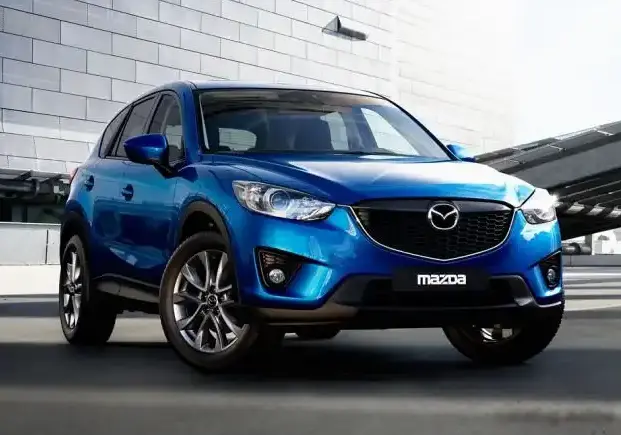
Technical Specifications
| Brand | Mazda |
| Model | CX-5 |
| Generation | CX-5 |
| Type (Engine) | 2.0 SKYACTIV-G (165 Hp) |
| Start of production | 2012 |
| End of production | 2015 |
| Powertrain Architecture | Internal Combustion engine |
| Body type | SUV |
| Seats | 5 |
| Doors | 5 |
| Fuel consumption (urban) | 7.5 l/100 km (31.4 US mpg) |
| Fuel consumption (extra urban) | 5.1 l/100 km (46.1 US mpg) |
| Fuel consumption (combined) | 6 l/100 km (39.2 US mpg) |
| CO2 emissions | 139 g/km |
| Fuel Type | Petrol (Gasoline) |
| Acceleration 0 – 100 km/h | 9.2 sec |
| Acceleration 0 – 62 mph | 9.2 sec |
| Acceleration 0 – 60 mph | 8.7 sec |
| Maximum speed | 200 km/h (124.27 mph) |
| Emission standard | Euro 5 |
| Weight-to-power ratio | 8 kg/Hp |
| Weight-to-torque ratio | 6.3 kg/Nm |
| Power | 165 Hp @ 6000 rpm |
| Torque | 210 Nm @ 4000 rpm (154.89 lb.-ft. @ 4000 rpm) |
| Engine layout | Front, Transverse |
| Engine Model/Code | PEY6, PEY7 |
| Engine displacement | 1997 cm3 (121.86 cu. in.) |
| Number of cylinders | 4 |
| Engine configuration | Inline |
| Cylinder Bore | 83.5 mm (3.29 in.) |
| Piston Stroke | 91.2 mm (3.59 in.) |
| Compression ratio | 14:1 |
| Number of valves per cylinder | 4 |
| Fuel injection system | Direct injection |
| Engine aspiration | Naturally aspirated engine |
| Valvetrain | DOHC |
| Engine oil capacity | 4.2 l (4.44 US qt | 3.7 UK qt) |
| Coolant capacity | 7.1 l (7.5 US qt | 6.25 UK qt) |
| Kerb Weight | 1315-1411 kg (2899.08 – 3110.72 lbs.) |
| Max. weight | 1930 kg (4254.92 lbs.) |
| Max load | 519-615 kg (1144.2 – 1355.84 lbs.) |
| Trunk (boot) space – minimum | 503 l (17.76 cu. ft.) |
| Trunk (boot) space – maximum | 1620 l (57.21 cu. ft.) |
| Fuel tank capacity | 56 l (14.79 US gal | 12.32 UK gal) |
| Max. roof load | 50 kg (110.23 lbs.) |
| Permitted trailer load with brakes (8%) | 1900 kg (4188.78 lbs.) |
| Permitted trailer load with brakes (12%) | 1800 kg (3968.32 lbs.) |
| Permitted trailer load without brakes | 690 kg (1521.19 lbs.) |
| Permitted towbar download | 88 kg (194.01 lbs.) |
| Length | 4555 mm (179.33 in.) |
| Width | 1840 mm (72.44 in.) |
| Height | 1710 mm (67.32 in.) |
| Wheelbase | 2700 mm (106.3 in.) |
| Front track | 1585 mm (62.4 in.) |
| Rear track | 1590 mm (62.6 in.) |
| Ride height (ground clearance) | 215 mm (8.46 in.) |
| Drag coefficient (Cd) | 0.33 |
| Minimum turning circle | 11.7 m (38.39 ft.) |
| Drivetrain | Front wheel drive |
| Number of gears | 6 |
| Gearbox type | Manual transmission |
| Front suspension | Independent, McPherson with coil spring and anti-roll bar |
| Rear suspension | Independent multi-link spring suspension with stabilizer |
| Front brakes | Ventilated discs, 297 mm |
| Rear brakes | Disc, 303 mm |
| Assisting systems | ABS (Anti-lock braking system) |
| Steering type | Steering rack and pinion |
| Power steering | Electric |
| Tires size | 225/55 R17 |
| Wheel rims size | 7J x 17 |
The Mazda CX-5 2.0 SKYACTIV-G (165 Hp) was introduced in 2012 as part of the first generation KE series CX-5. Built on the 1HX0/A3 platform, it marked Mazda’s entry into the increasingly popular compact SUV market. This variant was designed to offer a balance of fuel efficiency, practicality, and Mazda’s renowned driving experience. It served as the base model for the CX-5 range, appealing to customers who prioritized affordability and economy over outright performance. The 2.0-liter engine was particularly popular in European markets where tax regulations favored smaller engine capacities.
Powertrain & Engine Architecture
The heart of this CX-5 variant is the 1.997-liter (2.0-liter) SKYACTIV-G four-cylinder gasoline engine, designated as PEY6 or PEY7 depending on the specific market and emissions regulations. This engine is a key component of Mazda’s SKYACTIV technology, which focuses on improving engine efficiency through high compression ratios (14:1 in this case) and optimized combustion. The engine utilizes direct fuel injection, enhancing fuel atomization and combustion efficiency. The valvetrain employs a dual overhead camshaft (DOHC) configuration with four valves per cylinder, contributing to improved breathing and power delivery. The engine is transversely mounted at the front of the vehicle. The 165 horsepower and 154.89 lb-ft of torque are delivered through a six-speed manual transmission, driving the front wheels. While an automatic transmission was available in some markets, the 2.0-liter engine was often paired with the manual gearbox as standard.
Driving Characteristics
The CX-5 2.0 SKYACTIV-G with the manual transmission offers a reasonably engaging driving experience, though it’s not as sporty as the higher-output 2.5-liter versions. Acceleration from 0-60 mph takes around 8.7 seconds, which is adequate for everyday driving but doesn’t provide particularly brisk performance. The engine feels responsive at lower RPMs, thanks to the direct injection system, but power does taper off as the revs climb. The six-speed manual gearbox is well-matched to the engine’s characteristics, offering precise shifts and a decent spread of ratios. Compared to the 2.5-liter models, the 2.0-liter feels less powerful, especially when fully loaded or tackling steep inclines. However, it compensates with better fuel economy and a lighter front end, which can contribute to more agile handling.
Equipment & Trim Levels
The CX-5 2.0 SKYACTIV-G typically came with a respectable level of standard equipment, though it was less lavish than the higher trim levels. Standard features generally included air conditioning, power windows and mirrors, a basic audio system with USB connectivity, and alloy wheels. Safety features such as ABS, stability control, and multiple airbags were also standard. Interior upholstery was typically cloth, and the dashboard featured a straightforward design with easy-to-use controls. Optional extras included a sunroof, navigation system, leather upholstery, and a premium audio system. Trim levels varied by market, but generally followed a progression from base models to more well-equipped variants with additional comfort and convenience features.
Chassis & Braking
The CX-5 utilizes an independent suspension system on both the front and rear axles. The front suspension employs a McPherson strut design with coil springs and an anti-roll bar, while the rear suspension features a multi-link setup with a stabilizer bar. This configuration provides a good balance of ride comfort and handling. The braking system consists of ventilated discs on the front wheels and solid discs on the rear. ABS (Anti-lock Braking System) is standard, enhancing braking performance and stability. The steering is a rack-and-pinion system with electric power assistance, providing a responsive and precise feel.
Market Reception & Comparison
The Mazda CX-5 2.0 SKYACTIV-G was generally well-received by automotive critics. It was praised for its fuel efficiency, comfortable ride, and engaging handling. However, some reviewers noted that the 2.0-liter engine could feel underpowered, especially when compared to the more potent 2.5-liter options. In terms of fuel economy, the 2.0-liter variant consistently outperformed the 2.5-liter models, achieving around 39.2 US mpg on the combined cycle. Reliability has been generally good, with few reported issues specific to the 2.0-liter engine or transmission. Compared to competitors like the Nissan Qashqai and Hyundai ix35, the CX-5 offered a more premium driving experience and a more stylish interior.
Legacy
The Mazda CX-5 2.0 SKYACTIV-G has proven to be a reliable and durable vehicle. On the used car market, these models are often sought after by buyers looking for an affordable and fuel-efficient SUV. The SKYACTIV engine has demonstrated good long-term reliability, with proper maintenance. While the 2.0-liter engine may not offer the same level of performance as the larger 2.5-liter variant, it remains a viable option for drivers who prioritize economy and practicality. The CX-5’s overall design and driving dynamics have stood the test of time, making it a popular choice among used car buyers.