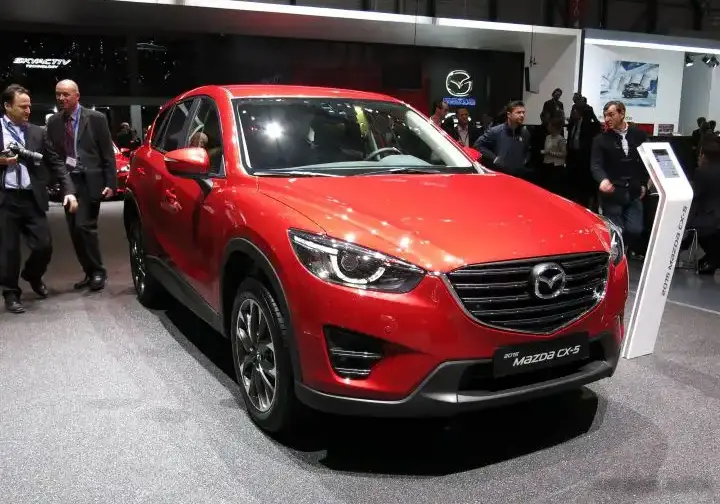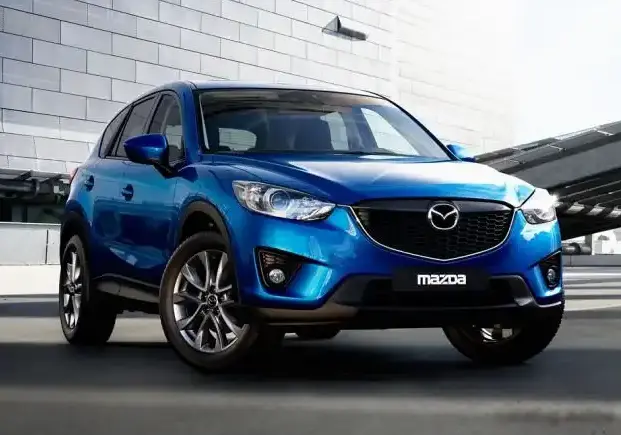
The Mazda CX-5 2.2 SKYACTIV-D (175 Hp) AWD Automatic was a diesel-powered variant of Mazda’s popular compact SUV, produced between 2012 and 2015. Positioned as a mid-range offering within the CX-5 lineup, it aimed to provide a balance of fuel efficiency, performance, and all-weather capability. This model was primarily sold in European and Asian markets where diesel engines were more prevalent, offering a compelling alternative to gasoline-powered crossovers. It represented Mazda’s early adoption of their SKYACTIV technology suite, focusing on maximizing engine efficiency and responsiveness.
Technical Specifications
| Brand | Mazda |
| Model | CX-5 |
| Type (Engine) | 2.2 SKYACTIV-D (175 Hp) AWD Automatic |
| Start of production | 2012 |
| End of production | 2015 |
| Powertrain Architecture | Internal Combustion engine |
| Body type | SUV |
| Seats | 5 |
| Doors | 5 |
| Fuel consumption (urban) | 6.4 l/100 km (36.8 US mpg, 44.1 UK mpg, 15.6 km/l) |
| Fuel consumption (extra urban) | 4.9 l/100 km (48 US mpg, 57.6 UK mpg, 20.4 km/l) |
| Fuel consumption (combined) | 5.5 l/100 km (42.8 US mpg, 51.4 UK mpg, 18.2 km/l) |
| CO2 emissions | 144 g/km |
| Fuel Type | Diesel |
| Acceleration 0 – 100 km/h | 9.4 sec |
| Acceleration 0 – 62 mph | 9.4 sec |
| Acceleration 0 – 60 mph | 8.9 sec |
| Maximum speed | 204 km/h (126.76 mph) |
| Emission standard | Euro 6 |
| Weight-to-power ratio | 8.5 kg/Hp, 117.4 Hp/tonne |
| Weight-to-torque ratio | 3.5 kg/Nm, 281.9 Nm/tonne |
| Power | 175 Hp @ 4500 rpm |
| Torque | 420 Nm @ 2000 rpm (309.78 lb.-ft. @ 2000 rpm) |
| Engine layout | Front, Transverse |
| Engine Model/Code | SHY4 |
| Engine displacement | 2191 cm3 (133.7 cu. in.) |
| Number of cylinders | 4 |
| Engine configuration | Inline |
| Cylinder Bore | 86 mm (3.39 in.) |
| Piston Stroke | 94.3 mm (3.71 in.) |
| Compression ratio | 14:1 |
| Number of valves per cylinder | 4 |
| Fuel injection system | Diesel Commonrail |
| Engine aspiration | Twin-Turbo, Intercooler |
| Valvetrain | DOHC |
| Engine oil capacity | 5.1 l (5.39 US qt | 4.49 UK qt) |
| Coolant | 8.6 l (9.09 US qt | 7.57 UK qt) |
| Kerb Weight | 1490 kg (3284.89 lbs.) |
| Max. weight | 2120 kg (4673.8 lbs.) |
| Max load | 630 kg (1388.91 lbs.) |
| Trunk (boot) space – minimum | 503 l (17.76 cu. ft.) |
| Trunk (boot) space – maximum | 1620 l (57.21 cu. ft.) |
| Fuel tank capacity | 58 l (15.32 US gal | 12.76 UK gal) |
| Max. roof load | 50 kg (110.23 lbs.) |
| Permitted trailer load with brakes (8%) | 2100 kg (4629.71 lbs.) |
| Permitted trailer load with brakes (12%) | 2000 kg (4409.25 lbs.) |
| Permitted trailer load without brakes | 750 kg (1653.47 lbs.) |
| Permitted towbar download | 88 kg (194.01 lbs.) |
| Length | 4555 mm (179.33 in.) |
| Width | 1840 mm (72.44 in.) |
| Height | 1710 mm (67.32 in.) |
| Wheelbase | 2700 mm (106.3 in.) |
| Front track | 1585 mm (62.4 in.) |
| Rear (Back) track | 1590 mm (62.6 in.) |
| Drag coefficient (Cd) | 0.33 |
| Minimum turning circle (turning diameter) | 11.7 m (38.39 ft.) |
| Drivetrain Architecture | All wheel drive (4×4) |
| Number of gears and type of gearbox | 6 gears, automatic transmission |
| Front suspension | Independent type McPherson |
| Rear suspension | Independent multi-link suspension |
| Front brakes | Ventilated discs, 297 mm |
| Rear brakes | Disc, 303 mm |
| Assisting systems | ABS (Anti-lock braking system) |
| Steering type | Steering rack and pinion |
| Power steering | Electric Steering |
| Tires size | 225/65 R17; 225/55 R19 |
| Wheel rims size | 7J x 17; 7J x 19 |
INTRODUCTION
The Mazda CX-5 2.2 SKYACTIV-D AWD Automatic, launched in 2012, was a key component of Mazda’s strategy to revitalize its lineup with fuel-efficient and engaging vehicles. Built on the 1HX0/A3 platform, it represented the first generation of the CX-5, a compact SUV designed to compete with established players like the Honda CR-V and Toyota RAV4, but with a stronger emphasis on driving dynamics. The 2.2-liter SKYACTIV-D engine, coupled with a six-speed automatic transmission and all-wheel drive, offered a compelling package for buyers seeking a practical and economical SUV.
Powertrain & Engine Architecture
At the heart of this CX-5 variant lies the SHY4 2.2-liter four-cylinder diesel engine. This engine is a cornerstone of Mazda’s SKYACTIV technology, designed to achieve high compression ratios (14:1) for improved thermal efficiency without requiring gasoline-style knock sensors. The engine utilizes a common-rail direct injection system, delivering fuel at extremely high pressures for optimized combustion. A twin-turbocharger setup, incorporating a small, low-inertia turbo for responsiveness and a larger turbo for peak power, contributes to the engine’s 175 horsepower and 420 Nm (309.78 lb.-ft.) of torque. The six-speed automatic transmission was specifically tuned to work with the diesel engine’s torque characteristics, providing smooth and efficient gear changes. The transmission features a torque converter for smooth launches and low-speed driving, and manual shift capability for more driver control.
Driving Characteristics
The CX-5 2.2 SKYACTIV-D Automatic offered a noticeably different driving experience compared to its gasoline counterparts. The high torque output of the diesel engine, available from as low as 2000 rpm, provided strong acceleration and effortless cruising. While not a sports car, the CX-5 felt surprisingly agile for an SUV, thanks to its well-tuned suspension and responsive steering. The automatic transmission, while generally smooth, could occasionally feel hesitant during quick downshifts. Compared to the manual transmission versions, the automatic offered greater convenience, but at the expense of some driver engagement. The all-wheel-drive system provided enhanced traction in inclement weather, making it a capable all-season vehicle.
Equipment & Trim Levels
The 2.2 SKYACTIV-D Automatic trim typically included features such as air conditioning, power windows and locks, a multi-function steering wheel, and a basic audio system with USB connectivity. Higher trim levels added features like leather upholstery, heated front seats, a sunroof, and a more advanced infotainment system with navigation. Safety features included ABS, electronic stability control, and multiple airbags. Optional extras often included a rear parking camera, blind-spot monitoring, and premium sound systems.
Chassis & Braking
The CX-5 featured an independent McPherson strut suspension at the front and an independent multi-link suspension at the rear, providing a comfortable ride and good handling characteristics. The front brakes were ventilated discs measuring 297mm, while the rear brakes were solid discs measuring 303mm. ABS (Anti-lock Braking System) was standard, enhancing braking performance and stability. The chassis was designed to minimize weight while maximizing rigidity, contributing to the vehicle’s overall handling prowess.
Market Reception & Comparison
The Mazda CX-5 2.2 SKYACTIV-D Automatic was generally well-received by automotive critics. It was praised for its fuel efficiency, comfortable ride, and engaging driving dynamics. However, some reviewers noted that the diesel engine could be slightly noisy compared to gasoline engines. Compared to the 2.0-liter gasoline version, the diesel offered significantly better fuel economy and more torque, but at a higher initial cost. The diesel also tended to hold its value slightly better in the used car market. Against competitors like the Honda CR-V and Toyota RAV4, the CX-5 offered a more sporty driving experience, but lacked the brand recognition and established reputation of its rivals.
Legacy
The Mazda CX-5 2.2 SKYACTIV-D Automatic proved to be a reliable and durable vehicle. The SKYACTIV-D engine, while complex, has generally demonstrated good long-term reliability when properly maintained. Common issues, if any, often relate to the diesel particulate filter (DPF), which can become clogged with soot if the vehicle is primarily used for short trips. In the used car market, these models continue to be sought after by buyers looking for a fuel-efficient and well-equipped SUV. The success of this variant helped establish the CX-5 as a popular and respected contender in the compact SUV segment, paving the way for subsequent generations of the vehicle.