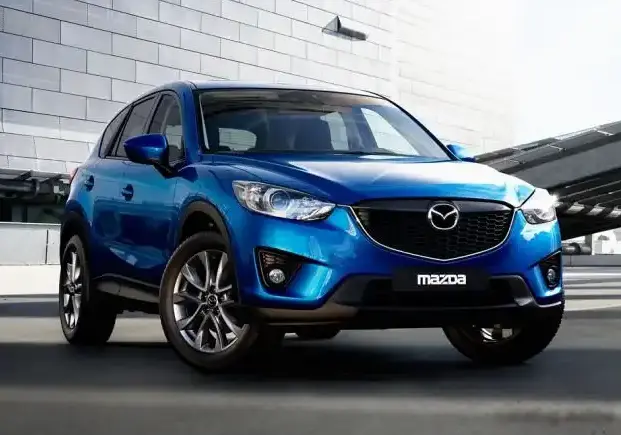
The Mazda CX-5 (facelift, produced from 2015 to 2017) 2.0i 4×4 represents a key iteration of Mazda’s popular compact crossover SUV. Introduced as part of the first-generation CX-5’s mid-cycle refresh, this variant aimed to provide a balance of affordability, practicality, and Mazda’s signature driving dynamics. Positioned as an entry-level all-wheel-drive option within the CX-5 range, it served as a stepping stone for buyers seeking the benefits of all-weather capability without the higher price tag of the more powerful 2.5-liter engine options. The facelift brought subtle styling updates, improved interior materials, and refinements to the vehicle’s already well-regarded chassis.
Technical Specifications
| Brand | Mazda |
| Model | CX-5 |
| Generation | CX-5 (facelift 2015) |
| Type (Engine) | 2.0i (160 Hp) 4×4 |
| Start of production | 2015 |
| End of production | 2017 |
| Powertrain Architecture | Internal Combustion engine |
| Body type | SUV |
| Seats | 5 |
| Doors | 5 |
| Fuel consumption (urban) | 8.2 l/100 km (28.7 US mpg) |
| Fuel consumption (extra urban) | 5.9 l/100 km (39.9 US mpg) |
| Fuel consumption (combined) | 6.7 l/100 km (35.1 US mpg) |
| CO2 emissions | 155 g/km |
| Fuel Type | Petrol (Gasoline) |
| Acceleration 0 – 100 km/h | 10.5 sec |
| Acceleration 0 – 62 mph | 10.5 sec |
| Acceleration 0 – 60 mph | 10 sec |
| Maximum speed | 194 km/h (120.55 mph) |
| Emission standard | Euro 6 |
| Weight-to-power ratio | 8.6 kg/Hp |
| Weight-to-torque ratio | 6.6 kg/Nm |
| Power | 160 Hp @ 6000 rpm |
| Torque | 208 Nm @ 4000 rpm (153.41 lb.-ft. @ 4000 rpm) |
| Engine layout | Front, Transverse |
| Engine Model/Code | PEY6, PEY7 |
| Engine displacement | 1998 cm3 (121.93 cu. in.) |
| Number of cylinders | 4 |
| Engine configuration | Inline |
| Compression ratio | 14:1 |
| Number of valves per cylinder | 4 |
| Fuel injection system | Direct injection |
| Engine oil capacity | 4.2 l (4.44 US qt | 3.7 UK qt) |
| Coolant capacity | 7.1 l (7.5 US qt | 6.25 UK qt) |
| Kerb Weight | 1375 kg (3031.36 lbs.) |
| Max. weight | 2005 kg (4420.27 lbs.) |
| Max load | 630 kg (1388.91 lbs.) |
| Trunk (boot) space – minimum | 503 l (17.76 cu. ft.) |
| Trunk (boot) space – maximum | 1620 l (57.21 cu. ft.) |
| Fuel tank capacity | 58 l (15.32 US gal | 12.76 UK gal) |
| Length | 4555 mm (179.33 in.) |
| Width | 1840 mm (72.44 in.) |
| Width including mirrors | 2168 mm (85.35 in.) |
| Height | 1710 mm (67.32 in.) |
| Wheelbase | 2700 mm (106.3 in.) |
| Ride height (ground clearance) | 210 mm (8.27 in.) |
| Drive wheel | All wheel drive (4×4) |
| Number of gears and type of gearbox | 6 gears, manual transmission |
| Front brakes | Ventilated discs |
| Rear brakes | Disc |
| Assisting systems | ABS (Anti-lock braking system) |
| Steering type | Steering rack and pinion |
| Power steering | Electric Steering |
Powertrain & Engine Architecture
The 2.0i 4×4 variant of the CX-5 facelift utilized Mazda’s SKYACTIV-G 2.0-liter inline-four cylinder gasoline engine, specifically the PEY6 or PEY7 engine code depending on the market. This engine was a key component of Mazda’s fuel efficiency and performance strategy. It featured direct injection, a high compression ratio of 14:1, and optimized intake and exhaust systems. The engine produced 160 horsepower at 6000 rpm and 208 Nm (153.41 lb-ft) of torque at 4000 rpm. The engine’s design prioritized torque delivery across a broad rev range, making it suitable for everyday driving. The 6-speed manual transmission was standard, offering precise shifts and contributing to the vehicle’s engaging driving experience.
Driving Characteristics
The CX-5 2.0i 4×4 with the manual transmission provided a reasonably engaging driving experience, though it wasn’t as sporty as the 2.5-liter models. Acceleration from 0-60 mph took around 10 seconds, which was adequate for most daily driving situations. The all-wheel-drive system provided enhanced traction in inclement weather, making it a practical choice for regions with snow or rain. The manual gearbox, while enjoyable for enthusiasts, required more driver involvement than the optional automatic transmission available on other CX-5 trims. The gear ratios were tuned for fuel efficiency, meaning the engine sometimes felt strained when accelerating quickly or climbing hills. Compared to the 2.5-liter engine, the 2.0-liter felt less powerful, but it offered better fuel economy.
Equipment & Trim Levels
The 2.0i 4×4 trim typically included standard features such as air conditioning, power windows and locks, a basic audio system with USB connectivity, and stability control. Safety features included ABS, traction control, and multiple airbags. Higher trim levels offered options like leather upholstery, a sunroof, a navigation system, and advanced safety features like blind-spot monitoring and lane departure warning. The interior design was generally functional and well-built, with a focus on ergonomics. The dashboard layout was straightforward, and the materials used were of decent quality for its price point.
Chassis & Braking
The CX-5’s chassis was a key strength, providing a comfortable ride and responsive handling. The suspension consisted of MacPherson struts in the front and a multi-link setup in the rear. The 2.0i 4×4 variant typically featured ventilated front disc brakes and solid rear disc brakes. The steering was precise and well-weighted, providing good feedback to the driver. The all-wheel-drive system was primarily front-wheel drive, with power automatically sent to the rear wheels when needed to maintain traction. Stabilizer bars were fitted to both the front and rear axles to reduce body roll during cornering.
Market Reception & Comparison
The Mazda CX-5 2.0i 4×4 was generally well-received by automotive critics. It was praised for its fuel efficiency, comfortable ride, and engaging handling. However, some reviewers noted that the 2.0-liter engine felt underpowered, especially when fully loaded or driving uphill. Compared to competitors like the Honda CR-V and Toyota RAV4, the CX-5 offered a more sporty driving experience but slightly less interior space. Fuel economy was competitive, averaging around 35.1 US mpg in combined driving. Reliability was generally good, with few reported issues with the engine or transmission.
Legacy
The Mazda CX-5 2.0i 4×4 has proven to be a reliable and durable vehicle in the used car market. The SKYACTIV-G engine is known for its longevity and relatively low maintenance costs. While not as sought-after as the higher-powered 2.5-liter models, the 2.0i 4×4 remains a practical and affordable option for buyers seeking a compact crossover SUV with all-wheel drive. Its combination of fuel efficiency, driving dynamics, and reliability has ensured its continued popularity among used car buyers.