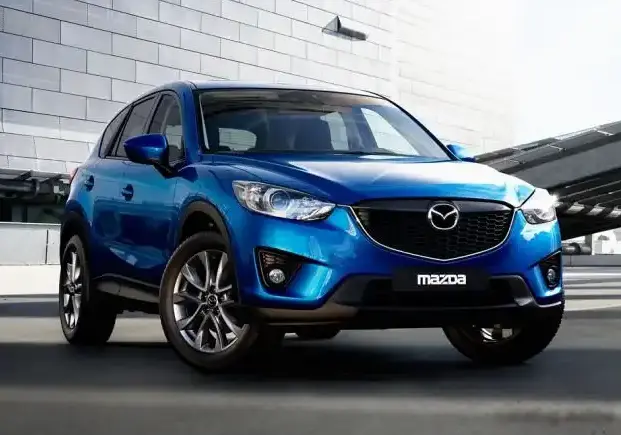
The Mazda CX-5 (facelift 2015) 2.0i 4×4 Automatic represents a key iteration within the second generation of Mazda’s popular compact SUV. Introduced in 2015 as part of a mid-cycle refresh, this variant aimed to provide a balance of affordability, practicality, and Mazda’s signature driving dynamics. Positioned as a mid-range offering within the CX-5 lineup, it served as a stepping stone between the base 2.0-liter front-wheel-drive models and the more powerful 2.5-liter options. Production of this specific configuration ran from 2015 to 2017, catering primarily to the North American and European markets where the CX-5 quickly gained recognition for its stylish design and engaging driving experience.
Technical Specifications
| Brand | Mazda |
| Model | CX-5 |
| Generation | CX-5 (facelift 2015) |
| Type (Engine) | 2.0i (160 Hp) 4×4 Automatic |
| Start of production | 2015 |
| End of production | 2017 |
| Powertrain Architecture | Internal Combustion engine |
| Body type | SUV |
| Seats | 5 |
| Doors | 5 |
| Fuel consumption (urban) | 8 l/100 km (29.4 US mpg) |
| Fuel consumption (extra urban) | 5.8 l/100 km (40.6 US mpg) |
| Fuel consumption (combined) | 6.6 l/100 km (35.6 US mpg) |
| CO2 emissions | 155 g/km |
| Fuel Type | Petrol (Gasoline) |
| Acceleration 0 – 100 km/h | 9.2 sec |
| Acceleration 0 – 62 mph | 9.2 sec |
| Acceleration 0 – 60 mph | 8.7 sec |
| Maximum speed | 182 km/h (113.09 mph) |
| Emission standard | Euro 6 |
| Weight-to-power ratio | 8.8 kg/Hp |
| Weight-to-torque ratio | 6.8 kg/Nm |
| Power | 160 Hp @ 6000 rpm |
| Torque | 208 Nm @ 4000 rpm (153.41 lb.-ft. @ 4000 rpm) |
| Engine layout | Front, Transverse |
| Engine Model/Code | PEY6, PEY7 |
| Engine displacement | 1998 cm3 (121.93 cu. in.) |
| Number of cylinders | 4 |
| Engine configuration | Inline |
| Compression ratio | 14:1 |
| Number of valves per cylinder | 4 |
| Fuel injection system | Direct injection |
| Engine oil capacity | 4.2 l (4.44 US qt | 3.7 UK qt) |
| Coolant capacity | 7.3 l (7.71 US qt | 6.42 UK qt) |
| Kerb Weight | 1405 kg (3097.49 lbs) |
| Max. weight | 2035 kg (4486.41 lbs) |
| Max load | 630 kg (1388.91 lbs) |
| Trunk (boot) space – minimum | 503 l (17.76 cu. ft.) |
| Trunk (boot) space – maximum | 1620 l (57.21 cu. ft.) |
| Fuel tank capacity | 58 l (15.32 US gal | 12.76 UK gal) |
| Length | 4555 mm (179.33 in.) |
| Width | 1840 mm (72.44 in.) |
| Width including mirrors | 2168 mm (85.35 in.) |
| Height | 1710 mm (67.32 in.) |
| Wheelbase | 2700 mm (106.3 in.) |
| Ride height (ground clearance) | 210 mm (8.27 in.) |
| Drive wheel | All wheel drive (4×4) |
| Number of gears and type of gearbox | 6 gears, automatic transmission |
| Front brakes | Ventilated discs |
| Rear brakes | Disc |
| Assisting systems | ABS (Anti-lock braking system) |
| Steering type | Steering rack and pinion |
| Power steering | Electric Steering |
Powertrain & Engine Architecture
At the heart of the CX-5 2.0i 4×4 Automatic lies Mazda’s SKYACTIV-G 2.0-liter inline-four cylinder gasoline engine, specifically the PEY6 or PEY7 variant depending on the market. This engine is characterized by its high compression ratio of 14:1, achieved through meticulous engineering and optimized combustion chamber design. Direct fuel injection is employed to precisely deliver fuel into the cylinders, enhancing efficiency and power output. The engine utilizes a dual overhead camshaft (DOHC) valvetrain with four valves per cylinder, contributing to its responsive nature. Paired with this engine is a six-speed automatic transmission, designed to provide smooth and efficient gear changes. This transmission isn’t a traditional torque-converter automatic; it incorporates a torque converter with a lock-up clutch to minimize slippage and improve fuel economy. The 4×4 system is an on-demand all-wheel-drive system, primarily operating in front-wheel drive to maximize efficiency, and engaging the rear wheels when traction is needed.
Driving Characteristics
The 160 horsepower and 153 lb-ft of torque produced by the 2.0-liter engine, when coupled with the six-speed automatic and all-wheel-drive system, delivers adequate, but not exhilarating, performance. Acceleration from 0-60 mph takes approximately 8.7 seconds. The automatic transmission is tuned for fuel efficiency, meaning shifts are generally smooth but not particularly aggressive. Compared to the 2.5-liter variants, the 2.0i feels noticeably less powerful, especially when fully loaded or tackling steep inclines. The gear ratios are optimized for everyday driving, providing sufficient power for merging onto highways and passing slower vehicles. However, drivers seeking a more spirited driving experience will likely find the 2.0i lacking the punch of its larger-engined siblings. The all-wheel-drive system provides enhanced stability and traction in inclement weather conditions, making it a practical choice for regions with snow or rain.
Equipment & Trim Levels
The 2.0i 4×4 Automatic trim typically included standard features such as air conditioning, power windows and locks, a touchscreen infotainment system with Bluetooth connectivity, and a rearview camera. Safety features like ABS, stability control, and multiple airbags were also standard. Interior upholstery was generally cloth, with options for leather upgrades available. Common optional extras included a sunroof, heated front seats, a premium sound system, and advanced safety technologies like blind-spot monitoring and lane departure warning. The dashboard layout was characterized by a clean and modern design, with a focus on ergonomics and ease of use.
Chassis & Braking
The CX-5’s chassis is built around a robust unibody construction, providing a good balance of rigidity and weight. The suspension system consists of MacPherson struts in the front and a multi-link setup in the rear. The 2.0i 4×4 Automatic models typically featured ventilated front disc brakes and solid rear disc brakes. The steering system is an electric power-assisted rack-and-pinion setup, offering precise and responsive steering feel. Stabilizer bars are fitted to both the front and rear axles to reduce body roll during cornering.
Market Reception & Comparison
The Mazda CX-5 2.0i 4×4 Automatic was generally well-received by automotive critics. It was praised for its stylish design, comfortable interior, and engaging driving dynamics. However, some reviewers noted that the 2.0-liter engine felt underpowered compared to the competition and the larger-engined CX-5 models. Fuel economy was considered competitive for its class, averaging around 35.6 US mpg in combined driving. Compared to rivals like the Honda CR-V and Toyota RAV4, the CX-5 offered a more premium feel and a more engaging driving experience, but often at a slightly higher price point. The 2.5-liter CX-5 models offered significantly better performance, but came with a higher price tag and slightly lower fuel economy.
Legacy
The SKYACTIV-G 2.0-liter engine and the six-speed automatic transmission used in the CX-5 2.0i 4×4 Automatic have proven to be relatively reliable powertrains. While some owners have reported minor issues with the infotainment system, major mechanical failures are uncommon. On the used car market, these models represent a good value proposition, offering a well-equipped and stylish SUV at an affordable price. The CX-5’s reputation for reliability and driving enjoyment has helped it maintain strong resale values, making it a popular choice among used car buyers.