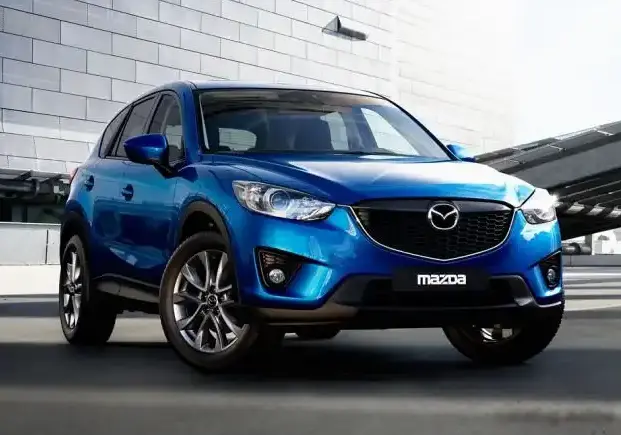
The Mazda CX-5 (facelift 2015) 2.0i, producing 165 horsepower, represents a key variant within the second generation of Mazda’s popular compact SUV. Introduced as part of a mid-cycle refresh in 2015 and continuing through 2017, this model aimed to provide a balance of affordability and Mazda’s signature driving dynamics. Positioned as the entry-level engine option in many markets, the 2.0i served as an accessible gateway to the CX-5 range, appealing to buyers prioritizing fuel efficiency and a comfortable ride over outright performance. It played a significant role in bolstering the CX-5’s sales, particularly in regions where smaller displacement engines were favored.
Technical Specifications
| Brand | Mazda |
| Model | CX-5 |
| Generation | CX-5 (facelift 2015) |
| Type (Engine) | 2.0i (165 Hp) |
| Start of production | 2015 |
| End of production | 2017 |
| Powertrain Architecture | Internal Combustion engine |
| Body type | SUV |
| Seats | 5 |
| Doors | 5 |
| Fuel consumption (urban) | 7.5 l/100 km (31.4 US mpg) |
| Fuel consumption (extra urban) | 5.1 l/100 km (46.1 US mpg) |
| Fuel consumption (combined) | 6 l/100 km (39.2 US mpg) |
| CO2 emissions | 139 g/km |
| Fuel Type | Petrol (Gasoline) |
| Acceleration 0 – 100 km/h | 9.2 sec |
| Acceleration 0 – 62 mph | 9.2 sec |
| Acceleration 0 – 60 mph | 8.7 sec |
| Maximum speed | 197 km/h (122.41 mph) |
| Emission standard | Euro 6 |
| Weight-to-power ratio | 8 kg/Hp |
| Weight-to-torque ratio | 6.3 kg/Nm |
| Power | 165 Hp @ 6000 rpm |
| Torque | 210 Nm @ 4000 rpm (154.89 lb.-ft. @ 4000 rpm) |
| Engine layout | Front, Transverse |
| Engine Model/Code | PEY6, PEY7 |
| Engine displacement | 1998 cm3 (121.93 cu. in.) |
| Number of cylinders | 4 |
| Engine configuration | Inline |
| Compression ratio | 14:1 |
| Number of valves per cylinder | 4 |
| Fuel injection system | Direct injection |
| Engine oil capacity | 4.2 l (4.44 US qt | 3.7 UK qt) |
| Coolant capacity | 7.1 l (7.5 US qt | 6.25 UK qt) |
| Kerb Weight | 1315 kg (2899.08 lbs.) |
| Max. weight | 1995 kg (4398.22 lbs.) |
| Max load | 680 kg (1499.14 lbs.) |
| Trunk (boot) space – minimum | 503 l (17.76 cu. ft.) |
| Trunk (boot) space – maximum | 1620 l (57.21 cu. ft.) |
| Fuel tank capacity | 56 l (14.79 US gal | 12.32 UK gal) |
| Length | 4555 mm (179.33 in.) |
| Width | 1840 mm (72.44 in.) |
| Width including mirrors | 2168 mm (85.35 in.) |
| Height | 1710 mm (67.32 in.) |
| Wheelbase | 2700 mm (106.3 in.) |
| Ride height (ground clearance) | 210 mm (8.27 in.) |
| Drivetrain Architecture | Front wheel drive |
| Number of gears | 6 |
| Type of gearbox | Manual transmission |
| Front brakes | Ventilated discs |
| Rear brakes | Disc |
| Assisting systems | ABS (Anti-lock braking system) |
| Steering type | Steering rack and pinion |
| Power steering | Electric Steering |
Powertrain & Engine Architecture
The 2.0i CX-5 utilizes Mazda’s PEY6 or PEY7 engine code, a 1.998-liter (121.93 cubic inches) inline-four cylinder gasoline engine. This engine is a key component of Mazda’s SKYACTIV technology suite, designed to maximize efficiency and responsiveness. A defining feature is its high compression ratio of 14:1, achieved through careful engineering and precise fuel control. Direct injection is employed to deliver fuel directly into the combustion chamber, optimizing combustion and reducing knocking. The engine features dual overhead camshafts (DOHC) and four valves per cylinder, contributing to its breathing efficiency. The engine’s output of 165 horsepower at 6000 rpm and 154.89 lb-ft of torque at 4000 rpm is delivered through a six-speed manual transmission in most configurations. This transmission was chosen for its precise shift feel and contribution to overall fuel economy.
Driving Characteristics
The 2.0i CX-5, paired with the six-speed manual, offers a driving experience focused on efficiency and ease of use. Acceleration from 0-60 mph takes approximately 8.7 seconds, which is respectable for the class but noticeably slower than the 2.5-liter variants. The engine delivers adequate power for everyday driving situations, including highway merging and passing, but requires more deliberate downshifting to maintain momentum when fully loaded or tackling steep inclines. The manual transmission provides a connected feel, allowing drivers to fully utilize the engine’s available power. Compared to the more powerful 2.5-liter engine, the 2.0i prioritizes fuel economy, achieving around 39.2 US mpg in combined driving conditions. The gear ratios are tuned for efficiency, with a taller final drive contributing to lower engine speeds at cruising speeds.
Equipment & Trim Levels
The 2.0i trim typically served as the entry point to the CX-5 lineup. Standard features generally included air conditioning, power windows and locks, a basic infotainment system with a touchscreen display, and Bluetooth connectivity. Safety features such as ABS, stability control, and multiple airbags were standard across all trims. Interior upholstery was typically cloth, with options for upgraded materials available on higher sub-trims. Optional extras included a sunroof, leather upholstery, a premium sound system, and advanced safety features like blind-spot monitoring and lane departure warning. The dashboard layout was consistent across the CX-5 range, featuring a driver-focused design with intuitive controls.
Chassis & Braking
The CX-5’s chassis is designed to provide a balance of ride comfort and handling agility. The front suspension utilizes MacPherson struts, while the rear suspension employs a multi-link setup. The 2.0i variant typically featured smaller diameter wheels and tires compared to higher trims, contributing to a slightly softer ride. Braking duties are handled by ventilated discs at the front and solid discs at the rear. ABS (Anti-lock Braking System) is standard, providing enhanced stopping power and control in emergency situations. The steering system is an electric power-assisted rack and pinion, offering precise and responsive steering feel.
Market Reception & Comparison
The Mazda CX-5 2.0i was generally well-received by automotive critics as a practical and fuel-efficient option within the compact SUV segment. While its performance wasn’t as exhilarating as the 2.5-liter models, it was praised for its comfortable ride, refined interior, and Mazda’s signature driving dynamics. Compared to competitors like the Honda CR-V and Toyota RAV4, the CX-5 2.0i offered a more engaging driving experience. Fuel economy was competitive, and reliability ratings were generally positive. However, some reviewers noted that the 2.0i engine could feel underpowered when fully loaded or driving uphill.
Legacy
The PEY6/PEY7 engine, as found in the 2.0i CX-5, has proven to be a relatively reliable powertrain. Common maintenance items include regular oil changes, spark plug replacements, and air filter servicing. While not prone to major mechanical failures, it’s important to address any potential issues promptly to prevent further damage. On the used car market, the 2.0i CX-5 represents a good value proposition for buyers seeking a fuel-efficient and well-equipped compact SUV. Its affordability and Mazda’s reputation for reliability make it a popular choice among budget-conscious consumers. The 2015-2017 facelift models, in particular, benefit from Mazda’s refinements to the interior and exterior design, enhancing their overall appeal.