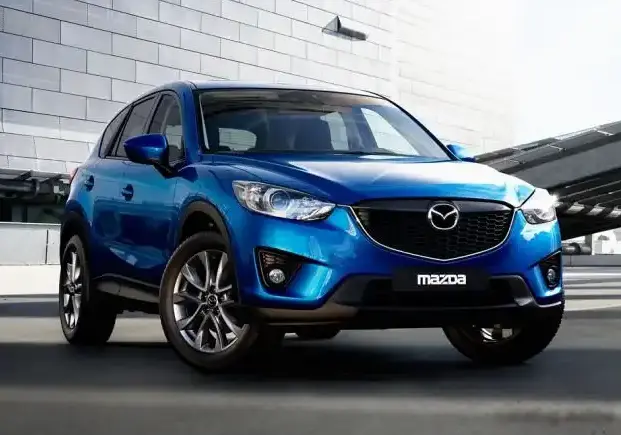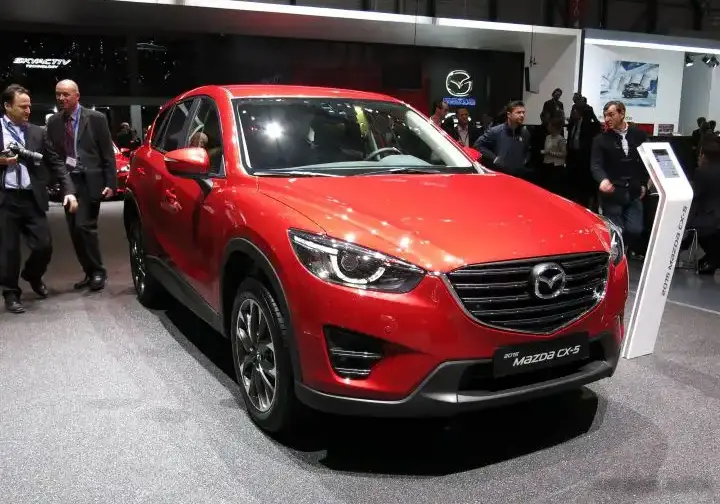
The Mazda CX-5 (facelift, 2015) 2.2d, producing 150 horsepower, represents a significant iteration of Mazda’s popular compact SUV. Introduced in 2015 and continuing through 2017, this variant occupied a key position in the CX-5 lineup, offering a balance between fuel efficiency, performance, and practicality. It was part of the first-generation CX-5 (KE series) which debuted in 2012, and the 2015 facelift brought styling updates and refinements to the powertrain. This particular diesel-powered version was primarily aimed at the European market, where diesel engines held a substantial share of the SUV segment, but was also available in other regions with diesel options.
Technical Specifications
| Brand | Mazda |
| Model | CX-5 |
| Generation | CX-5 (facelift 2015) |
| Type (Engine) | 2.2d (150 Hp) |
| Start of production | 2015 |
| End of production | 2017 |
| Powertrain Architecture | Internal Combustion engine |
| Body type | SUV |
| Seats | 5 |
| Doors | 5 |
| Fuel consumption (urban) | 5.4 l/100 km (43.6 US mpg, 52.3 UK mpg, 18.5 km/l) |
| Fuel consumption (extra urban) | 4.1 l/100 km (57.4 US mpg, 68.9 UK mpg, 24.4 km/l) |
| Fuel consumption (combined) | 4.6 l/100 km (51.1 US mpg, 61.4 UK mpg, 21.7 km/l) |
| CO2 emissions | 119 g/km |
| Fuel Type | Diesel |
| Acceleration 0 – 100 km/h | 9.2 sec |
| Acceleration 0 – 62 mph | 9.2 sec |
| Acceleration 0 – 60 mph | 8.7 sec |
| Maximum speed | 202 km/h (125.52 mph) |
| Emission standard | Euro 6 |
| Weight-to-power ratio | 9.5 kg/Hp, 105.6 Hp/tonne |
| Weight-to-torque ratio | 3.7 kg/Nm, 267.6 Nm/tonne |
| Power | 150 Hp @ 4500 rpm |
| Power per litre | 68.5 Hp/l |
| Torque | 380 Nm @ 1800-2600 rpm (280.27 lb.-ft. @ 1800-2600 rpm) |
| Engine layout | Front, Transverse |
| Engine Model/Code | SHY1 |
| Engine displacement | 2191 cm3 (133.7 cu. in.) |
| Number of cylinders | 4 |
| Engine configuration | Inline |
| Compression ratio | 14:1 |
| Number of valves per cylinder | 4 |
| Fuel injection system | Diesel Commonrail |
| Engine aspiration | BiTurbo, Intercooler |
| Engine oil capacity | 5.1 l (5.39 US qt | 4.49 UK qt) |
| Coolant capacity | 8.5 l (8.98 US qt | 7.48 UK qt) |
| Kerb Weight | 1420 kg (3130.56 lbs.) |
| Max. weight | 2050 kg (4519.48 lbs.) |
| Max load | 630 kg (1388.91 lbs.) |
| Trunk (boot) space – minimum | 503 l (17.76 cu. ft.) |
| Trunk (boot) space – maximum | 1620 l (57.21 cu. ft.) |
| Fuel tank capacity | 56 l (14.79 US gal | 12.32 UK gal) |
| Length | 4555 mm (179.33 in.) |
| Width | 1840 mm (72.44 in.) |
| Width including mirrors | 2168 mm (85.35 in.) |
| Height | 1710 mm (67.32 in.) |
| Wheelbase | 2700 mm (106.3 in.) |
| Ride height (ground clearance) | 210 mm (8.27 in.) |
| Drivetrain Architecture | The Internal combustion engine (ICE) drives the front wheels of the vehicle. |
| Drive wheel | Front wheel drive |
| Number of gears and type of gearbox | 6 gears, manual transmission |
| Front brakes | Ventilated discs |
| Rear brakes | Disc |
| Assisting systems | ABS (Anti-lock braking system) |
| Steering type | Steering rack and pinion |
| Power steering | Electric Steering |
Powertrain & Engine Architecture
The heart of the CX-5 2.2d is the SHY1 engine, a 2.2-liter inline-four cylinder diesel. This engine utilizes a sophisticated bi-turbocharger system, employing two turbochargers in series to minimize turbo lag and deliver a broad torque curve. The first, smaller turbocharger spools up quickly at low engine speeds, providing immediate response. As engine speed increases, the second, larger turbocharger takes over, providing sustained power. A common rail direct injection system, operating at extremely high pressures, ensures precise fuel delivery and efficient combustion. The engine boasts a compression ratio of 14:1, contributing to its thermal efficiency. The 6-speed manual transmission was standard, offering precise gear changes and a direct connection to the engine.
Driving Characteristics
The 150 horsepower and 380 Nm (280 lb-ft) of torque provided by the 2.2d engine offered a comfortable and capable driving experience. While not overtly sporty, the CX-5 2.2d delivered ample power for everyday driving and highway cruising. Acceleration from 0-60 mph took approximately 8.7 seconds, and top speed was rated at 125.52 mph. The bi-turbo setup minimized turbo lag, providing a relatively linear power delivery. Compared to the 2.0-liter gasoline engine options available in the CX-5 range, the 2.2d offered significantly more torque at lower engine speeds, making it more effortless for overtaking and towing. However, it lacked the higher-revving character of the gasoline engines. Compared to higher-output diesel variants (often exceeding 175 hp), this version prioritized fuel economy over outright performance.
Equipment & Trim Levels
The 2015 facelift CX-5 2.2d typically came well-equipped, even in base trim levels. Standard features often included air conditioning, power windows and mirrors, a touchscreen infotainment system with Bluetooth connectivity, and a suite of safety features like ABS, traction control, and multiple airbags. Higher trim levels added features such as leather upholstery, heated front seats, a sunroof, and advanced driver-assistance systems like lane departure warning and automatic emergency braking. Interior upholstery was typically cloth in lower trims, with leather options available. Dashboard configurations were consistent across the range, featuring a clean and functional design.
Chassis & Braking
The CX-5’s chassis was designed to balance ride comfort and handling. It utilized a MacPherson strut front suspension and a multi-link rear suspension. The 2.2d variant, due to its weight, often featured slightly stiffer spring rates compared to lighter gasoline-powered models. Braking duties were handled by ventilated discs at the front and solid discs at the rear. ABS (Anti-lock Braking System) was standard. The steering system was an electric power-assisted rack and pinion, providing a responsive and precise feel.
Market Reception & Comparison
The Mazda CX-5 2.2d was generally well-received by automotive critics. It was praised for its fuel efficiency, comfortable ride, and spacious interior. The diesel engine was noted for its refinement and strong torque output. Compared to competitors like the Nissan Qashqai and Hyundai Tucson, the CX-5 was often lauded for its more engaging driving dynamics and higher-quality interior materials. Fuel economy was a key selling point, with combined figures around 51.1 US mpg. Reliability was also considered good, although diesel engines generally require more diligent maintenance than their gasoline counterparts.
Legacy
The SHY1 2.2-liter diesel engine proved to be a robust and reliable unit when properly maintained. While diesel emissions regulations have become increasingly stringent in recent years, the CX-5 2.2d remains a popular choice in the used car market, particularly for those seeking a fuel-efficient and practical SUV. Common issues, if any, typically relate to the diesel particulate filter (DPF) requiring periodic regeneration, especially with frequent short trips. Overall, the 2015-2017 Mazda CX-5 2.2d represents a well-rounded and capable SUV that continues to offer good value for money.