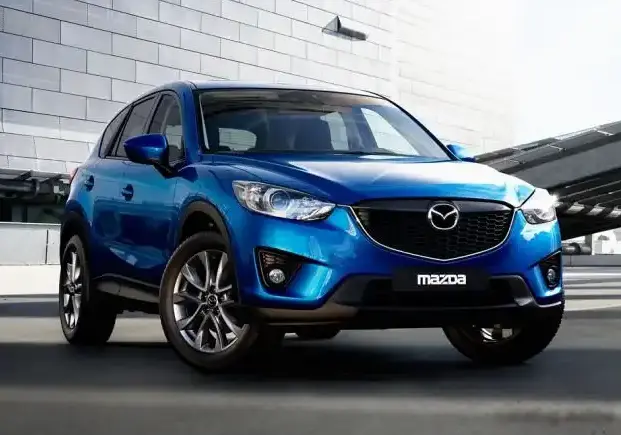
The Mazda CX-5 (facelift 2015) 2.2d 4×4 represents a significant iteration of Mazda’s popular compact SUV, produced from 2015 to 2017. This variant, powered by a 2.2-liter Skyactiv-D diesel engine producing 150 horsepower, was positioned as a mid-range offering within the CX-5 lineup, appealing to buyers seeking a balance of fuel efficiency, all-weather capability, and reasonable performance. It built upon the success of the initial CX-5 launch, incorporating styling refinements and technological updates while retaining the core values of Mazda’s “Kodo – Soul of Motion” design philosophy and Skyactiv technology. This model played a key role in establishing Mazda as a premium contender in the increasingly competitive crossover segment, particularly in European and Asian markets.
Technical Specifications
| Brand | Mazda |
| Model | CX-5 |
| Generation | CX-5 (facelift 2015) |
| Type (Engine) | 2.2d (150 Hp) 4×4 |
| Start of production | 2015 |
| End of production | 2017 |
| Powertrain Architecture | Internal Combustion engine |
| Body type | SUV |
| Seats | 5 |
| Doors | 5 |
| Fuel consumption (urban) | 6 l/100 km (39.2 US mpg, 47.1 UK mpg, 16.7 km/l) |
| Fuel consumption (extra urban) | 4.7 l/100 km (50 US mpg, 60.1 UK mpg, 21.3 km/l) |
| Fuel consumption (combined) | 5.2 l/100 km (45.2 US mpg, 54.3 UK mpg, 19.2 km/l) |
| CO2 emissions | 136 g/km |
| Fuel Type | Diesel |
| Acceleration 0 – 100 km/h | 9.4 sec |
| Acceleration 0 – 62 mph | 9.4 sec |
| Acceleration 0 – 60 mph | 8.9 sec |
| Maximum speed | 197 km/h (122.41 mph) |
| Emission standard | Euro 6 |
| Weight-to-power ratio | 9.9 kg/Hp, 101.4 Hp/tonne |
| Weight-to-torque ratio | 3.9 kg/Nm, 256.8 Nm/tonne |
| Power | 150 Hp @ 4500 rpm |
| Torque | 380 Nm @ 1800-2600 rpm (280.27 lb.-ft. @ 1800-2600 rpm) |
| Engine layout | Front, Transverse |
| Engine Model/Code | SHY1 |
| Engine displacement | 2191 cm3 (133.7 cu. in.) |
| Number of cylinders | 4 |
| Engine configuration | Inline |
| Compression ratio | 14:1 |
| Number of valves per cylinder | 4 |
| Fuel injection system | Diesel Commonrail |
| Engine aspiration | BiTurbo, Intercooler |
| Engine oil capacity | 5.1 l (5.39 US qt | 4.49 UK qt) |
| Coolant capacity | 8.5 l (8.98 US qt | 7.48 UK qt) |
| Kerb Weight | 1480 kg (3262.84 lbs.) |
| Max. weight | 2110 kg (4651.75 lbs.) |
| Max load | 630 kg (1388.91 lbs.) |
| Trunk (boot) space – minimum | 503 l (17.76 cu. ft.) |
| Trunk (boot) space – maximum | 1620 l (57.21 cu. ft.) |
| Fuel tank capacity | 58 l (15.32 US gal | 12.76 UK gal) |
| Length | 4555 mm (179.33 in.) |
| Width | 1840 mm (72.44 in.) |
| Width including mirrors | 2168 mm (85.35 in.) |
| Height | 1710 mm (67.32 in.) |
| Wheelbase | 2700 mm (106.3 in.) |
| Ride height (ground clearance) | 210 mm (8.27 in.) |
| Drive wheel | All wheel drive (4×4) |
| Number of gears and type of gearbox | 6 gears, manual transmission |
| Front brakes | Ventilated discs |
| Rear brakes | Disc |
| Assisting systems | ABS (Anti-lock braking system) |
| Steering type | Steering rack and pinion |
| Power steering | Electric Steering |
INTRODUCTION
The 2015 facelift of the Mazda CX-5 brought with it a refreshed exterior, interior enhancements, and importantly, the continued availability of the 2.2-liter Skyactiv-D diesel engine. This engine, designated SHY1, was a key component of Mazda’s strategy to offer a fuel-efficient and capable SUV option, particularly in markets where diesel fuel was prevalent. The 150 horsepower, four-wheel-drive configuration was a popular choice, offering a balance between performance and economy. It sat in the middle of the CX-5 range, above the lower-powered 2.0-liter gasoline variants and below the more potent 2.5-liter gasoline models.
Powertrain & Engine Architecture
The heart of this CX-5 variant is the SHY1 2.2-liter Skyactiv-D inline-four diesel engine. This engine is characterized by its high compression ratio of 14:1, a feature contributing to its thermal efficiency. It utilizes a twin-turbocharger setup – a small turbo for quick response at low engine speeds and a larger turbo for sustained power at higher RPMs. The engine employs a common-rail direct injection system, delivering fuel at extremely high pressures for optimized combustion. The Skyactiv-D technology focuses on maximizing combustion efficiency and reducing particulate matter emissions. The 6-speed manual transmission was standard, offering precise gear changes and a direct connection to the engine. The transmission’s gear ratios were tuned to provide a balance of acceleration and fuel economy, with a relatively long final drive ratio to enhance highway cruising efficiency.
Driving Characteristics
The 150 hp 2.2d 4×4 CX-5 delivers a composed and refined driving experience. While not overtly sporty, it provides ample power for everyday driving and highway overtaking. The twin-turbo setup minimizes turbo lag, providing a relatively linear power delivery from around 1800 rpm. The 380 Nm (280 lb-ft) of torque is readily available, making it a capable performer even when fully loaded. Compared to the higher-output gasoline versions, the diesel offers superior fuel economy and a more relaxed driving style. However, it lacks the immediate responsiveness and higher revving nature of the gasoline engines. The all-wheel-drive system provides enhanced traction in adverse weather conditions, making it a confident choice for year-round use.
Equipment & Trim Levels
The 2.2d 4×4 trim typically included standard features such as air conditioning, power windows and mirrors, a touchscreen infotainment system with Bluetooth connectivity, and a suite of safety features including ABS, traction control, and multiple airbags. Higher trim levels offered upgrades such as leather upholstery, a sunroof, heated front seats, and a premium sound system. Interior materials were generally of good quality, reflecting Mazda’s commitment to creating a premium feel. The dashboard layout was driver-focused, with logically arranged controls and clear instrumentation.
Chassis & Braking
The CX-5 utilizes a MacPherson strut front suspension and a multi-link rear suspension, providing a comfortable ride and predictable handling. The suspension was tuned to balance ride comfort with body control. The 2.2d 4×4 models were equipped with ventilated front disc brakes and solid rear discs, providing adequate stopping power for the vehicle’s weight and performance. The electric power steering system offered a light and precise feel, enhancing maneuverability.
Market Reception & Comparison
The Mazda CX-5 2.2d 4×4 was generally well-received by automotive critics. It was praised for its fuel efficiency, comfortable ride, and stylish design. Compared to competitors like the Nissan Qashqai and Kia Sportage, the CX-5 was often noted for its more engaging driving dynamics and higher-quality interior. The diesel engine offered significantly better fuel economy than the gasoline alternatives, making it an attractive option for drivers covering long distances. However, some critics noted that the diesel engine could be slightly noisy compared to some of its rivals.
Legacy
The SHY1 2.2-liter Skyactiv-D engine has proven to be a relatively reliable powertrain, although, like all diesel engines, it requires regular maintenance, including oil changes and diesel particulate filter (DPF) regeneration. On the used car market, the 2015-2017 CX-5 2.2d 4×4 remains a popular choice, offering a compelling combination of practicality, fuel efficiency, and driving enjoyment. Its reputation for reliability and Mazda’s strong brand image contribute to its continued desirability. The Skyactiv-D technology laid the groundwork for Mazda’s future diesel engine development, and the CX-5 helped solidify Mazda’s position as a leading manufacturer of compact SUVs.