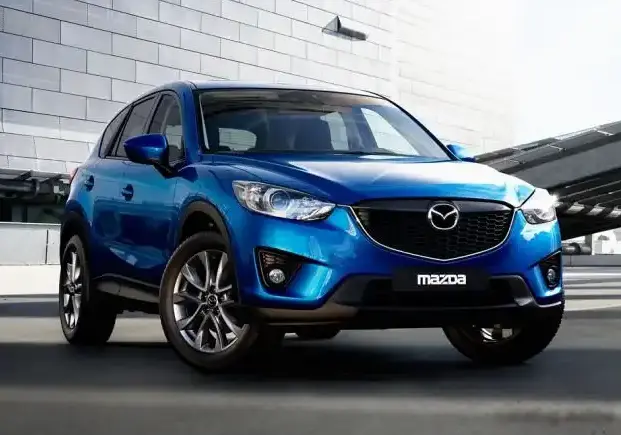
The Mazda CX-5 (facelift, 2015) 2.2d with 150 horsepower and a four-wheel-drive automatic transmission represents a significant iteration of Mazda’s popular compact SUV. Introduced in 2015 as part of a mid-cycle refresh, this variant aimed to balance fuel efficiency, practicality, and a more refined driving experience within the CX-5 lineup. It was positioned as a mid-range offering, appealing to buyers seeking a capable all-weather vehicle with diesel economy. Production of this specific configuration ran from 2015 to 2017, building upon the success of the initial CX-5 launched in 2012, which was based on the Mazda’s Skyactiv technology platform.
Technical Specifications
| Brand | Mazda |
| Model | CX-5 |
| Generation | CX-5 (facelift 2015) |
| Type (Engine) | 2.2d (150 Hp) 4×4 Automatic |
| Start of production | 2015 |
| End of production | 2017 |
| Powertrain Architecture | Internal Combustion engine |
| Body type | SUV |
| Seats | 5 |
| Doors | 5 |
| Fuel consumption (urban) | 6.4 l/100 km (36.8 US mpg, 44.1 UK mpg, 15.6 km/l) |
| Fuel consumption (extra urban) | 4.9 l/100 km (48 US mpg, 57.6 UK mpg, 20.4 km/l) |
| Fuel consumption (combined) | 5.5 l/100 km (42.8 US mpg, 51.4 UK mpg, 18.2 km/l) |
| CO2 emissions | 144 g/km |
| Fuel Type | Diesel |
| Acceleration 0 – 100 km/h | 10.2 sec |
| Acceleration 0 – 62 mph | 10.2 sec |
| Acceleration 0 – 60 mph | 9.7 sec |
| Maximum speed | 194 km/h (120.55 mph) |
| Emission standard | Euro 6 |
| Weight-to-power ratio | 10 kg/Hp, 100.3 Hp/tonne |
| Weight-to-torque ratio | 3.9 kg/Nm, 254.2 Nm/tonne |
| Power | 150 Hp @ 4500 rpm |
| Torque | 380 Nm @ 1800-2600 rpm (280.27 lb.-ft. @ 1800-2600 rpm) |
| Engine layout | Front, Transverse |
| Engine Model/Code | SHY1 |
| Engine displacement | 2191 cm3 (133.7 cu. in.) |
| Number of cylinders | 4 |
| Engine configuration | Inline |
| Compression ratio | 14:1 |
| Number of valves per cylinder | 4 |
| Fuel injection system | Diesel Commonrail |
| Engine aspiration | BiTurbo, Intercooler |
| Engine oil capacity | 5.1 l (5.39 US qt | 4.49 UK qt) |
| Coolant capacity | 8.6 l (9.09 US qt | 7.57 UK qt) |
| Kerb Weight | 1495 kg (3295.91 lbs.) |
| Max. weight | 2124 kg (4682.62 lbs.) |
| Max load | 629 kg (1386.71 lbs.) |
| Trunk (boot) space – minimum | 503 l (17.76 cu. ft.) |
| Trunk (boot) space – maximum | 1620 l (57.21 cu. ft.) |
| Fuel tank capacity | 58 l (15.32 US gal | 12.76 UK gal) |
| Length | 4555 mm (179.33 in.) |
| Width | 1840 mm (72.44 in.) |
| Width including mirrors | 2168 mm (85.35 in.) |
| Height | 1710 mm (67.32 in.) |
| Wheelbase | 2700 mm (106.3 in.) |
| Ride height (ground clearance) | 210 mm (8.27 in.) |
| Drive wheel | All wheel drive (4×4) |
| Number of gears and type of gearbox | 6 gears, automatic transmission |
| Front brakes | Ventilated discs |
| Rear brakes | Disc |
| Assisting systems | ABS (Anti-lock braking system) |
| Steering type | Steering rack and pinion |
| Power steering | Electric Steering |
Powertrain & Engine Architecture
At the heart of the CX-5 2.2d 4×4 Automatic lies Mazda’s SHY1 2.2-liter four-cylinder diesel engine. This engine utilizes a common-rail direct injection system, delivering fuel at extremely high pressure for optimized combustion. A key feature is its twin-turbocharger setup – a small turbo for immediate response at low engine speeds and a larger turbo to maintain power throughout the rev range. This configuration helps mitigate turbo lag, a common issue with diesel engines. The engine also incorporates an intercooler to further enhance performance by cooling the intake air. The 150 horsepower output is achieved at 4500 rpm, while the substantial 380 Nm (280 lb-ft) of torque is available from 1800 to 2600 rpm, providing strong pulling power. The engine’s 14:1 compression ratio is typical for a diesel engine, contributing to its efficiency. The engine is paired with a six-speed automatic transmission, specifically tuned to work with the diesel’s torque characteristics. This transmission provides smooth shifts and contributes to the overall refinement of the driving experience.
Driving Characteristics
The 2.2d Automatic CX-5 offers a comfortable and capable driving experience. The automatic transmission, while not offering the outright sportiness of a manual, provides smooth and predictable gear changes. The abundance of low-end torque from the diesel engine means that the CX-5 feels responsive in everyday driving situations, with ample power for overtaking and climbing hills. Acceleration from 0-60 mph takes around 9.7 seconds, which is respectable for a diesel SUV. Compared to the 2.0-liter gasoline versions of the CX-5, the 2.2d offers significantly more torque, making it feel stronger and more effortless to drive, especially when fully loaded or towing. However, it lacks the higher-revving enthusiasm of the gasoline engines. Compared to higher-output diesel variants (like those exceeding 175 hp), this 150 hp version prioritizes fuel economy over outright performance. The all-wheel-drive system provides excellent traction in various weather conditions, enhancing stability and confidence.
Equipment & Trim Levels
The 2.2d 4×4 Automatic trim typically included a good level of standard equipment. Features commonly found in this variant include air conditioning, power windows and mirrors, a multi-function steering wheel, and a basic audio system with USB connectivity. Higher trim levels, often denoted by names like “Sport” or “Touring,” added features such as leather upholstery, heated front seats, a touchscreen infotainment system with navigation, and advanced safety features like lane departure warning and automatic emergency braking. Optional extras could include a sunroof, premium sound system, and parking sensors.
Chassis & Braking
The CX-5’s chassis is designed to provide a balance between comfort and handling. It utilizes MacPherson strut suspension in the front and a multi-link suspension in the rear. The 2.2d models, due to their increased weight, often featured slightly stiffer spring rates compared to the lighter gasoline variants. Braking duties are handled by ventilated discs at the front and solid discs at the rear. Anti-lock Braking System (ABS) is standard, providing enhanced stopping power and control. The steering is electrically assisted, offering a light and precise feel.
Market Reception & Comparison
The Mazda CX-5 2.2d 4×4 Automatic was generally well-received by automotive critics. It was praised for its fuel efficiency, comfortable ride, and spacious interior. The diesel engine was noted for its refinement and strong torque output. However, some reviewers found the automatic transmission to be slightly hesitant at times. Compared to competitors like the Nissan Qashqai and Hyundai Tucson, the CX-5 was often seen as offering a more premium driving experience and a more stylish interior. In terms of fuel economy, the 2.2d consistently outperformed the gasoline-powered CX-5 models, making it an attractive option for drivers covering long distances. Reliability was generally good, although diesel engines can be more susceptible to issues with the particulate filter if not driven on longer journeys regularly.
Legacy
The Mazda CX-5 2.2d 4×4 Automatic has proven to be a relatively reliable vehicle in the used car market. The SHY1 diesel engine, while requiring regular maintenance (including diesel particulate filter regeneration), is generally robust. The automatic transmission has also proven to be durable. Today, these vehicles represent a good value proposition for buyers seeking a practical and fuel-efficient SUV. However, potential buyers should be aware of the potential costs associated with diesel engine maintenance and the impact of increasingly stringent emissions regulations on older diesel vehicles.