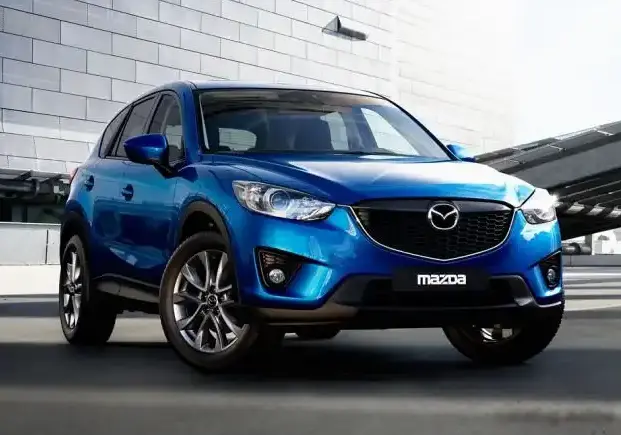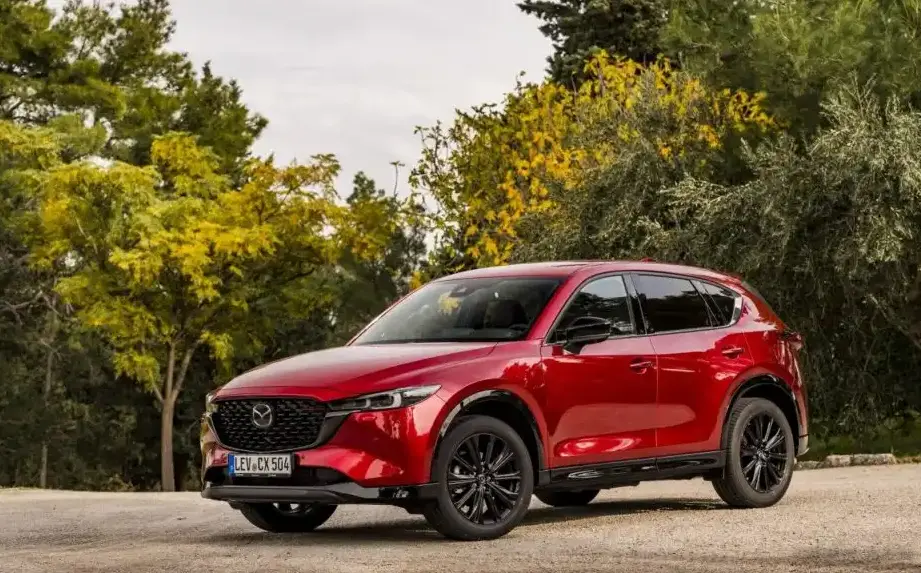
The Mazda CX-5 II (facelift 2021) 2.0 e-SKYACTIV G (165 Hp) Mild Hybrid represents a key iteration within the second generation of Mazda’s popular compact SUV. Introduced in November 2022, this variant aimed to balance fuel efficiency with reasonable performance, slotting into the CX-5 lineup as an entry-level to mid-range option. It builds upon the foundation of the KF series CX-5, which debuted in 2017, incorporating Mazda’s Skyactiv technology and a mild hybrid system to enhance fuel economy and reduce emissions. This model is primarily marketed in Europe and other regions outside of North America, where Mazda focuses on different powertrain options for the CX-5.
Technical Specifications
| Brand | Mazda |
| Model | CX-5 |
| Generation | CX-5 II (facelift 2021) |
| Type (Engine) | 2.0 e-SKYACTIV G (165 Hp) Mild Hybrid |
| Start of production | November, 2022 |
| Powertrain Architecture | MHEV (Mild Hybrid Electric Vehicle) |
| Body type | SUV |
| Seats | 5 |
| Doors | 5 |
| Fuel consumption at Low speed (WLTP) | 8 l/100 km (29.4 US mpg, 35.3 UK mpg, 12.5 km/l) |
| Fuel consumption at Medium speed (WLTP) | 6.3 l/100 km (37.3 US mpg, 44.8 UK mpg, 15.9 km/l) |
| Fuel consumption at high speed (WLTP) | 5.6 l/100 km (42 US mpg, 50.4 UK mpg, 17.9 km/l) |
| Fuel consumption at very high speed (WLTP) | 6.8 l/100 km (34.6 US mpg, 41.5 UK mpg, 14.7 km/l) |
| Combined fuel consumption (WLTP) | 6.5 l/100 km (36.2 US mpg, 43.5 UK mpg, 15.4 km/l) |
| CO2 emissions (WLTP) | 146 g/km |
| Fuel Type | Petrol (Gasoline) |
| Acceleration 0 – 100 km/h | 10.7 sec |
| Acceleration 0 – 62 mph | 10.7 sec |
| Acceleration 0 – 60 mph | 10.2 sec |
| Maximum speed | 201 km/h (124.9 mph) |
| Emission standard | Euro 6d |
| Weight-to-power ratio | 9.2 kg/Hp, 108.3 Hp/tonne |
| Weight-to-torque ratio | 7.2 kg/Nm, 139.9 Nm/tonne |
| Battery voltage | 24 V |
| Battery technology | Lithium-ion (Li-Ion) |
| Power | 165 Hp @ 6000 rpm |
| Torque | 213 Nm @ 4000 rpm (157.1 lb.-ft. @ 4000 rpm) |
| Engine layout | Front, Transverse |
| Engine Model/Code | PE |
| Engine displacement | 1998 cm3 (121.93 cu. in.) |
| Number of cylinders | 4 |
| Engine configuration | Inline |
| Cylinder Bore | 83.5 mm (3.29 in.) |
| Piston Stroke | 91.2 mm (3.59 in.) |
| Compression ratio | 13.5:1 |
| Number of valves per cylinder | 4 |
| Fuel injection system | Direct injection |
| Engine aspiration | Naturally aspirated engine |
| Valvetrain | DOHC |
| Engine oil capacity | 4.2 l (4.44 US qt | 3.7 UK qt) |
| Coolant | 7.1 l (7.5 US qt | 6.25 UK qt) |
| Kerb Weight | 1523-1583 kg (3357.64 – 3489.92 lbs.) |
| Max. weight | 2075 kg (4574.59 lbs.) |
| Max load | 492-552 kg (1084.67 – 1216.95 lbs.) |
| Trunk (boot) space – minimum | 522 l (18.43 cu. ft.) |
| Trunk (boot) space – maximum | 1638 l (57.85 cu. ft.) |
| Fuel tank capacity | 56 l (14.79 US gal | 12.32 UK gal) |
| Max. roof load | 75 kg (165.35 lbs.) |
| Permitted trailer load with brakes (12%) | 1800 kg (3968.32 lbs.) |
| Length | 4575 mm (180.12 in.) |
| Width | 1845 mm (72.64 in.) |
| Width including mirrors | 2115 mm (83.27 in.) |
| Height | 1675-1680 mm (65.94 – 66.14 in.) |
| Wheelbase | 2700 mm (106.3 in.) |
| Front track | 1595 mm (62.8 in.) |
| Rear (Back) track | 1595 mm (62.8 in.) |
| Ride height (ground clearance) | 192-200 mm (7.56 – 7.87 in.) |
| Minimum turning circle (turning diameter) | 11.9 m (39.04 ft.) |
| Drivetrain Architecture | ICE and electric motor drive the front wheels |
| Drive wheel | Front wheel drive |
| Number of gears and type of gearbox | 6 gears, manual transmission |
| Front suspension | Independent type McPherson |
| Rear suspension | Independent multi-link suspension |
| Front brakes | Ventilated discs, 297 mm |
| Rear brakes | Disc, 303 mm |
| Assisting systems | ABS (Anti-lock braking system) |
| Steering type | Steering rack and pinion |
| Power steering | Electric Steering |
| Tires size | 225/65 R17; 225/55 R19 |
| Wheel rims size | 17; 19 |
Powertrain & Engine Architecture
At the heart of the CX-5 2.0 e-SKYACTIV G Mild Hybrid lies Mazda’s PE engine, a 1.998-liter inline-four cylinder gasoline engine. This engine is part of the Skyactiv-G family, known for its high compression ratio (13.5:1) and focus on efficiency. Direct injection is employed to optimize fuel delivery and combustion. The engine utilizes a DOHC (Dual Overhead Camshaft) valvetrain with four valves per cylinder, contributing to its breathing efficiency. The mild hybrid system consists of a 24V lithium-ion battery and an integrated starter generator (ISG). The ISG assists the engine during acceleration, providing a small power boost and allowing for smoother start-stop operation. This system doesn’t enable electric-only driving, but it recovers energy during braking and deceleration, storing it in the battery for later use. The engine is transversely mounted, driving the front wheels through a six-speed manual transmission.
Driving Characteristics
The 165 horsepower and 157 lb-ft of torque produced by this powertrain configuration result in a 0-60 mph time of around 10.2 seconds. While not particularly sporty, the engine provides adequate power for everyday driving situations. The mild hybrid system helps to smooth out the engine’s response, particularly at lower speeds. The six-speed manual transmission offers a reasonably engaging driving experience, although the gear ratios are tuned more for fuel economy than outright performance. Compared to higher-output CX-5 variants (like those with the 2.5-liter engine), this 2.0-liter version feels less eager to accelerate, but it offers a more refined and economical driving experience. The manual transmission provides more driver involvement than the optional automatic transmission available on other trims.
Equipment & Trim Levels
The 2.0 e-SKYACTIV G Mild Hybrid trim typically included standard features such as Mazda’s infotainment system with a 8-inch touchscreen display, Apple CarPlay and Android Auto integration, and a suite of safety features including lane departure warning, lane keep assist, and automatic emergency braking. Interior upholstery was generally cloth, with options for leather upgrades. Depending on the market and optional packages, features like a sunroof, heated seats, and a premium sound system could be added. The trim level generally sat in the middle of the CX-5 range, offering a good balance of features and affordability.
Chassis & Braking
The CX-5 II utilizes an independent McPherson strut suspension at the front and an independent multi-link suspension at the rear. This setup provides a comfortable ride and good handling characteristics. Front brakes are ventilated discs measuring 297mm, while rear brakes are solid discs measuring 303mm. ABS (Anti-lock Braking System) is standard. Stabilizer bars are fitted to both the front and rear axles to reduce body roll during cornering. The suspension tuning is geared towards comfort and stability rather than sporty handling.
Market Reception & Comparison
Critics generally praised the CX-5 2.0 e-SKYACTIV G Mild Hybrid for its fuel efficiency and comfortable ride. However, some reviewers noted that the engine could feel underpowered, especially when fully loaded or driving uphill. Compared to the 2.5-liter variants, this engine offered lower running costs but sacrificed some performance. The mild hybrid system was seen as a positive addition, contributing to improved fuel economy and reduced emissions. In terms of reliability, the Skyactiv-G engines have generally proven to be durable, although regular maintenance is essential.
Legacy
The Mazda CX-5 II 2.0 e-SKYACTIV G Mild Hybrid has established itself as a popular choice in the used car market, particularly for buyers seeking a fuel-efficient and reliable compact SUV. The Skyactiv-G engine has a reputation for longevity, and the mild hybrid system adds a layer of modernity. While not the most exciting vehicle to drive, it offers a practical and well-rounded package that appeals to a wide range of buyers. Its continued presence in the used car market reflects its enduring appeal and Mazda’s commitment to building quality vehicles.