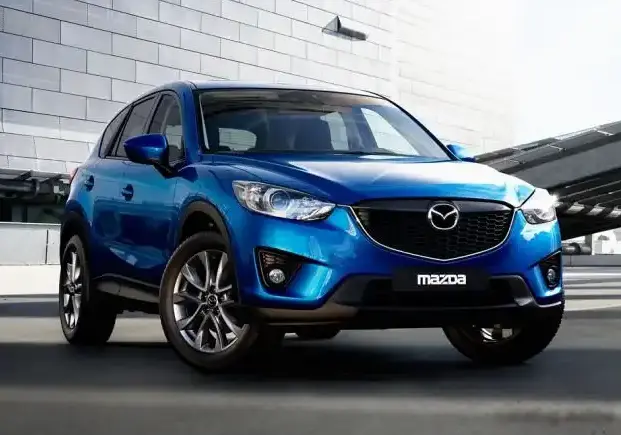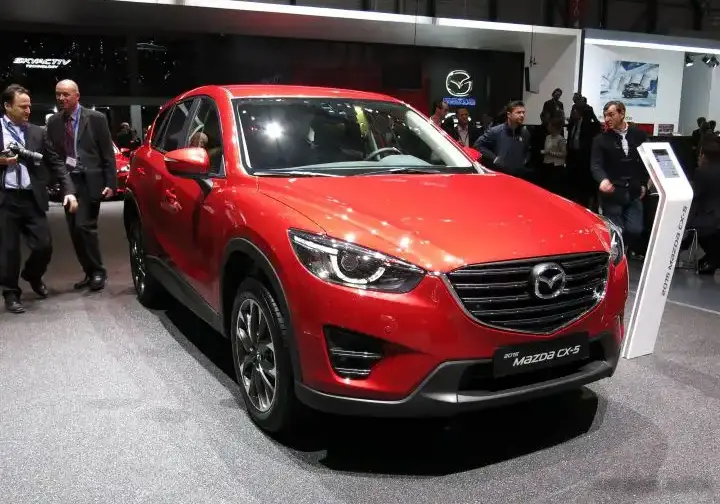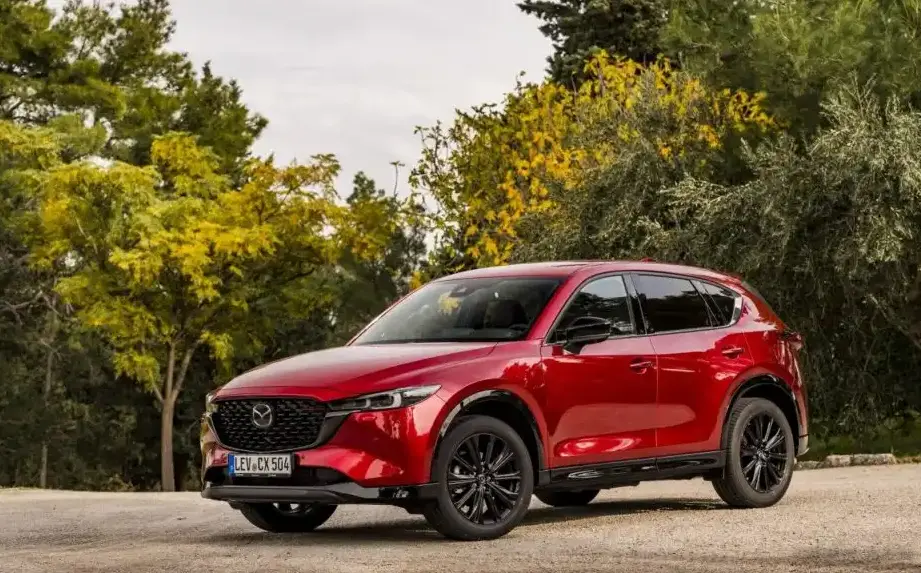
The Mazda CX-5 II (facelift 2021) 2.2 SKYACTIV-D 150 hp AWD represents a significant iteration of Mazda’s popular compact SUV, introduced in September 2021. This variant slots into the CX-5 lineup as a diesel-powered option offering a balance between fuel efficiency and respectable performance, primarily aimed at markets where diesel remains a popular choice. It builds upon the already successful second-generation CX-5 (KF series), incorporating styling refinements and updated technology. The 2.2 SKYACTIV-D engine, coupled with all-wheel drive, positions this trim as a practical and capable choice for drivers seeking a versatile SUV for both daily commuting and longer journeys.
Technical Specifications
| Brand | Mazda |
| Model | CX-5 |
| Generation | CX-5 II (facelift 2021) |
| Type (Engine) | 2.2 SKYACTIV-D (150 Hp) AWD |
| Start of production | September, 2021 |
| Powertrain Architecture | Internal Combustion engine |
| Body type | SUV |
| Seats | 5 |
| Doors | 5 |
| Fuel consumption at Low speed (WLTP) | 6.5-6.7 l/100 km (36.2 – 35.1 US mpg, 43.5 – 42.2 UK mpg, 15.4 – 14.9 km/l) |
| Fuel consumption at Medium speed (WLTP) | 5.9-6 l/100 km (39.9 – 39.2 US mpg, 47.9 – 47.1 UK mpg, 16.9 – 16.7 km/l) |
| Fuel consumption at high speed (WLTP) | 5.5-5.6 l/100 km (42.8 – 42 US mpg, 51.4 – 50.4 UK mpg, 18.2 – 17.9 km/l) |
| Fuel consumption at very high speed (WLTP) | 7 l/100 km (33.6 US mpg, 40.4 UK mpg, 14.3 km/l) |
| Combined fuel consumption (WLTP) | 6.3 l/100 km (37.3 US mpg, 44.8 UK mpg, 15.9 km/l) |
| CO2 emissions (WLTP) | 164-165 g/km |
| Fuel consumption (economy) – urban (NEDC) | 5.8 l/100 km (40.6 US mpg, 48.7 UK mpg, 17.2 km/l) |
| Fuel consumption (economy) – extra urban (NEDC) | 4.8 l/100 km (49 US mpg, 58.9 UK mpg, 20.8 km/l) |
| Fuel consumption (economy) – combined (NEDC) | 5.2 l/100 km (45.2 US mpg, 54.3 UK mpg, 19.2 km/l) |
| CO2 emissions (NEDC) | 137 g/km |
| Fuel Type | Diesel |
| Acceleration 0 – 100 km/h | 10.1 sec |
| Acceleration 0 – 62 mph | 10.1 sec |
| Acceleration 0 – 60 mph | 9.6 sec |
| Maximum speed | 199 km/h (123.65 mph) |
| Emission standard | Euro 6d |
| Weight-to-power ratio | 11.1 kg/Hp, 90.3 Hp/tonne |
| Weight-to-torque ratio | 4.4 kg/Nm, 228.8 Nm/tonne |
| Power | 150 Hp @ 4500 rpm |
| Power per litre | 68.5 Hp/l |
| Torque | 380 Nm @ 1800-2600 rpm (280.27 lb.-ft. @ 1800-2600 rpm) |
| Engine layout | Front, Transverse |
| Engine Model/Code | SHY6 |
| Engine displacement | 2191 cm3 (133.7 cu. in.) |
| Number of cylinders | 4 |
| Engine configuration | Inline |
| Cylinder Bore | 86 mm (3.39 in.) |
| Piston Stroke | 94.3 mm (3.71 in.) |
| Compression ratio | 14.4:1 |
| Number of valves per cylinder | 4 |
| Fuel injection system | Diesel Commonrail |
| Engine aspiration | Turbocharger, Intercooler |
| Valvetrain | DOHC |
| Engine oil capacity | 5.1 l (5.39 US qt | 4.49 UK qt) |
| Coolant | 8.7 l (9.19 US qt | 7.65 UK qt) |
| Kerb Weight | 1661-1711 kg (3661.88 – 3772.11 lbs.) |
| Max. weight | 2220 kg (4894.26 lbs.) |
| Max load | 509-559 kg (1122.15 – 1232.38 lbs.) |
| Trunk (boot) space – minimum | 510 l (18.01 cu. ft.) |
| Trunk (boot) space – maximum | 1626 l (57.42 cu. ft.) |
| Fuel tank capacity | 58 l (15.32 US gal | 12.76 UK gal) |
| Max. roof load | 75 kg (165.35 lbs.) |
| Permitted trailer load with brakes (8%) | 2100 kg (4629.71 lbs.) |
| Permitted trailer load with brakes (12%) | 2000 kg (4409.25 lbs.) |
| Permitted trailer load without brakes | 750 kg (1653.47 lbs.) |
| Length | 4575 mm (180.12 in.) |
| Width | 1845 mm (72.64 in.) |
| Width including mirrors | 2115 mm (83.27 in.) |
| Height | 1680-1685 mm (66.14 – 66.34 in.) |
| Wheelbase | 2700 mm (106.3 in.) |
| Front track | 1595 mm (62.8 in.) |
| Rear (Back) track | 1595 mm (62.8 in.) |
| Front overhang | 965 mm (37.99 in.) |
| Rear overhang | 910 mm (35.83 in.) |
| Ride height (ground clearance) | 192-200 mm (7.56 – 7.87 in.) |
| Minimum turning circle (turning diameter) | 11 m (36.09 ft.) |
| Drivetrain Architecture | The Internal combustion engine (ICE) drives the front wheels permanently, and the rear wheels are driven through an electrically or mechanically operated clutch if necessary. |
| Drive wheel | All wheel drive (4×4) |
| Number of gears and type of gearbox | 6 gears, manual transmission |
| Front suspension | Independent type McPherson |
| Rear suspension | Independent multi-link suspension |
| Front brakes | Ventilated discs, 320 mm |
| Rear brakes | Disc, 303 mm |
| Assisting systems | ABS (Anti-lock braking system) |
| Steering type | Steering rack and pinion |
| Power steering | Electric Steering |
| Tires size | 225/65 R17; 225/55 R19 |
| Wheel rims size | 7J x 17; 7J x 19 |
INTRODUCTION
The Mazda CX-5 II (facelift 2021) 2.2 SKYACTIV-D 150 hp AWD is a five-seat compact SUV that represents a mid-cycle refresh of the second-generation CX-5. Introduced in 2017, the second generation CX-5 quickly gained popularity for its refined driving dynamics, upscale interior, and attractive styling. The 2021 facelift brought subtle exterior updates, enhanced interior features, and improvements to the vehicle’s safety systems. This particular variant, powered by the 2.2-liter SKYACTIV-D diesel engine producing 150 horsepower, and equipped with all-wheel drive, was primarily targeted towards European and Asian markets where diesel engines continue to hold a significant share of the automotive landscape. It offered a compelling alternative to gasoline-powered CX-5 models, emphasizing fuel economy and torque for comfortable long-distance cruising.
Powertrain & Engine Architecture
At the heart of the CX-5 II 2.2 SKYACTIV-D 150 hp AWD lies Mazda’s SHY6 engine, a 2.2-liter four-cylinder diesel engine. This engine is a key component of Mazda’s SKYACTIV technology, designed to maximize efficiency and minimize emissions. The SHY6 utilizes a high compression ratio of 14.4:1, contributing to its thermal efficiency. It employs a common-rail direct injection system, delivering fuel directly into the combustion chamber at extremely high pressure for optimized combustion. The engine also features a variable geometry turbocharger (VGT) and an intercooler to enhance power output and reduce turbo lag. The engine’s DOHC (Double Overhead Camshaft) valvetrain further optimizes airflow for improved performance. The 6-speed manual transmission is standard, providing precise gear changes and contributing to the vehicle’s engaging driving experience.
Driving Characteristics
The 150 hp SKYACTIV-D engine, while not the most powerful option in the CX-5 lineup, delivers a respectable level of performance. Acceleration from 0-60 mph takes approximately 9.6 seconds, and the vehicle has a top speed of 199 km/h (123.65 mph). The engine’s strong low-end torque (380 Nm or 280.27 lb-ft) makes it well-suited for everyday driving and overtaking maneuvers. The all-wheel-drive system provides enhanced traction and stability, particularly in adverse weather conditions. Compared to the higher-output diesel variants or the gasoline-powered CX-5s, this 150 hp version prioritizes fuel efficiency over outright performance. The 6-speed manual transmission offers a more engaging driving experience than an automatic, allowing drivers to maintain control over gear selection and engine speed. However, it requires more driver involvement, especially in stop-and-go traffic.
Equipment & Trim Levels
The CX-5 II 2.2 SKYACTIV-D 150 hp AWD typically came equipped with a comprehensive range of standard features. These included automatic headlights, rain-sensing wipers, a 7-inch infotainment screen with Mazda Connect, Bluetooth connectivity, and a rearview camera. Higher trim levels offered additional features such as leather upholstery, a premium sound system, a sunroof, and advanced safety technologies like adaptive cruise control, lane departure warning, and blind-spot monitoring. Interior upholstery was typically cloth on base models, with leather options available on higher trims. Dashboard configuration was consistent across the range, featuring a clean and modern design with a focus on ergonomics.
Chassis & Braking
The CX-5 II utilizes a robust chassis with independent suspension on all four wheels. The front suspension employs a McPherson strut setup, while the rear features a multi-link design. This configuration provides a comfortable ride quality and responsive handling. The vehicle is equipped with ventilated disc brakes at the front and solid disc brakes at the rear, providing adequate stopping power. Anti-lock Braking System (ABS) is standard, enhancing safety during emergency braking situations. Stabilizer bars are fitted to both the front and rear axles to reduce body roll during cornering.
Market Reception & Comparison
The Mazda CX-5 II 2.2 SKYACTIV-D 150 hp AWD was generally well-received by automotive critics. It was praised for its fuel efficiency, comfortable ride, and refined driving dynamics. However, some reviewers noted that the 150 hp engine could feel underpowered when fully loaded or when tackling steep inclines. Compared to the 2.0-liter gasoline engine, the diesel variant offered significantly better fuel economy, but at a slightly higher purchase price. Compared to the more powerful diesel options, it provided a more affordable entry point into the CX-5 diesel range.
Legacy
The SHY6 2.2 SKYACTIV-D engine has proven to be a reliable and durable powertrain. While diesel engines have faced increased scrutiny in recent years due to emissions concerns, the SKYACTIV-D engines have generally demonstrated good longevity. On the used car market, the CX-5 II 2.2 SKYACTIV-D 150 hp AWD remains a popular choice for buyers seeking a fuel-efficient and practical SUV. Regular maintenance, including oil changes and filter replacements, is crucial for ensuring the long-term reliability of this powertrain. The combination of Mazda’s engineering expertise and the inherent durability of the diesel engine contribute to the continued appeal of this variant.