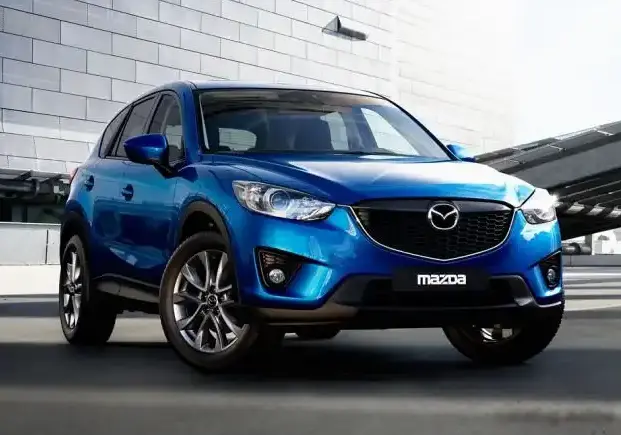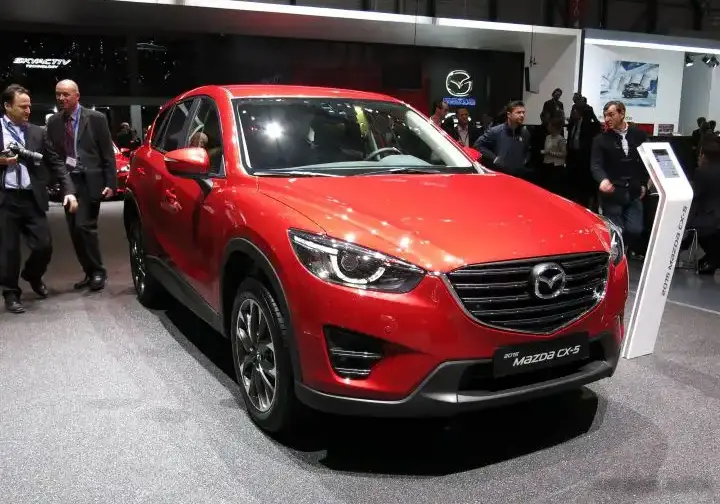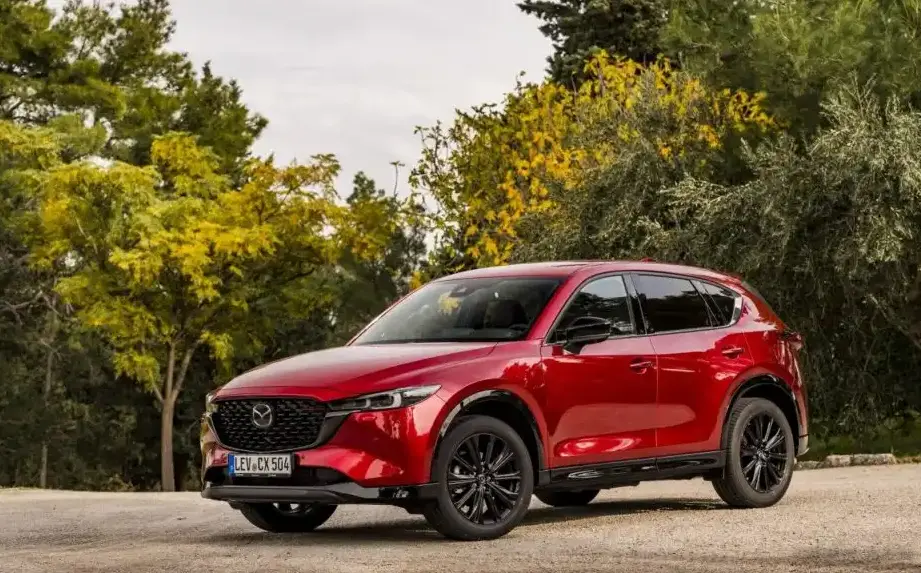
The Mazda CX-5 II (facelift 2021) 2.2 SKYACTIV-D 184 Hp represents a significant iteration of Mazda’s popular compact SUV, introduced in September 2021. This variant slots into the mid-range of the CX-5 lineup, offering a balance between performance, fuel efficiency, and refinement. It builds upon the foundation of the second-generation CX-5 (KF series), incorporating styling updates, technological enhancements, and refined powertrain options. The CX-5, since its initial release, has been a key model for Mazda, demonstrating the company’s commitment to driving dynamics and premium interior quality within the competitive crossover segment, particularly in European and North American markets.
Technical Specifications
| Brand | Mazda |
| Model | CX-5 |
| Generation | CX-5 II (facelift 2021) |
| Type (Engine) | 2.2 SKYACTIV-D (184 Hp) |
| Start of production | September, 2021 |
| Powertrain Architecture | Internal Combustion engine |
| Body type | SUV |
| Seats | 5 |
| Doors | 5 |
| Fuel consumption at Low speed (WLTP) | 6.2 l/100 km (37.9 US mpg, 45.6 UK mpg, 16.1 km/l) |
| Fuel consumption at Medium speed (WLTP) | 5.3 l/100 km (44.4 US mpg, 53.3 UK mpg, 18.9 km/l) |
| Fuel consumption at high speed (WLTP) | 4.7 l/100 km (50 US mpg, 60.1 UK mpg, 21.3 km/l) |
| Fuel consumption at very high speed (WLTP) | 6.3 l/100 km (37.3 US mpg, 44.8 UK mpg, 15.9 km/l) |
| Combined fuel consumption (WLTP) | 5.6 l/100 km (42 US mpg, 50.4 UK mpg, 17.9 km/l) |
| CO2 emissions (WLTP) | 147 g/km |
| Fuel consumption (economy) – urban (NEDC) | 5.5 l/100 km (42.8 US mpg, 51.4 UK mpg, 18.2 km/l) |
| Fuel consumption (economy) – extra urban (NEDC) | 4.5 l/100 km (52.3 US mpg, 62.8 UK mpg, 22.2 km/l) |
| Fuel consumption (economy) – combined (NEDC) | 4.9 l/100 km (48 US mpg, 57.6 UK mpg, 20.4 km/l) |
| CO2 emissions (NEDC) | 128 g/km |
| Fuel Type | Diesel |
| Acceleration 0 – 100 km/h | 9.2 sec |
| Acceleration 0 – 62 mph | 9.2 sec |
| Acceleration 0 – 60 mph | 8.7 sec |
| Maximum speed | 214 km/h (132.97 mph) |
| Emission standard | Euro 6d |
| Weight-to-power ratio | 8.8 kg/Hp, 114.1 Hp/tonne |
| Weight-to-torque ratio | 3.6 kg/Nm, 276.1 Nm/tonne |
| Power | 184 Hp @ 4000 rpm |
| Torque | 445 Nm @ 2000 rpm (328.22 lb.-ft. @ 2000 rpm) |
| Engine layout | Front, Transverse |
| Engine Model/Code | SHY8 |
| Engine displacement | 2191 cm3 (133.7 cu. in.) |
| Number of cylinders | 4 |
| Engine configuration | Inline |
| Cylinder Bore | 86 mm (3.39 in.) |
| Piston Stroke | 94.3 mm (3.71 in.) |
| Compression ratio | 14.4:1 |
| Number of valves per cylinder | 4 |
| Fuel injection system | Diesel Commonrail |
| Engine aspiration | Turbocharger, Intercooler |
| Valvetrain | DOHC |
| Engine oil capacity | 5.1 l (5.39 US qt | 4.49 UK qt) |
| Coolant | 8.7 l (9.19 US qt | 7.65 UK qt) |
| Kerb Weight | 1612-1648 kg (3553.85 – 3633.22 lbs.) |
| Max. weight | 2143 kg (4724.51 lbs.) |
| Max load | 495-531 kg (1091.29 – 1170.65 lbs.) |
| Trunk (boot) space – minimum | 510 l (18.01 cu. ft.) |
| Trunk (boot) space – maximum | 1626 l (57.42 cu. ft.) |
| Fuel tank capacity | 56 l (14.79 US gal | 12.32 UK gal) |
| Max. roof load | 75 kg (165.35 lbs.) |
| Permitted trailer load with brakes (8%) | 2000 kg (4409.25 lbs.) |
| Permitted trailer load with brakes (12%) | 2000 kg (4409.25 lbs.) |
| Permitted trailer load without brakes | 750 kg (1653.47 lbs.) |
| Length | 4575 mm (180.12 in.) |
| Width | 1845 mm (72.64 in.) |
| Width including mirrors | 2115 mm (83.27 in.) |
| Height | 1680-1685 mm (66.14 – 66.34 in.) |
| Wheelbase | 2700 mm (106.3 in.) |
| Front track | 1595 mm (62.8 in.) |
| Rear (Back) track | 1595 mm (62.8 in.) |
| Front overhang | 965 mm (37.99 in.) |
| Rear overhang | 910 mm (35.83 in.) |
| Ride height (ground clearance) | 192-200 mm (7.56 – 7.87 in.) |
| Minimum turning circle (turning diameter) | 11 m (36.09 ft.) |
| Drivetrain Architecture | The Internal combustion engine (ICE) drives the front wheels of the vehicle. |
| Drive wheel | Front wheel drive |
| Number of gears and type of gearbox | 6 gears, manual transmission |
| Front suspension | Independent type McPherson |
| Rear suspension | Independent multi-link suspension |
| Front brakes | Ventilated discs, 320 mm |
| Rear brakes | Disc, 303 mm |
| Assisting systems | ABS (Anti-lock braking system) |
| Steering type | Steering rack and pinion |
| Power steering | Electric Steering |
| Tires size | 225/65 R17; 225/55 R19 |
| Wheel rims size | 7J x 17; 7J x 19 |
INTRODUCTION
The 2.2 SKYACTIV-D engine in the 2021 CX-5 II represents Mazda’s continued refinement of diesel technology. This engine, part of the SKYACTIV suite of innovations, is designed to deliver a balance of power, efficiency, and reduced emissions. The 184 horsepower variant, paired with a six-speed automatic transmission, was positioned as a popular choice for buyers seeking a capable and economical SUV. It offered a step up in performance from the base 2.0-liter gasoline engine while remaining more affordable and fuel-efficient than the higher-output diesel options. The facelifted CX-5 II aimed to enhance the model’s appeal with updated styling, improved interior materials, and enhanced safety features.
Powertrain & Engine Architecture
The SHY8 2.2-liter SKYACTIV-D engine is a four-cylinder diesel featuring a high compression ratio of 14.4:1. This high compression, combined with a sophisticated common-rail direct injection system and a variable geometry turbocharger, contributes to both its power output and fuel efficiency. Mazda’s SKYACTIV technology focuses on optimizing combustion, reducing internal friction, and improving thermal efficiency. The engine utilizes a dual-mass flywheel to minimize vibrations and enhance driving comfort. The six-speed automatic transmission is designed to provide smooth and responsive shifts, with a focus on maintaining optimal engine speed for both performance and fuel economy. The transmission features a torque converter lock-up clutch to improve efficiency at cruising speeds.
Driving Characteristics
The CX-5 II 2.2 SKYACTIV-D 184 Hp offers a composed and refined driving experience. While not as overtly sporty as some competitors, it provides ample power for everyday driving and highway cruising. The 445 Nm (328.22 lb.-ft.) of torque, available from 2000 rpm, provides strong acceleration in most situations. The automatic transmission generally shifts smoothly, although it can occasionally feel hesitant during quick downshifts. Compared to the higher-output 184 hp diesel versions, this variant offers a slightly less aggressive throttle response. However, it provides a more relaxed and fuel-efficient driving experience, making it well-suited for long-distance journeys. The front-wheel-drive configuration contributes to a lighter overall weight, further enhancing fuel economy.
Equipment & Trim Levels
The 2.2 SKYACTIV-D 184 Hp variant of the CX-5 II typically came equipped with a generous level of standard features. These included automatic climate control, a 7-inch infotainment screen with Mazda Connect, Bluetooth connectivity, and a rearview camera. Higher trim levels added features such as leather upholstery, a premium sound system, a power liftgate, and advanced safety technologies like adaptive cruise control and lane departure warning. Optional extras included a sunroof, navigation system, and a 360-degree view camera. Interior upholstery generally consisted of cloth or a combination of cloth and synthetic leather, depending on the trim level.
Chassis & Braking
The CX-5 II utilizes a MacPherson strut front suspension and a multi-link rear suspension, providing a comfortable and controlled ride. The suspension is tuned to balance handling and ride quality, offering a good compromise between agility and comfort. The braking system consists of ventilated discs at the front and solid discs at the rear. Anti-lock braking system (ABS) and electronic brakeforce distribution (EBD) are standard features. The steering is an electric power-assisted rack and pinion system, providing precise and responsive steering feel.
Market Reception & Comparison
The Mazda CX-5 II 2.2 SKYACTIV-D 184 Hp was generally well-received by automotive critics. It was praised for its fuel efficiency, comfortable ride, and refined interior. Compared to the gasoline-powered CX-5, the diesel variant offered significantly better fuel economy and torque. However, some critics noted that the diesel engine was slightly noisier than the gasoline engine. Compared to other diesel SUVs in its class, the CX-5 offered a more engaging driving experience and a more premium interior. Its fuel economy figures were competitive, and its reliability was generally considered to be good.
Legacy
The SHY8 2.2 SKYACTIV-D engine has proven to be a reliable and durable powertrain. While diesel engines, in general, have faced increased scrutiny regarding emissions, Mazda’s SKYACTIV-D technology has helped to mitigate these concerns. On the used car market, the CX-5 II 2.2 SKYACTIV-D 184 Hp remains a popular choice, offering a compelling combination of value, efficiency, and refinement. Regular maintenance, including oil changes and filter replacements, is crucial for ensuring the long-term reliability of this powertrain. The engine’s robust construction and Mazda’s reputation for quality contribute to its continued appeal in the used car market.