Technical Specifications
| Brand | Mazda |
| Model | CX-7 |
| Generation | CX-7 |
| Type (Engine) | 2.3 DISI Turbo (244 Hp) Automatic |
| Start of production | 2006 |
| End of production | 2009 |
| Powertrain Architecture | Internal Combustion engine |
| Body type | SUV, Crossover |
| Seats | 5 |
| Doors | 5 |
| Fuel consumption (urban) | 12.4-13.8 l/100 km (19-17 US mpg) |
| Fuel consumption (extra urban) | 9.8-10.2 l/100 km (24-23.1 US mpg) |
| Fuel Type | Petrol (Gasoline) |
| Emission standard | LEV II |
| Weight-to-power ratio | 6.9 kg/Hp |
| Weight-to-torque ratio | 4.8 kg/Nm |
| Power | 244 Hp @ 5000 rpm |
| Power per litre | 107.9 Hp/l |
| Torque | 350 Nm @ 2500 rpm (258.15 lb.-ft. @ 2500 rpm) |
| Maximum engine speed | 6700 rpm |
| Engine layout | Front, Transverse |
| Engine Model/Code | L3-VDT |
| Engine displacement | 2261 cm3 (137.97 cu. in.) |
| Number of cylinders | 4 |
| Engine configuration | Inline |
| Cylinder Bore | 87.5 mm (3.44 in.) |
| Piston Stroke | 94 mm (3.7 in.) |
| Compression ratio | 9.5:1 |
| Number of valves per cylinder | 4 |
| Fuel injection system | Direct injection |
| Engine aspiration | Turbocharger, Intercooler |
| Valvetrain | DOHC |
| Engine oil capacity | 5.7 l (6.02 US qt | 5.02 UK qt) |
| Coolant capacity | 9 l (9.51 US qt | 7.92 UK qt) |
| Kerb Weight | 1683 kg (3710.38 lbs.) |
| Max. weight | 2168 kg (4779.62 lbs.) |
| Max load | 485 kg (1069.24 lbs.) |
| Trunk (boot) space – minimum | 847 l (29.91 cu. ft.) |
| Trunk (boot) space – maximum | 1659 l (58.59 cu. ft.) |
| Fuel tank capacity | 69 l (18.23 US gal | 15.18 UK gal) |
| Permitted trailer load with brakes (12%) | 907 kg (1999.59 lbs.) |
| Length | 4675 mm (184.06 in.) |
| Width | 1872 mm (73.7 in.) |
| Height | 1645 mm (64.76 in.) |
| Wheelbase | 2750 mm (108.27 in.) |
| Front track | 1617 mm (63.66 in.) |
| Rear track | 1612 mm (63.46 in.) |
| Ride height (ground clearance) | 206 mm (8.11 in.) |
| Minimum turning circle | 11.4 m (37.4 ft.) |
| Drivetrain Architecture | Front wheel drive |
| Number of gears | 6 |
| Gearbox type | Automatic transmission |
| Front suspension | Independent, McPherson with coil spring and anti-roll bar |
| Rear suspension | Independent multi-link with stabilizer |
| Front brakes | Ventilated discs |
| Rear brakes | Ventilated discs |
| Assisting systems | ABS |
| Steering type | Steering rack and pinion |
| Power steering | Electric |
| Tires size | 235/60 R18 |
| Wheel rims size | 7.5J x 18 |
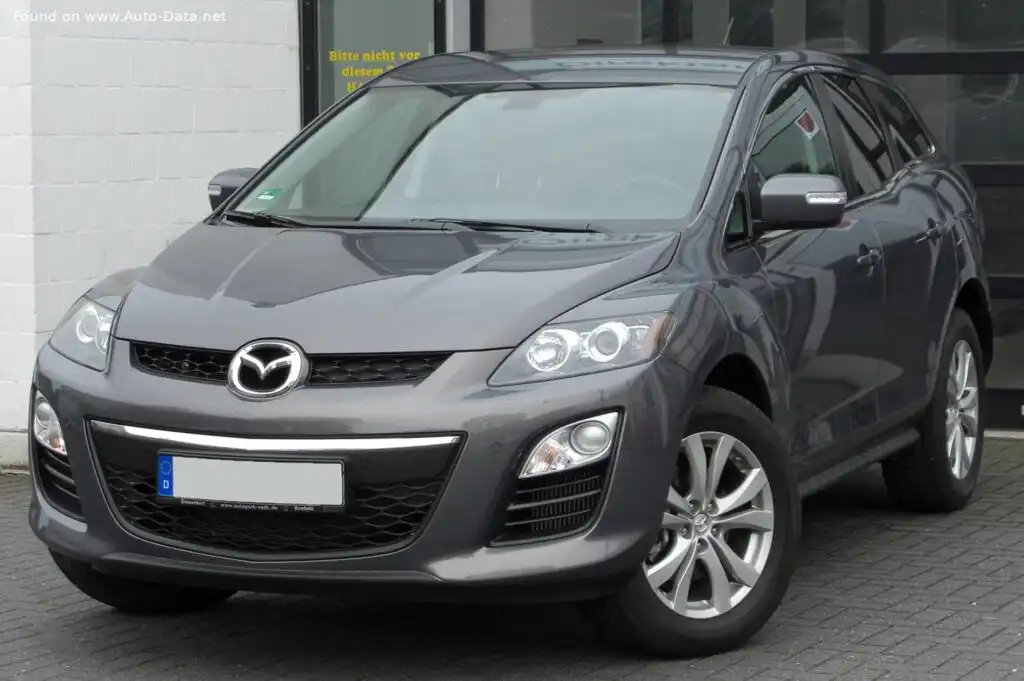
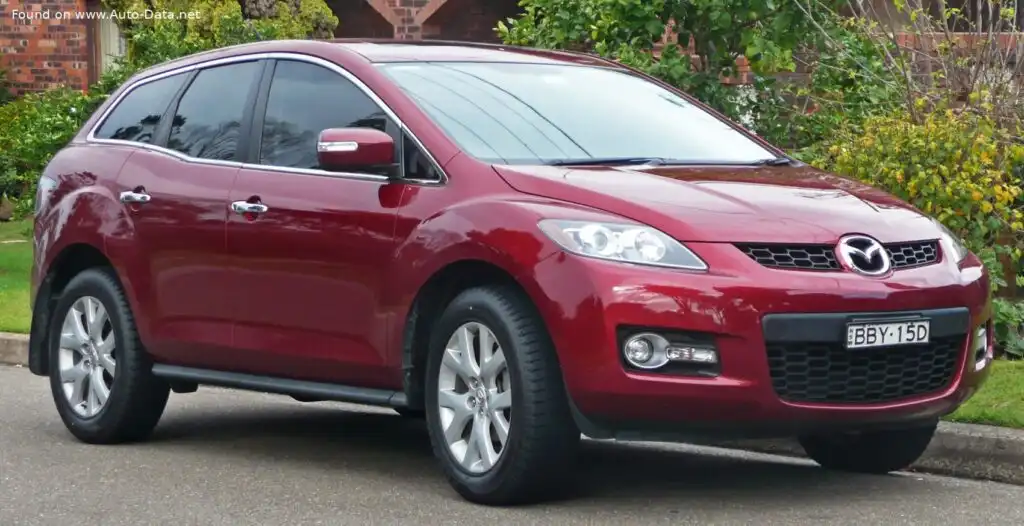
The Mazda CX-7 2.3 DISI Turbo Automatic, launched in 2006, was a pivotal model for Mazda, showcasing the brand’s “Zoom-Zoom” philosophy within the growing crossover SUV segment. Built on the Ford/Mazda jointly developed C1 platform (also known as the 1HX0/A3 platform), the CX-7 aimed to provide a more engaging driving experience than many of its competitors. The 2.3 DISI Turbo variant, with its direct injection spark ignition engine, was positioned as the performance-oriented choice, offering a significant power upgrade over the base 2.5L engine. Production continued through 2009, with minor updates to features and trim levels over its lifespan.
Powertrain & Engine Architecture
At the heart of the CX-7 2.3 DISI Turbo lies the L3-VDT engine, a 2.3-liter inline-four cylinder powerplant. “DISI” stands for Direct Injection Spark Ignition, a technology that combines the benefits of both direct and port fuel injection. At low engine speeds, fuel is injected into the intake ports for cleaner combustion, while at higher speeds, direct injection into the cylinders provides increased power and efficiency. The engine utilizes a single-scroll turbocharger with an intercooler to boost output to 244 horsepower at 5000 rpm and 350 Nm (258 lb-ft) of torque at 2500 rpm. The engine features a double overhead camshaft (DOHC) valvetrain with four valves per cylinder. The six-speed automatic transmission, sourced from Aisin, was specifically tuned to handle the increased torque output of the turbocharged engine. It featured manual shift capability, allowing drivers some control over gear selection.
Driving Characteristics
The CX-7 2.3 DISI Turbo Automatic offered a noticeably more spirited driving experience compared to its naturally aspirated sibling. The turbocharger provided a surge of power in the mid-range, making overtaking and merging onto highways relatively effortless. While not a sports car, the CX-7 handled corners with a degree of composure, thanks to its well-tuned suspension. The automatic transmission, while smooth, wasn’t particularly quick to downshift, and some drivers preferred the responsiveness of the available manual transmission. The gear ratios were optimized for a balance of acceleration and fuel economy, but the added weight of the turbocharger and all-wheel-drive system (available on some trims) did impact overall efficiency.
Equipment & Trim Levels
The CX-7 2.3 DISI Turbo Automatic was typically offered in higher trim levels, such as the Touring and Grand Touring. Standard features generally included air conditioning, power windows and locks, a CD player with auxiliary input, and keyless entry. Higher trims added features like leather upholstery, a sunroof, a premium sound system, and automatic climate control. Optional extras included navigation system, and upgraded alloy wheels. Interior materials were generally of good quality for the price point, and the cabin offered a comfortable and spacious environment for five passengers.
Chassis & Braking
The CX-7 utilized an independent suspension system at all four wheels. The front suspension employed a McPherson strut design with coil springs and an anti-roll bar, while the rear featured a multi-link setup with a stabilizer bar. This configuration provided a good balance of ride comfort and handling. Braking duties were handled by ventilated disc brakes on all four wheels, providing adequate stopping power. Anti-lock Braking System (ABS) was standard. The steering system was a rack-and-pinion setup with electric power steering, offering a responsive and precise feel.
Market Reception & Comparison
The Mazda CX-7 2.3 DISI Turbo Automatic was generally well-received by automotive critics. It was praised for its sporty handling, powerful engine, and stylish design. However, some reviewers noted the relatively small cargo area compared to some competitors and the somewhat firm ride quality. Compared to the base 2.5L CX-7, the 2.3 DISI Turbo offered a significant performance advantage, but at a higher price point and with slightly lower fuel economy. Compared to rivals like the Honda CR-V and Toyota RAV4, the CX-7 prioritized driving dynamics over outright practicality.
Legacy
The Mazda CX-7 2.3 DISI Turbo Automatic, while discontinued in 2009, remains a popular choice in the used car market. The L3-VDT engine, while generally reliable, is known to require regular maintenance, particularly regarding oil changes and turbocharger health. The direct injection system can also be prone to carbon buildup over time, potentially affecting performance. However, with proper care, the powertrain can provide many years of reliable service. The CX-7’s sporty character and distinctive styling continue to appeal to buyers seeking a crossover SUV that offers a more engaging driving experience than the typical offerings in its class.