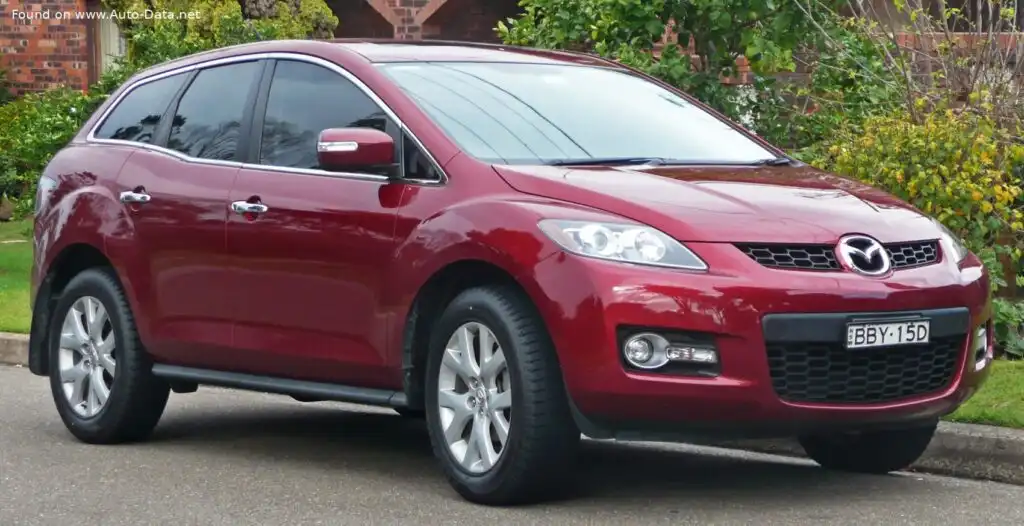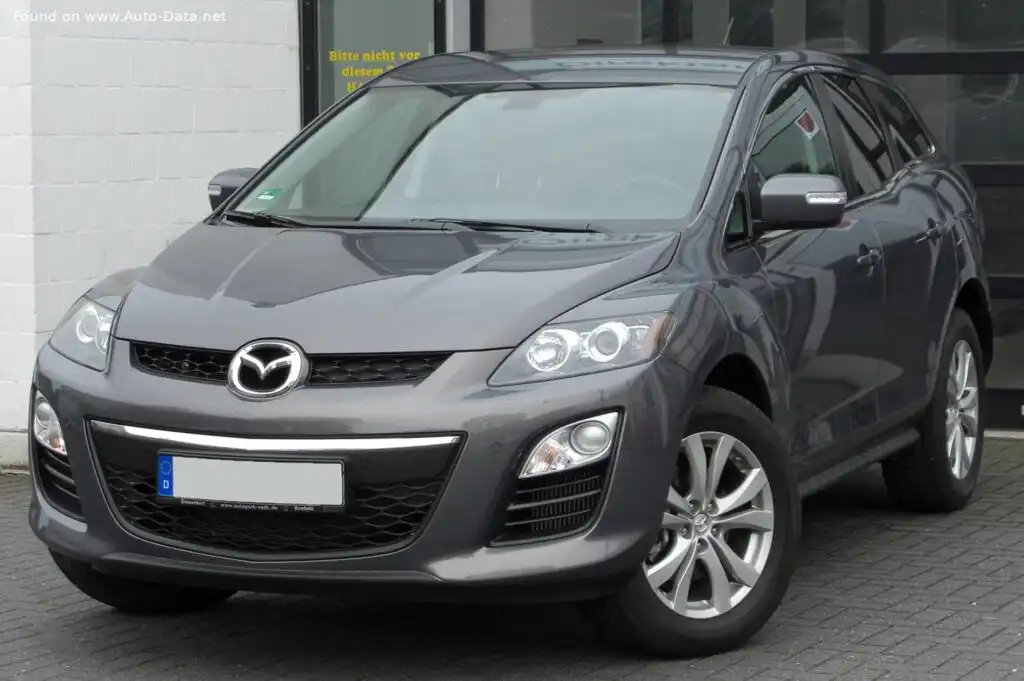
The Mazda CX-7 (facelift, 2009) 2.2 MZR-CD 173 hp AWD represents a mid-cycle refresh of Mazda’s foray into the compact crossover SUV segment. Introduced in October 2009 and continuing through 2012, this variant combined a diesel engine with all-wheel drive, primarily aimed at the European and Asian markets where diesel fuel was more prevalent and cost-effective. It sat within the CX-7 range as a mid-range offering, positioned between the lower-powered gasoline variants and potential higher-specification trims. The facelift brought styling updates and refinements to the original CX-7, which debuted in 2006, enhancing its appeal in a competitive market.
Technical Specifications
| Brand | Mazda |
| Model | CX-7 |
| Generation | CX-7 (facelift 2009) |
| Type (Engine) | 2.2 MZR-CD (173 Hp) AWD |
| Start of production | October, 2009 |
| End of production | 2012 |
| Powertrain Architecture | Internal Combustion engine |
| Body type | SUV, Crossover |
| Seats | 5 |
| Doors | 5 |
| Fuel consumption (economy) – urban (NEDC) | 9.1 l/100 km (25.8 US mpg, 31 UK mpg, 11 km/l) |
| Fuel consumption (economy) – extra urban (NEDC) | 6.6 l/100 km (35.6 US mpg, 42.8 UK mpg, 15.2 km/l) |
| Fuel consumption (economy) – combined (NEDC) | 7.5 l/100 km (31.4 US mpg, 37.7 UK mpg, 13.3 km/l) |
| CO2 emissions (NEDC) | 199 g/km |
| Fuel Type | Diesel |
| Acceleration 0 – 100 km/h | 11.3 sec |
| Acceleration 0 – 62 mph | 11.3 sec |
| Acceleration 0 – 60 mph | 10.7 sec |
| Maximum speed | 200 km/h (124.27 mph) |
| Emission standard | Euro 5 |
| Weight-to-power ratio | 10.3 kg/Hp, 96.6 Hp/tonne |
| Weight-to-torque ratio | 4.5 kg/Nm, 223.5 Nm/tonne |
| Power | 173 Hp @ 3500 rpm |
| Power per litre | 79.2 Hp/l |
| Torque | 400 Nm @ 2000 rpm (295.02 lb.-ft. @ 2000 rpm) |
| Engine layout | Front, Transverse |
| Engine Model/Code | R2AA |
| Engine displacement | 2184 cm3 (133.28 cu. in.) |
| Number of cylinders | 4 |
| Engine configuration | Inline |
| Cylinder Bore | 86 mm (3.39 in.) |
| Piston Stroke | 94 mm (3.7 in.) |
| Compression ratio | 16.3:1 |
| Number of valves per cylinder | 4 |
| Fuel injection system | Diesel Commonrail |
| Engine aspiration | Turbocharger, Intercooler |
| Valvetrain | DOHC |
| Engine oil capacity | 4.7 l (4.97 US qt | 4.14 UK qt) |
| Coolant | 9 l (9.51 US qt | 7.92 UK qt) |
| Kerb Weight | 1790 kg (3946.27 lbs.) |
| Max. weight | 2430 kg (5357.23 lbs.) |
| Max load | 640 kg (1410.96 lbs.) |
| Trunk (boot) space – minimum | 455 l (16.07 cu. ft.) |
| Trunk (boot) space – maximum | 774 l (27.33 cu. ft.) |
| Fuel tank capacity | 69 l (18.23 US gal | 15.18 UK gal) |
| Max. roof load | 100 kg (220.46 lbs.) |
| Permitted trailer load with brakes (12%) | 1800 kg (3968.32 lbs.) |
| Permitted trailer load without brakes | 750 kg (1653.47 lbs.) |
| Length | 4700 mm (185.04 in.) |
| Width | 1870 mm (73.62 in.) |
| Height | 1645 mm (64.76 in.) |
| Wheelbase | 2750 mm (108.27 in.) |
| Front track | 1615 mm (63.58 in.) |
| Rear (Back) track | 1610 mm (63.39 in.) |
| Ride height (ground clearance) | 207 mm (8.15 in.) |
| Minimum turning circle (turning diameter) | 12.2 m (40.03 ft.) |
| Drivetrain Architecture | The Internal combustion engine (ICE) drives the front wheels permanently, and the rear wheels are driven through an electrically or mechanically operated clutch if necessary. |
| Drive wheel | All wheel drive (4×4) |
| Number of gears and type of gearbox | 6 gears, manual transmission |
| Front suspension | Independent, type McPherson with coil spring and anti-roll bar |
| Rear suspension | Independent multi-link spring suspension with stabilizer |
| Front brakes | Ventilated discs, 320 mm |
| Rear brakes | Ventilated discs, 325 mm |
| Assisting systems | ABS (Anti-lock braking system) |
| Steering type | Steering rack and pinion |
| Power steering | Electric Steering |
| Tires size | 235/55 R19 |
| Wheel rims size | 7.5J x 19 |
INTRODUCTION
The 2009 facelift of the Mazda CX-7, equipped with the 2.2-liter MZR-CD diesel engine and all-wheel drive, was a significant offering for Mazda, particularly in markets receptive to diesel technology. Building upon the original CX-7 launched in 2006, the facelift addressed some criticisms of the earlier model, focusing on interior refinement and exterior styling. This variant aimed to provide a balance of fuel efficiency, reasonable performance, and the added security of all-wheel drive. It was positioned as a practical and stylish crossover, appealing to families and individuals seeking a versatile vehicle for both urban and occasional off-road use. The CX-7, in general, was Mazda’s first entry into the growing crossover SUV segment, and the 2.2 MZR-CD AWD model represented a key component of its European and Asian strategy.
Powertrain & Engine Architecture
The heart of this CX-7 variant is the 2.2-liter MZR-CD four-cylinder diesel engine, bearing the internal code R2AA. This engine is a common-rail direct injection diesel, utilizing a high-pressure fuel system for optimized combustion. The MZR-CD series engines were known for their relatively quiet operation for diesels, achieved through careful engineering of the combustion process and the inclusion of noise-reducing technologies. The engine features a single turbocharger with an intercooler, boosting power output to 173 horsepower at 3500 rpm and a substantial 400 Nm (295 lb-ft) of torque at 2000 rpm. The engine utilizes a double overhead camshaft (DOHC) valvetrain with four valves per cylinder, contributing to its efficient breathing and power delivery. The 6-speed manual transmission was standard, providing a good balance between fuel economy and driver engagement. The transmission’s gear ratios were tuned to maximize the diesel engine’s torque, providing strong acceleration in everyday driving situations.
Driving Characteristics
The CX-7 2.2 MZR-CD AWD offered a distinctly different driving experience compared to its gasoline-powered siblings. The high torque output of the diesel engine provided strong low-end and mid-range acceleration, making it feel more responsive in typical driving scenarios. While not a sports car, the CX-7 could accelerate from 0-100 km/h (0-62 mph) in approximately 11.3 seconds. The all-wheel-drive system enhanced traction, particularly on slippery surfaces, providing a sense of stability and confidence. Compared to the higher-output gasoline versions, the diesel offered superior fuel economy, making it a more economical choice for long-distance driving. However, the diesel engine was noticeably louder and less refined than the gasoline engines, a common characteristic of diesel technology at the time. The manual transmission, while engaging, required more driver involvement than the automatic transmissions offered on other CX-7 trims.
Equipment & Trim Levels
The 2.2 MZR-CD AWD trim typically included a respectable level of standard equipment. Features commonly found in this variant included air conditioning, power windows and locks, a CD/MP3 audio system, and alloy wheels. Safety features such as ABS, traction control, and multiple airbags were also standard. Higher trim levels offered optional extras such as leather upholstery, a sunroof, a navigation system, and premium audio systems. The interior design was generally functional and well-built, with a focus on practicality and durability. The dashboard layout was straightforward and easy to use, with logically placed controls. Interior color schemes typically included dark grays and blacks, with options for lighter accents.
Chassis & Braking
The CX-7’s chassis featured an independent suspension system at all four wheels. The front suspension utilized a McPherson strut design with coil springs and an anti-roll bar, while the rear suspension employed a multi-link setup, also with coil springs and a stabilizer bar. This suspension configuration provided a comfortable ride quality while maintaining reasonable handling characteristics. The braking system consisted of ventilated disc brakes on all four wheels, providing ample stopping power. The ABS (Anti-lock Braking System) helped to maintain steering control during emergency braking situations. The all-wheel-drive system employed a multi-plate clutch to distribute torque between the front and rear axles, optimizing traction based on road conditions.
Market Reception & Comparison
The Mazda CX-7 2.2 MZR-CD AWD was generally well-received by automotive critics, particularly in Europe and Asia. Reviewers praised its fuel efficiency, strong torque output, and comfortable ride. However, some criticisms were leveled at the engine’s noise and vibration levels, as well as the somewhat dated interior design compared to newer competitors. Compared to the gasoline-powered CX-7 variants, the diesel offered significantly better fuel economy, making it a more attractive option for drivers covering long distances. Compared to other diesel-powered crossovers in its class, the CX-7 offered a competitive combination of performance, features, and price. The manual transmission was seen as a plus by driving enthusiasts, but some buyers preferred the convenience of an automatic transmission.
Legacy
The Mazda CX-7 2.2 MZR-CD AWD, while not a massive sales success globally, established Mazda as a player in the compact crossover segment. The 2.2 MZR-CD engine proved to be a relatively reliable unit, although, like all diesel engines, it required regular maintenance and the use of high-quality diesel fuel. On the used car market, these models are generally sought after for their fuel efficiency and all-wheel-drive capability. However, potential buyers should be aware of the potential for diesel particulate filter (DPF) issues, particularly if the vehicle has been primarily used for short trips. Overall, the CX-7 2.2 MZR-CD AWD remains a practical and capable crossover, offering a unique blend of performance, efficiency, and style.