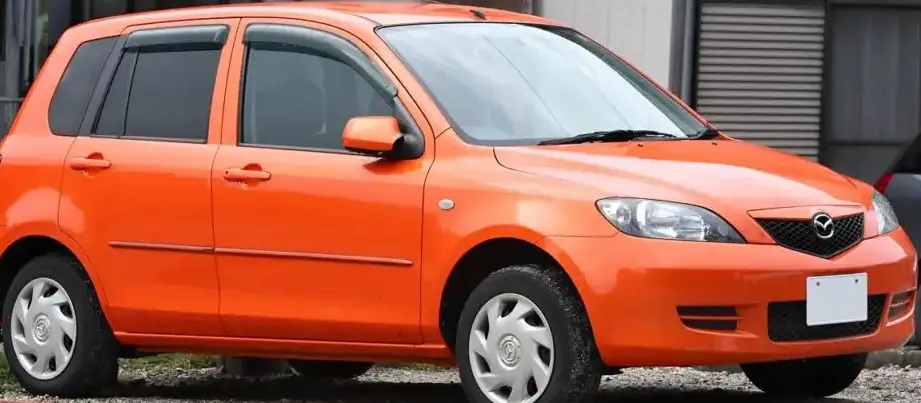
The Mazda Demio (DW) 1.3 16V, produced between 1998 and 2003, represented the entry point into the second generation of Mazda’s popular subcompact hatchback. Sold as the Mazda2 in many international markets, the Demio DW was a crucial model for Mazda, offering an affordable and practical vehicle in the highly competitive supermini segment. This specific 1.3-liter, 72 horsepower variant, typically paired with a five-speed manual transmission, was designed to appeal to budget-conscious buyers and those prioritizing fuel efficiency. It served as the foundation of the DW lineup, with higher trims offering larger engines and more features.
Technical Specifications
| Brand | Mazda |
| Model | Demio |
| Generation | Demio (DW) |
| Type (Engine) | 1.3 16V (72 Hp) |
| Start of production | 1998 |
| End of production | 2003 |
| Powertrain Architecture | Internal Combustion engine |
| Body type | Hatchback |
| Seats | 5 |
| Doors | 5 |
| Fuel consumption (urban) | 7-7.8 l/100 km (33.6 – 30.2 US mpg, 40.4 – 36.2 UK mpg, 14.3 – 12.8 km/l) |
| Fuel consumption (extra urban) | 6 l/100 km (39.2 US mpg, 47.1 UK mpg, 16.7 km/l) |
| Fuel consumption (combined) | 6.5-7 l/100 km (36.2 – 33.6 US mpg, 43.5 – 40.4 UK mpg, 15.4 – 14.3 km/l) |
| Fuel Type | Petrol (Gasoline) |
| Acceleration 0 – 100 km/h | 13.1 sec |
| Acceleration 0 – 62 mph | 13.1 sec |
| Acceleration 0 – 60 mph | 12.4 sec |
| Maximum speed | 170 km/h (105.63 mph) |
| Weight-to-power ratio | 13.2 kg/Hp, 75.8 Hp/tonne |
| Weight-to-torque ratio | 9 kg/Nm, 110.5 Nm/tonne |
| Power | 72 Hp @ 5500 rpm |
| Power per litre | 54.4 Hp/l |
| Torque | 105 Nm @ 3500 rpm (77.44 lb.-ft. @ 3500 rpm) |
| Engine layout | Front, Transverse |
| Engine displacement | 1324 cm3 (80.8 cu. in.) |
| Number of cylinders | 4 |
| Engine configuration | Inline |
| Cylinder Bore | 71 mm (2.8 in.) |
| Piston Stroke | 83.6 mm (3.29 in.) |
| Compression ratio | 9.4:1 |
| Number of valves per cylinder | 4 |
| Fuel injection system | Multi-port manifold injection |
| Engine aspiration | Naturally aspirated engine |
| Valvetrain | OHC |
| Kerb Weight | 950 kg (2094.39 lbs.) |
| Max. weight | 1450 kg (3196.7 lbs.) |
| Max load | 500 kg (1102.31 lbs.) |
| Trunk (boot) space – minimum | 330 l (11.65 cu. ft.) |
| Trunk (boot) space – maximum | 1298 l (45.84 cu. ft.) |
| Fuel tank capacity | 40 l (10.57 US gal | 8.8 UK gal) |
| Length | 3815 mm (150.2 in.) |
| Width | 1670 mm (65.75 in.) |
| Height | 1535 mm (60.43 in.) |
| Wheelbase | 2390 mm (94.09 in.) |
| Front track | 1420 mm (55.91 in.) |
| Rear (Back) track | 1418 mm (55.83 in.) |
| Drivetrain Architecture | The Internal combustion engine (ICE) drives the front wheels of the vehicle. |
| Drive wheel | Front wheel drive |
| Number of gears and type of gearbox | 5 gears, manual transmission |
| Front suspension | Spring Strut |
| Rear suspension | Coil spring |
| Front brakes | Ventilated discs |
| Rear brakes | Drum |
| Assisting systems | ABS (Anti-lock braking system) |
| Steering type | Steering rack and pinion |
| Power steering | Hydraulic Steering |
| Tires size | 165/70 R13 |
INTRODUCTION
The Mazda Demio DW, launched in 1998, represented a significant step forward for Mazda’s small car offerings. Built on the 1HX0/A3 platform, it shared underpinnings with the Ford Fiesta Mk5, a result of Mazda’s partnership with Ford at the time. The 1.3 16V variant was the entry-level model, designed to provide affordable transportation with reasonable fuel economy. It was primarily marketed towards first-time car buyers, city dwellers, and those seeking a practical and reliable hatchback. This model was particularly popular in Europe and Japan, where small, fuel-efficient cars are in high demand.
Powertrain & Engine Architecture
The heart of the Demio 1.3 16V is the Mazda B3 engine, specifically the B3-ME (EGI) variant. This 1.3-liter inline-four cylinder engine utilizes a single overhead camshaft (SOHC) valvetrain with four valves per cylinder. The engine employs multi-point fuel injection, contributing to improved fuel efficiency and smoother operation. The engine code ‘ME’ denotes the electronic fuel injection system. While not a powerhouse, the B3 engine was known for its reliability and relatively simple maintenance requirements. The five-speed manual transmission offered a decent spread of gears, allowing for reasonable acceleration and highway cruising. The transmission itself was a conventional design, prioritizing durability and ease of repair over outright performance.
Driving Characteristics
The Demio 1.3 16V offered a predictable and undemanding driving experience. With 72 horsepower and 105 Nm of torque, acceleration was modest, taking approximately 13.1 seconds to reach 62 mph. However, the light weight of the vehicle (around 950 kg) helped to mitigate the lack of outright power. The gear ratios were tuned for fuel efficiency, meaning the engine needed to be revved to extract the most performance. Compared to the higher-output 1.5-liter and 1.8-liter variants, the 1.3 felt noticeably slower, particularly when fully loaded or tackling steep inclines. The manual transmission provided a more engaging driving experience than the optional automatic, offering greater control and responsiveness.
Equipment & Trim Levels
The base-level Demio 1.3 16V was typically equipped with basic amenities. Standard features generally included power steering, central locking, electric front windows, and an adjustable steering column. Interior upholstery was typically a durable cloth material. Optional extras included air conditioning, alloy wheels, and a radio/cassette player. Higher trim levels, such as the GLX, added features like electric mirrors, a better stereo system, and upgraded interior trim. The overall interior design was functional and practical, prioritizing space and usability over luxury.
Chassis & Braking
The Demio DW featured a MacPherson strut front suspension and a coil spring rear suspension. This setup provided a comfortable ride quality, although it wasn’t particularly sporty. The front brakes were ventilated discs, offering adequate stopping power, while the rear brakes were drums, a cost-saving measure common in this class of vehicle. ABS (Anti-lock Braking System) was available as an option, enhancing safety in emergency braking situations. The steering was a rack and pinion system with hydraulic power assistance, providing light and precise steering feel.
Market Reception & Comparison
The Mazda Demio 1.3 16V was generally well-received by critics as a practical and affordable supermini. It was praised for its fuel efficiency, reliability, and spacious interior. However, some reviewers noted its lack of power and relatively basic equipment levels. Compared to rivals like the Ford Fiesta, Volkswagen Polo, and Peugeot 206, the Demio offered a competitive package, particularly in terms of value for money. The 1.5-liter and 1.8-liter Demio variants offered significantly more performance but came at a higher price point, appealing to a different segment of the market. The 1.3 was often seen as the sensible choice for those prioritizing economy and practicality.
Legacy
The Mazda Demio (DW) 1.3 16V has proven to be a remarkably durable and reliable vehicle. Many examples are still on the road today, testament to the quality of its engineering and construction. The B3 engine is known for its longevity, and parts availability remains relatively good. In the used car market, the 1.3 variant is often the most affordable Demio DW, making it an attractive option for budget-conscious buyers. While it may not offer the performance of its more powerful siblings, its simplicity, reliability, and fuel efficiency continue to make it a worthwhile consideration for those seeking a practical and affordable supermini.