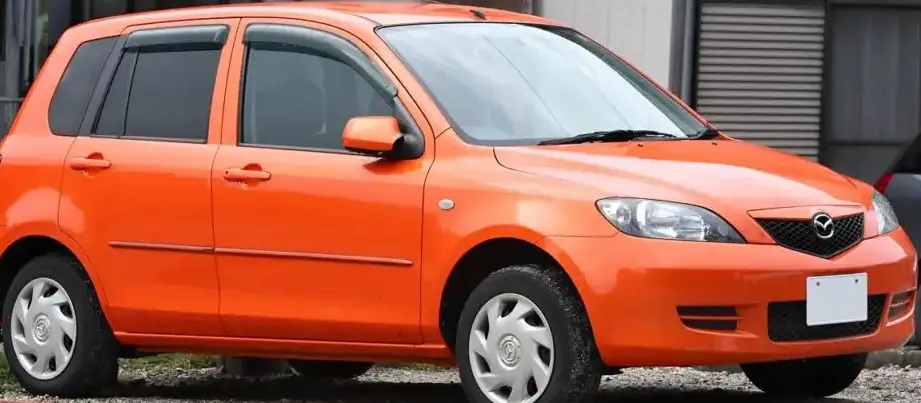
The Mazda Demio (DY) 1.3 i, producing 91 horsepower, was a key variant within the second-generation Demio (also known as the Mazda2) lineup, manufactured from 2003 to 2007. Positioned as the entry-level engine option in many markets, particularly in Europe and Asia, it offered an affordable and fuel-efficient choice for buyers seeking a compact hatchback. The DY generation represented a significant step forward for Mazda in terms of design and engineering, moving away from the more utilitarian aesthetic of its predecessor and embracing a more modern and stylish appearance. This specific 1.3-liter variant played a crucial role in attracting a broader customer base, offering a balance between practicality and economy.
Technical Specifications
| Brand | Mazda |
| Model | Demio |
| Generation | Demio (DY) |
| Type (Engine) | 1.3 i (91 Hp) |
| Start of production | 2003 |
| End of production | 2007 |
| Powertrain Architecture | Internal Combustion engine |
| Body type | Hatchback |
| Seats | 5 |
| Doors | 5 |
| Fuel Type | Petrol (Gasoline) |
| Weight-to-power ratio | 12.1 kg/Hp, 82.7 Hp/tonne |
| Weight-to-torque ratio | 8.9 kg/Nm, 112.7 Nm/tonne |
| Power | 91 Hp @ 6000 rpm |
| Power per litre | 67.5 Hp/l |
| Torque | 124 Nm @ 4000 rpm (91.46 lb.-ft. @ 4000 rpm) |
| Engine layout | Front, Transverse |
| Engine Model/Code | ZJ-VE |
| Engine displacement | 1349 cm3 (82.32 cu. in.) |
| Number of cylinders | 4 |
| Engine configuration | Inline |
| Cylinder Bore | 74 mm (2.91 in.) |
| Piston Stroke | 78.4 mm (3.09 in.) |
| Compression ratio | 10:1 |
| Number of valves per cylinder | 4 |
| Fuel injection system | Multi-port manifold injection |
| Engine aspiration | Naturally aspirated engine |
| Valvetrain | DOHC |
| Kerb Weight | 1100 kg (2425.08 lbs.) |
| Trunk (boot) space – minimum | 330 l (11.65 cu. ft.) |
| Trunk (boot) space – maximum | 1298 l (45.84 cu. ft.) |
| Fuel tank capacity | 45 l (11.89 US gal | 9.9 UK gal) |
| Length | 3925 mm (154.53 in.) |
| Width | 1680 mm (66.14 in.) |
| Height | 1530 mm (60.24 in.) |
| Wheelbase | 2490 mm (98.03 in.) |
| Front track | 1475 mm (58.07 in.) |
| Rear (Back) track | 1450 mm (57.09 in.) |
| Drivetrain Architecture | The Internal combustion engine (ICE) drives the front wheels of the vehicle. |
| Drive wheel | Front wheel drive |
| Number of gears and type of gearbox | 4 gears, automatic transmission |
| Front suspension | Spring Strut |
| Rear suspension | Coil spring |
| Front brakes | Disc |
| Rear brakes | Drum |
| Assisting systems | ABS (Anti-lock braking system) |
| Steering type | Steering rack and pinion |
| Power steering | Hydraulic Steering |
| Tires size | 175/60 R14 |
Powertrain & Engine Architecture
The heart of the Demio 1.3 i is the ZJ-VE engine, a 1.3-liter inline-four cylinder gasoline engine. This engine utilizes a multi-port fuel injection system, delivering fuel directly into the intake ports, optimizing combustion efficiency. The engine features a double overhead camshaft (DOHC) valvetrain, enhancing valve control and contributing to improved performance across the rev range. The compression ratio of 10:1 strikes a balance between power output and fuel economy. Paired with this engine is a four-speed automatic transmission. This transmission, while providing convenience, was geared more towards fuel efficiency than outright acceleration. It featured typical torque converter technology for smooth shifts, but lacked the responsiveness of a manual gearbox or more modern automatic transmissions.
Driving Characteristics
The 1.3-liter automatic Demio offered a comfortable and predictable driving experience. With 91 horsepower, acceleration was adequate for city driving and highway merging, but not particularly brisk. The four-speed automatic transmission, while smooth, resulted in noticeable gear changes and a tendency to hold onto gears longer to maximize fuel economy. Compared to the available five-speed manual transmission, the automatic version felt noticeably slower. The gear ratios were optimized for low-end torque, making it easy to navigate urban environments, but limited its ability to deliver strong performance at higher speeds. The power delivery was linear, but lacked the punch of higher-output variants like the 1.5-liter engine.
Equipment & Trim Levels
The 1.3 i trim typically served as the base model, offering a practical and well-equipped package. Standard features generally included power steering, central locking, electric front windows, and an AM/FM radio. Air conditioning was often an optional extra. Interior upholstery was typically cloth, with a simple and functional dashboard layout. Higher trim levels, such as the 1.5-liter variants, added features like alloy wheels, upgraded audio systems, and more premium interior materials. The 1.3 i focused on providing essential features at an affordable price point.
Chassis & Braking
The Demio (DY) utilized a front-wheel-drive layout with a MacPherson strut suspension in the front and a coil spring suspension in the rear. This setup provided a comfortable ride quality, absorbing bumps and irregularities in the road surface effectively. The front brakes were disc brakes, offering good stopping power, while the rear brakes were drum brakes, a cost-saving measure common in entry-level models. Anti-lock Braking System (ABS) was standard, enhancing safety by preventing wheel lockup during hard braking. The chassis was relatively lightweight, contributing to the car’s nimble handling characteristics.
Market Reception & Comparison
The Mazda Demio 1.3 i was generally well-received by critics as a practical and economical city car. Its fuel efficiency was a major selling point, making it an attractive option for budget-conscious buyers. However, the automatic transmission was sometimes criticized for its lack of responsiveness and the engine’s limited power output. Compared to the 1.5-liter variants, the 1.3 i offered lower performance but significantly better fuel economy. The 1.5-liter models appealed to drivers who prioritized performance, while the 1.3 i catered to those seeking affordability and efficiency. The 1.9-liter diesel options (available in some markets) offered even better fuel economy but came with a higher purchase price and different driving characteristics.
Legacy
The ZJ-VE engine, while not known for being particularly high-performance, proved to be a reliable and durable powertrain. The four-speed automatic transmission, while dated by modern standards, also demonstrated reasonable longevity. In the used car market, the Demio 1.3 i remains a popular choice for first-time car buyers and those seeking an affordable and reliable runabout. Maintenance costs are generally low, and parts availability is good. While not a particularly exciting vehicle, the Demio 1.3 i represents a solid and dependable option for those prioritizing practicality and economy. Its enduring popularity is a testament to its well-rounded design and engineering.