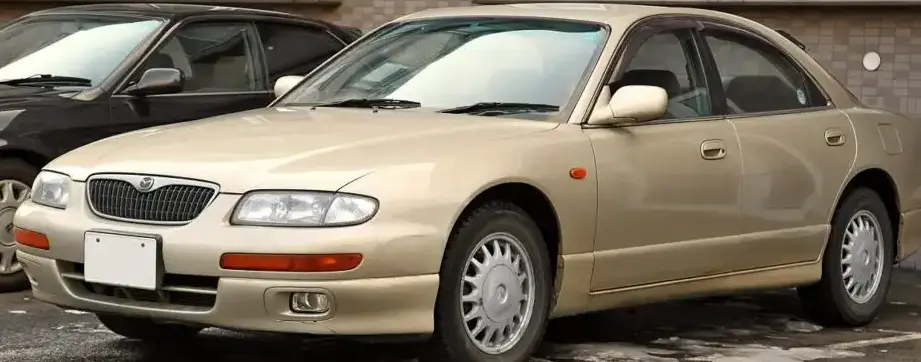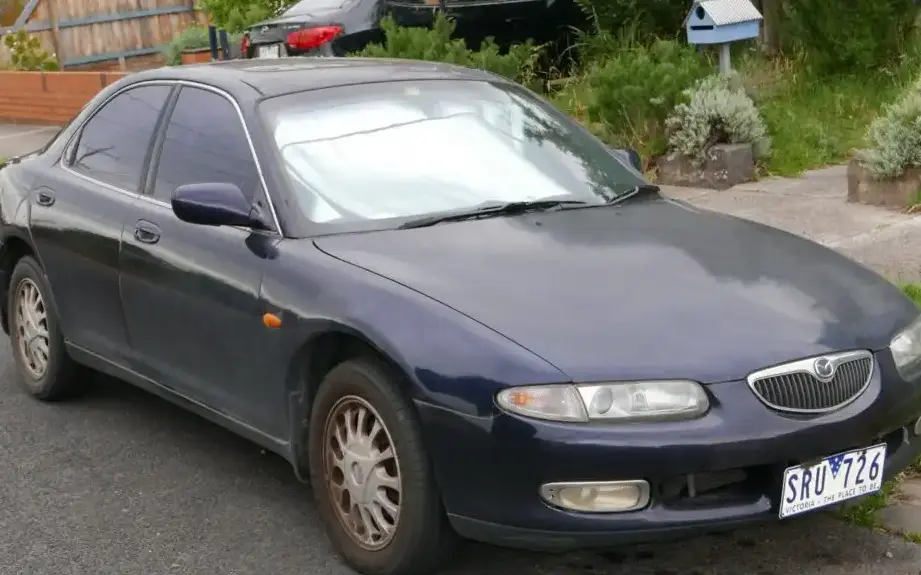
The Mazda Eunos 500 1.8i V6 24V, produced between 1991 and 1994, represented a significant offering in Mazda’s lineup, particularly within the Japanese domestic market (JDM) and export markets under the Eunos brand. Positioned as a comfortable and relatively sporty sedan, the 500 aimed to bridge the gap between mainstream Mazda models and the more luxurious offerings. It was built on the Mazda BG platform, sharing its underpinnings with other models like the Mazda Sentia and the Ford Telstar. This variant, equipped with the 1.8-liter V6 engine and a five-speed manual transmission, occupied a middle ground in the 500 range, offering a balance of performance and fuel efficiency.
Technical Specifications
| Brand | Mazda |
| Model | Eunos 500 |
| Generation | Eunos 500 |
| Type (Engine) | 1.8i V6 24V (140 Hp) |
| Start of production | 1991 |
| End of production | 1994 |
| Powertrain Architecture | Internal Combustion engine |
| Body type | Sedan |
| Seats | 5 |
| Doors | 4 |
| Fuel Type | Petrol (Gasoline) |
| Maximum speed | 195 km/h (121.17 mph) |
| Weight-to-power ratio | 8.3 kg/Hp, 120.7 Hp/tonne |
| Weight-to-torque ratio | 7.4 kg/Nm, 135.3 Nm/tonne |
| Power | 140 Hp @ 7000 rpm |
| Power per litre | 75.9 Hp/l |
| Torque | 157 Nm @ 5500 rpm (115.8 lb.-ft. @ 5500 rpm) |
| Engine layout | Front, Transverse |
| Engine displacement | 1845 cm3 (112.59 cu. in.) |
| Number of cylinders | 6 |
| Engine configuration | V-engine |
| Cylinder Bore | 75 mm (2.95 in.) |
| Piston Stroke | 69.6 mm (2.74 in.) |
| Compression ratio | 9.2:1 |
| Number of valves per cylinder | 4 |
| Fuel injection system | Multi-port manifold injection |
| Engine aspiration | Naturally aspirated engine |
| Valvetrain | DOHC |
| Kerb Weight | 1160 kg (2557.36 lbs.) |
| Fuel tank capacity | 60 l (15.85 US gal | 13.2 UK gal) |
| Length | 4545 mm (178.94 in.) |
| Width | 1698 mm (66.85 in.) |
| Height | 1350 mm (53.15 in.) |
| Wheelbase | 2610 mm (102.76 in.) |
| Front track | 1480 mm (58.27 in.) |
| Rear (Back) track | 1490 mm (58.66 in.) |
| Drivetrain Architecture | The Internal combustion engine (ICE) drives the front wheels of the vehicle. |
| Drive wheel | Front wheel drive |
| Number of gears and type of gearbox | 5 gears, manual transmission |
| Front suspension | Wishbone |
| Rear suspension | Coil spring |
| Front brakes | Ventilated discs |
| Rear brakes | Disc |
| Assisting systems | ABS (Anti-lock braking system) |
| Steering type | Steering rack and pinion |
| Power steering | Hydraulic Steering |
| Tires size | 185/65 R14 S |
| Wheel rims size | 14 |
Powertrain & Engine Architecture
The heart of this Eunos 500 variant is the Mazda J5-DE 1.8-liter V6 engine. This engine, part of Mazda’s J-series, is a naturally aspirated, 24-valve DOHC unit. It utilizes a multi-port fuel injection system, delivering fuel directly to each cylinder for optimized combustion. The V6 configuration, while less common in front-wheel-drive cars of this era, provided a smoother power delivery and a more refined engine note compared to inline-four alternatives. The engine’s 9.2:1 compression ratio was a compromise between performance and fuel efficiency. Paired with this engine is a smooth-shifting five-speed manual transmission, allowing drivers to fully utilize the engine’s power band. This transmission was chosen to provide a more engaging driving experience than the available automatic options.
Driving Characteristics
The 1.8i V6 with the manual transmission offered a respectable driving experience for its time. While not a performance powerhouse, the engine produced sufficient power for comfortable cruising and overtaking. The 140 horsepower peak arrived at 7000 rpm, requiring drivers to rev the engine to access its full potential. The 157 Nm (115.8 lb-ft) of torque, available at 5500 rpm, provided adequate pulling power. The five-speed manual transmission allowed for precise gear selection, and the gear ratios were well-matched to the engine’s characteristics. Compared to the automatic transmission versions, the manual offered a more direct connection to the engine and improved fuel economy. It also felt more responsive, particularly during acceleration. Compared to the larger 2.0-liter V6 variants, this 1.8L offered a lighter front end and slightly more nimble handling.
Equipment & Trim Levels
The Eunos 500 1.8i V6 typically came equipped with a reasonable level of standard features. Interior appointments included cloth upholstery, power windows, power steering, and a basic audio system. Air conditioning was often standard, but could be optional depending on the specific market. Higher trim levels, often denoted by suffixes, added features like alloy wheels, upgraded audio systems, and more luxurious interior trim. Optional extras included a sunroof, leather upholstery, and a more advanced sound system. The dashboard layout was functional and driver-focused, with clearly marked gauges and controls.
Chassis & Braking
The Eunos 500 utilized a front-wheel-drive layout with independent wishbone suspension at the front and a coil spring rear suspension. This setup provided a comfortable ride quality while maintaining reasonable handling characteristics. The car was equipped with ventilated disc brakes at the front and solid disc brakes at the rear, providing adequate stopping power for its weight class. An Anti-lock Braking System (ABS) was included as a standard safety feature, enhancing braking performance in slippery conditions. The steering was rack and pinion, providing precise and responsive steering feel.
Market Reception & Comparison
The Eunos 500 1.8i V6 was generally well-received by automotive critics. It was praised for its comfortable ride, refined engine, and relatively spacious interior. However, some critics noted that the 1.8-liter engine could feel underpowered when fully loaded or driving uphill. Compared to the 2.0-liter V6 models, the 1.8 offered better fuel economy but less outright performance. The manual transmission version was favored by enthusiasts for its more engaging driving experience. Reliability was generally good, although routine maintenance was essential to keep the V6 engine running smoothly.
Legacy
Today, the Eunos 500 1.8i V6 is becoming increasingly sought after by collectors and enthusiasts, particularly those interested in JDM cars. The V6 engine, while not the most powerful, is known for its durability and smooth operation. Finding well-maintained examples can be challenging, as many have been subjected to years of use. Parts availability can also be an issue, although many components are shared with other Mazda models of the era. The 500’s combination of comfort, style, and relative rarity has cemented its place as a desirable classic car.