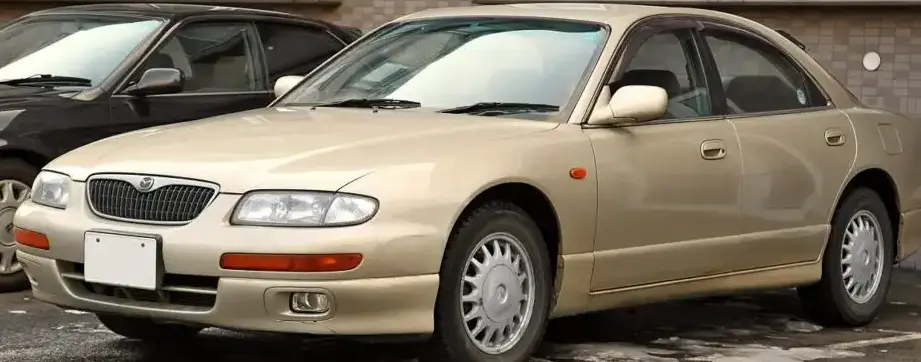
The Mazda Eunos 500 2.0i V6 24V, produced between 1991 and 1996, represents a unique chapter in Mazda’s history. Sold under the Eunos luxury brand – a marketing strategy employed by Mazda to target a more affluent customer base in Japan – the 500 was essentially a rebadged and slightly more refined version of the Mazda Sentia (known as the 929 outside of Japan). Positioned as a mid-size executive sedan, it aimed to compete with established European and domestic rivals, offering a blend of comfort, technology, and a relatively sporty driving experience. The 2.0i V6 24V variant, producing 160 horsepower, was a key offering within the 500 lineup, balancing performance with reasonable fuel consumption and a more accessible price point than the flagship models.
Technical Specifications
| Brand | Mazda |
| Model | Eunos 500 |
| Generation | Eunos 500 |
| Type (Engine) | 2.0i V6 24V (160 Hp) |
| Start of production | 1991 |
| End of production | 1996 |
| Powertrain Architecture | Internal Combustion engine |
| Body type | Sedan |
| Seats | 5 |
| Doors | 4 |
| Fuel Type | Petrol (Gasoline) |
| Maximum speed | 205 km/h (127.38 mph) |
| Weight-to-power ratio | 7.5 kg/Hp, 133.3 Hp/tonne |
| Weight-to-torque ratio | 6.7 kg/Nm, 150 Nm/tonne |
| Power | 160 Hp @ 6500 rpm |
| Power per litre | 80.2 Hp/l |
| Torque | 180 Nm @ 5500 rpm (132.76 lb.-ft. @ 5500 rpm) |
| Engine layout | Front, Transverse |
| Engine displacement | 1995 cm3 (121.74 cu. in.) |
| Number of cylinders | 6 |
| Engine configuration | V-engine |
| Cylinder Bore | 78 mm (3.07 in.) |
| Piston Stroke | 69.6 mm (2.74 in.) |
| Compression ratio | 10:1 |
| Number of valves per cylinder | 4 |
| Fuel injection system | Multi-port manifold injection |
| Engine aspiration | Naturally aspirated engine |
| Valvetrain | DOHC |
| Kerb Weight | 1200 kg (2645.55 lbs.) |
| Fuel tank capacity | 60 l (15.85 US gal | 13.2 UK gal) |
| Length | 4545 mm (178.94 in.) |
| Width | 1695 mm (66.73 in.) |
| Height | 1350 mm (53.15 in.) |
| Wheelbase | 2610 mm (102.76 in.) |
| Front track | 1480 mm (58.27 in.) |
| Rear (Back) track | 1490 mm (58.66 in.) |
| Drivetrain Architecture | The Internal combustion engine (ICE) drives the front wheels of the vehicle. |
| Drive wheel | Front wheel drive |
| Number of gears and type of gearbox | 5 gears, manual transmission |
| Front suspension | Wishbone |
| Rear suspension | Coil spring |
| Front brakes | Ventilated discs |
| Rear brakes | Disc |
| Assisting systems | ABS (Anti-lock braking system) |
| Steering type | Steering rack and pinion |
| Power steering | Hydraulic Steering |
| Tires size | 195/65 R15 H |
| Wheel rims size | 15 |
Powertrain & Engine Architecture
The heart of the Eunos 500 2.0i V6 24V is the JE series 2.0-liter V6 engine. This engine, a naturally aspirated powerplant, featured a 60-degree V-angle, contributing to a smoother power delivery and reduced vibrations. The “24V” designation refers to the four valves per cylinder (two intake, two exhaust) operated by a dual overhead camshaft (DOHC) valvetrain. Fuel delivery was managed by a multi-port fuel injection system, optimizing combustion efficiency and responsiveness. The engine’s block was constructed from cast iron, providing durability, while the cylinder head was made of aluminum alloy to reduce weight. The 5-speed manual transmission was the standard offering for this variant, providing drivers with full control over the engine’s power. The transmission was designed for smooth shifts and relatively quiet operation, complementing the refined character of the vehicle.
Driving Characteristics
The 160 horsepower and 180 Nm (132.76 lb-ft) of torque offered by the 2.0i V6 provided adequate performance for comfortable highway cruising and city driving. While not overtly sporty, the engine delivered a linear power curve, making it predictable and easy to manage. The 5-speed manual transmission allowed drivers to exploit the engine’s power band effectively. Compared to the higher-output V6 options available in the Eunos 500 range, this variant prioritized fuel efficiency and a more relaxed driving experience. The front-wheel-drive configuration provided good traction in most conditions, but could exhibit some understeer when pushed hard through corners. The gear ratios were tuned for a balance between acceleration and fuel economy, with fifth gear acting as an overdrive for efficient highway travel.
Equipment & Trim Levels
The Eunos 500 2.0i V6 24V typically came equipped with a respectable level of standard features. These included power windows, power locks, air conditioning, and a basic audio system. Interior upholstery was generally cloth, though leather options were available as upgrades. The dashboard layout was functional and well-designed, with clear instrumentation. Optional extras included a sunroof, upgraded audio systems, and alloy wheels. The Eunos brand emphasized luxury and refinement, so even the base models offered a comfortable and well-appointed interior. The 2.0i V6 trim sat in the middle of the lineup, offering a good balance of features and price.
Chassis & Braking
The Eunos 500 utilized a front independent suspension with wishbone configuration, providing a comfortable ride and reasonable handling. The rear suspension employed a coil spring setup. Braking duties were handled by ventilated discs at the front and solid discs at the rear, providing adequate stopping power for the vehicle’s weight and performance. An Anti-lock Braking System (ABS) was standard, enhancing safety by preventing wheel lockup during hard braking. The steering system was a rack and pinion setup with hydraulic power assistance, offering precise and responsive steering feel. The 195/65 R15 tires provided a good compromise between ride comfort and grip.
Market Reception & Comparison
The Eunos 500 2.0i V6 24V was generally well-received by critics for its comfortable ride, refined interior, and smooth engine. However, it wasn’t considered a particularly exciting or sporty vehicle. Compared to the higher-spec V6 models, the 2.0i offered a more affordable entry point into the Eunos 500 range, but at the expense of some performance. Fuel economy was reasonable for a V6 engine of this era, but not class-leading. Reliability was generally good, although maintenance costs could be higher than for some domestic rivals due to the complexity of the V6 engine and the vehicle’s relatively sophisticated technology.
Legacy
Today, the Eunos 500 2.0i V6 24V is a relatively rare sight on the roads. Its status as a collectible is growing, particularly among enthusiasts of Japanese classic cars. The JE series V6 engine is known for its durability, but regular maintenance is essential to prevent issues. Parts availability can be a challenge, but a dedicated community of owners and online resources can help with sourcing components. The Eunos 500 represents a unique and often overlooked chapter in Mazda’s history, offering a glimpse into the company’s ambition to compete in the luxury car market. The 2.0i V6 24V variant remains a compelling option for those seeking a comfortable, reliable, and relatively affordable classic Japanese sedan.