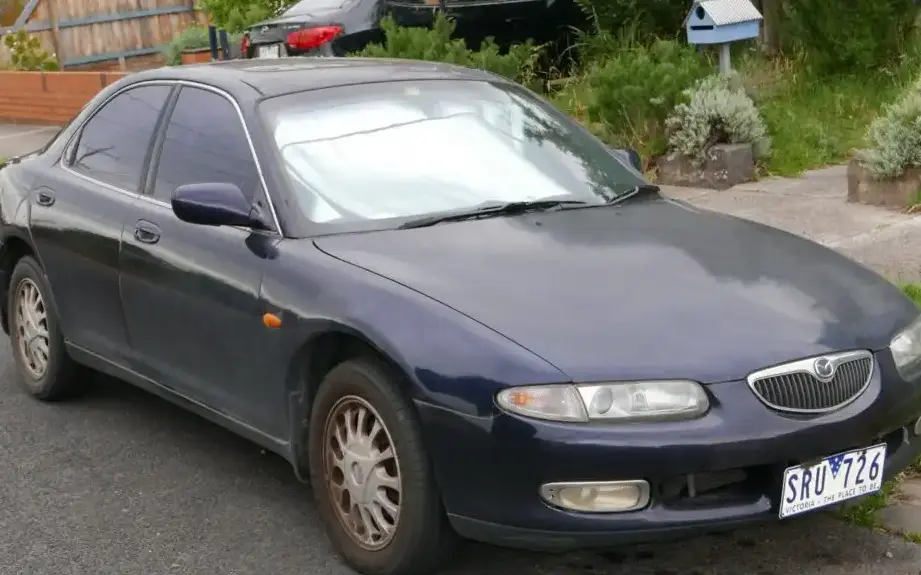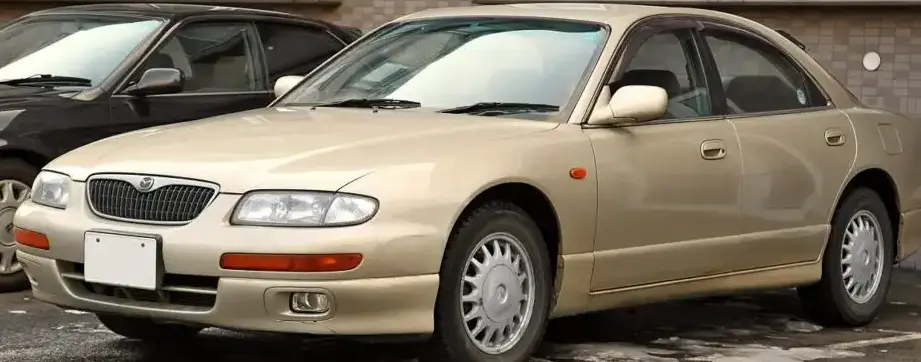
The Mazda Eunos 800 2.5 i V6 24V, produced between 1993 and 1996, represents a significant effort by Mazda to enter the executive car segment, primarily targeting the Japanese domestic market (JDM) and select export markets. Positioned as a more luxurious and refined offering than Mazda’s existing lineup, the Eunos 800 was essentially a rebadged and significantly upgraded version of the Ford Telstar, itself a derivative of the Mazda Cronos. The 2.5 i V6 24V variant, boasting 200 horsepower, sat at the top of the Eunos 800 range, offering a blend of performance and comfort intended to compete with established European and Japanese luxury sedans.
Technical Specifications
| Brand | Mazda |
| Model | Eunos 800 |
| Generation | Eunos 800 |
| Type (Engine) | 2.5 i V6 24V (200 Hp) |
| Start of production | 1993 |
| End of production | 1996 |
| Powertrain Architecture | Internal Combustion engine |
| Body type | Sedan |
| Seats | 5 |
| Doors | 4 |
| Fuel consumption (combined) | 11.4 l/100 km |
| Fuel consumption (US mpg) | 20.6 US mpg |
| Fuel consumption (UK mpg) | 24.8 UK mpg |
| Fuel consumption (km/l) | 8.8 km/l |
| Fuel Type | Petrol (Gasoline) |
| Weight-to-power ratio | 7.2 kg/Hp |
| Hp/tonne | 138.9 Hp/tonne |
| Weight-to-torque ratio | 6.4 kg/Nm |
| Nm/tonne | 155.6 Nm/tonne |
| Power | 200 Hp @ 6500 rpm |
| Power per litre | 80.1 Hp/l |
| Torque | 224 Nm @ 5500 rpm |
| Torque (lb.-ft.) | 165.21 lb.-ft. @ 5500 rpm |
| Engine layout | Front, Transverse |
| Engine displacement | 2497 cm3 |
| Engine displacement (cu. in.) | 152.38 cu. in. |
| Number of cylinders | 6 |
| Engine configuration | V-engine |
| Cylinder Bore | 84.5 mm |
| Cylinder Bore (in.) | 3.33 in. |
| Piston Stroke | 74.2 mm |
| Piston Stroke (in.) | 2.92 in. |
| Compression ratio | 9.2:1 |
| Number of valves per cylinder | 4 |
| Fuel injection system | Multi-port manifold injection |
| Engine aspiration | Naturally aspirated engine |
| Valvetrain | DOHC |
| Kerb Weight | 1440 kg |
| Kerb Weight (lbs.) | 3174.66 lbs. |
| Fuel tank capacity | 70 l |
| Fuel tank capacity (US gal) | 18.49 US gal |
| Fuel tank capacity (UK gal) | 15.4 UK gal |
| Length | 4825 mm |
| Length (in.) | 189.96 in. |
| Width | 1770 mm |
| Width (in.) | 69.69 in. |
| Height | 1395 mm |
| Height (in.) | 54.92 in. |
| Wheelbase | 2750 mm |
| Wheelbase (in.) | 108.27 in. |
| Front track | 1530 mm |
| Front track (in.) | 60.24 in. |
| Rear track | 1530 mm |
| Rear track (in.) | 60.24 in. |
| Drivetrain Architecture | The Internal combustion engine (ICE) drives the front wheels of the vehicle. |
| Drive wheel | Front wheel drive |
| Number of gears | 4 |
| Gearbox type | automatic transmission |
| Front suspension | Double wishbone |
| Rear suspension | Double wishbone |
| Front brakes | Ventilated discs |
| Rear brakes | Disc |
| Assisting systems | ABS (Anti-lock braking system) |
| Steering type | Steering rack and pinion |
| Power steering | Hydraulic Steering |
| Tires size | 205/65 R15 H |
| Wheel rims size | 15 |
Powertrain & Engine Architecture
The heart of the Eunos 800 2.5 i V6 was the JE series 2.5-liter V6 engine. This engine, a 60-degree V configuration, utilized a cast iron block and aluminum cylinder heads. It featured a double overhead camshaft (DOHC) valvetrain with four valves per cylinder, contributing to its relatively high specific output. Fuel delivery was handled by a multi-port fuel injection system, optimizing combustion efficiency and responsiveness. The engine’s 9.2:1 compression ratio was a compromise between performance and the quality of fuel available in target markets. Paired with this engine was a four-speed automatic transmission, designed for smooth and comfortable shifts. While not a particularly advanced transmission by modern standards, it was well-suited to the car’s intended role as a luxury cruiser.
Driving Characteristics
The 200 horsepower and 224 Nm (165 lb-ft) of torque provided by the 2.5L V6 offered respectable performance for its time. Acceleration was brisk, though not overtly sporty, with a 0-60 mph time estimated around 8.5-9 seconds. The automatic transmission, while smooth, did detract somewhat from the engine’s potential, resulting in a less engaging driving experience compared to the available manual transmission options in other Eunos 800 variants. The gear ratios were tuned for comfortable cruising rather than outright acceleration. The front-wheel-drive configuration, while common for cars in this class, meant that the Eunos 800 wasn’t as dynamically balanced as rear-wheel-drive competitors. However, the well-tuned suspension and power steering provided a comfortable and predictable ride.
Equipment & Trim Levels
The 2.5 i V6 24V typically came well-equipped, reflecting its position as the flagship model. Standard features included power windows, power locks, air conditioning, a high-quality audio system, and velour upholstery. Higher trim levels offered leather upholstery, woodgrain interior trim, and a sunroof. Optional extras included a navigation system (a rarity for the early 1990s), upgraded sound systems, and alloy wheels. The interior design prioritized comfort and spaciousness, offering ample room for both front and rear passengers.
Chassis & Braking
The Eunos 800 utilized a front-engine, front-wheel-drive layout. Suspension consisted of a double wishbone setup at both the front and rear, providing a comfortable ride and reasonable handling. Braking duties were handled by ventilated discs at the front and solid discs at the rear. An Anti-lock Braking System (ABS) was standard, enhancing safety and control during hard braking. The steering employed a rack and pinion system with hydraulic power assistance, offering precise and effortless steering.
Market Reception & Comparison
The Eunos 800 2.5 i V6 24V was generally well-received by critics, who praised its comfortable ride, spacious interior, and refined engine. However, it faced stiff competition from established European and Japanese rivals, such as the BMW 5 Series, Mercedes-Benz E-Class, and Toyota Crown. Compared to the lower-spec Eunos 800 variants (such as the 1.8L and 2.0L models), the 2.5 i V6 offered significantly more performance and a more luxurious experience. Fuel economy, however, was considerably lower than the smaller-engined versions. Reliability was generally good, though the complexity of the V6 engine and automatic transmission meant that maintenance costs could be higher than those of simpler models.
Legacy
The Eunos 800, while not a massive sales success, remains a fondly remembered car among enthusiasts. The 2.5 i V6 24V variant, in particular, is sought after for its smooth engine and comfortable ride. Today, finding a well-maintained example can be challenging, but they represent a unique and relatively affordable entry into the world of 1990s Japanese luxury. The JE series V6 engine, while not known for being particularly groundbreaking, proved to be reasonably durable, and many examples are still running today with proper maintenance. The Eunos 800 stands as a testament to Mazda’s ambition to compete in the premium car segment and offers a distinctive alternative to more common European and Japanese luxury sedans.