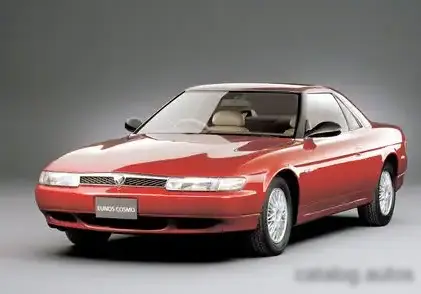
The Mazda Eunos Cosmo, produced between 1990 and 1995, represents a unique chapter in Mazda’s history. Specifically, the 13B Type E variant, equipped with a 230 horsepower rotary engine and a four-speed automatic transmission, was the flagship model of the series. Positioned as a luxurious grand tourer, the Cosmo aimed to compete with established European sports coupes, offering a blend of Japanese reliability and innovative technology. It was sold primarily in Japan through Mazda’s Eunos dealership network, a brand focused on providing a more upscale customer experience. The Cosmo utilized Mazda’s JC platform, a dedicated chassis designed to accommodate the complex rotary engine and rear-wheel-drive layout.
Technical Specifications
| Brand | Mazda |
| Model | Eunos Cosmo |
| Generation | Eunos Cosmo |
| Type (Engine) | 13B Type E (230 Hp) |
| Start of production | 1990 |
| End of production | 1995 |
| Powertrain Architecture | Internal Combustion engine |
| Body type | Coupe |
| Seats | 2 |
| Doors | 2 |
| Fuel consumption (urban) | 13.5 l/100 km (17.4 US mpg, 20.9 UK mpg, 7.4 km/l) |
| Fuel consumption (extra urban) | 6.9 l/100 km (34.1 US mpg, 40.9 UK mpg, 14.5 km/l) |
| Fuel Type | Petrol (Gasoline) |
| Maximum speed | 230 km/h (142.92 mph) |
| Weight-to-power ratio | 6.6 kg/Hp, 152.3 Hp/tonne |
| Weight-to-torque ratio | 5.1 kg/Nm, 194.7 Nm/tonne |
| Power | 230 Hp @ 6500 rpm |
| Power per litre | 87.9 Hp/l |
| Torque | 294 Nm @ 3500 rpm (216.84 lb.-ft. @ 3500 rpm) |
| Engine layout | Front, Longitudinal |
| Engine displacement | 2616 cm3 (159.64 cu. in.) |
| Engine configuration | Rotary (Wankel) |
| Compression ratio | 9:1 |
| Fuel injection system | Multi-port manifold injection |
| Engine aspiration | Turbocharger |
| Kerb Weight | 1510 kg (3328.98 lbs) |
| Fuel tank capacity | 72 l (19.02 US gal | 15.84 UK gal) |
| Length | 4815 mm (189.57 in) |
| Width | 1795 mm (70.67 in) |
| Height | 1305 mm (51.38 in) |
| Wheelbase | 2750 mm (108.27 in) |
| Front track | 1520 mm (59.84 in) |
| Rear track | 1510 mm (59.45 in) |
| Drivetrain Architecture | Rear wheel drive |
| Drive wheel | Rear wheel drive |
| Number of gears and type of gearbox | 4 gears, automatic transmission |
| Front suspension | Double wishbone |
| Rear suspension | Coil spring |
| Front brakes | Ventilated discs |
| Rear brakes | Ventilated discs |
| Assisting systems | ABS (Anti-lock braking system) |
| Steering type | Steering rack and pinion |
| Power steering | Hydraulic Steering |
| Tires size | 215/60 R15 V |
| Wheel rims size | 15 |
Powertrain & Engine Architecture
The heart of the Eunos Cosmo 13B Type E is its 2.6-liter (2616 cc) 13B-REW rotary engine. This engine is a twin-rotor Wankel design, known for its smooth power delivery and high power-to-weight ratio. The Type E version featured a sequential twin turbocharger system, a significant advancement for rotary engines. This system minimized turbo lag and provided a broader, more usable powerband. The engine utilized multi-port fuel injection and a 9:1 compression ratio. The four-speed automatic transmission was specifically tuned to handle the unique characteristics of the rotary engine, with gear ratios optimized for both acceleration and cruising. The transmission wasn’t known for particularly quick shifts, but it provided a comfortable driving experience.
Driving Characteristics
The 13B Type E with the automatic transmission delivered a surprisingly refined driving experience. While not as overtly sporty as a manual transmission version, the automatic offered smooth acceleration and effortless cruising. The turbocharger system provided strong mid-range torque, making overtaking relatively easy. The automatic transmission’s gear ratios were spaced to prioritize comfort over outright performance. Compared to the manual transmission Cosmo, the automatic version sacrificed some responsiveness, but gained in ease of use. The rear-wheel-drive layout contributed to balanced handling, although the Cosmo’s weight (1510 kg / 3328.98 lbs) was noticeable in cornering.
Equipment & Trim Levels
The 13B Type E represented the highest trim level of the Eunos Cosmo. Standard features included leather upholstery, power-adjustable seats, a premium sound system, climate control, and power windows and locks. The interior was designed with a focus on luxury and comfort, featuring wood trim and a well-appointed dashboard. Optional extras included a navigation system (a rarity for the time), upgraded sound systems, and special paint colors. The Cosmo’s interior was a significant step up from other Japanese sports coupes of the era, rivaling European offerings in terms of fit and finish.
Chassis & Braking
The Cosmo’s chassis featured a double wishbone suspension at the front and a coil spring suspension at the rear. This setup provided a comfortable ride while maintaining reasonable handling characteristics. The car was equipped with ventilated disc brakes on all four wheels, along with an Anti-lock Braking System (ABS) as standard equipment. The steering was a rack and pinion system with hydraulic power assistance, providing precise and responsive steering feel. The 215/60 R15 tires offered a good balance of grip and ride comfort.
Market Reception & Comparison
The Eunos Cosmo was generally well-received by automotive critics in Japan. The 13B Type E variant was praised for its smooth power delivery, luxurious interior, and advanced technology. However, the rotary engine’s reputation for requiring more frequent maintenance than traditional piston engines was a concern for some. Compared to other trims, the Type E offered a significant performance advantage, but at a higher price point. Fuel economy, while respectable for a sports coupe of its era (13.5 l/100 km urban, 6.9 l/100 km extra urban), was not a strong point. The Cosmo’s primary competitors were European grand tourers like the BMW 6 Series and the Porsche 944, although the Cosmo offered a unique driving experience and a different aesthetic.
Legacy
The Eunos Cosmo, and particularly the 13B Type E variant, remains a sought-after vehicle among enthusiasts. The rotary engine, while complex, is celebrated for its unique character and performance potential. The Cosmo’s innovative technology and luxurious features have also contributed to its enduring appeal. However, the rotary engine’s inherent weaknesses – apex seal wear and oil consumption – mean that finding a well-maintained example can be challenging. Parts availability can also be an issue, as many components are specific to the Cosmo and are no longer in production. Despite these challenges, the Eunos Cosmo 13B Type E is remembered as a bold and innovative sports coupe that pushed the boundaries of Japanese automotive engineering.