Technical Specifications
| Brand | Mazda |
| Model | Familia |
| Generation | Familia |
| Type (Engine) | 1.3 i (73 Hp) |
| Start of production | 1989 |
| End of production | 1994 |
| Powertrain Architecture | Internal Combustion engine |
| Body type | Sedan |
| Seats | 5 |
| Doors | 4 |
| Fuel Type | Petrol (Gasoline) |
| Power | 73 Hp @ 5500 rpm |
| Power per litre | 55.1 Hp/l |
| Torque | 108 Nm @ 4000 rpm / 79.66 lb.-ft. @ 4000 rpm |
| Engine layout | Front, Transverse |
| Engine displacement | 1324 cm3 / 80.8 cu. in. |
| Number of cylinders | 4 |
| Engine configuration | Inline |
| Cylinder Bore | 71 mm / 2.8 in. |
| Piston Stroke | 83.6 mm / 3.29 in. |
| Compression ratio | 9.4:1 |
| Number of valves per cylinder | 4 |
| Fuel injection system | Multi-port manifold injection |
| Engine aspiration | Naturally aspirated engine |
| Valvetrain | OHC |
| Fuel tank capacity | 50 l / 13.21 US gal | 11 UK gal |
| Length | 4215 mm / 165.94 in. |
| Width | 1675 mm / 65.94 in. |
| Height | 1375 mm / 54.13 in. |
| Wheelbase | 2500 mm / 98.43 in. |
| Minimum turning circle | 9.6 m / 31.5 ft. |
| Drivetrain Architecture | The Internal combustion engine (ICE) drives the front wheels of the vehicle. |
| Drive wheel | Front wheel drive |
| Front brakes | Ventilated discs |
| Rear brakes | Drum |
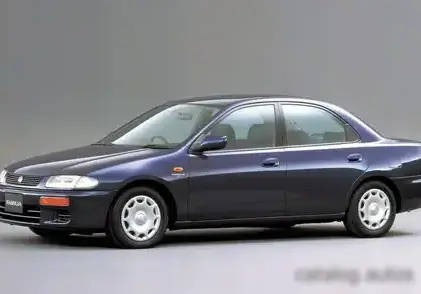
The Mazda Familia 1.3i (73 hp) was a compact sedan produced between 1989 and 1994, representing a key variant within the broader Familia (also known as the 323 in some markets) lineage. This particular iteration, powered by a 1.3-liter inline-four engine, served as the entry point to the Familia range, targeting buyers seeking economical and reliable transportation. It was primarily sold in Japan, Australia, and select European markets, offering a practical and affordable option in the competitive compact car segment. The Familia, in its various iterations, was a significant model for Mazda, helping to establish the brand as a maker of dependable and value-oriented vehicles.
Powertrain & Engine Architecture
The heart of the Familia 1.3i was the Mazda B6 engine, a 1324cc inline-four cylinder unit. This engine, designated as the B6-ME, featured a single overhead camshaft (OHC) operating four valves per cylinder. The engine utilized a multi-port fuel injection system, contributing to improved fuel efficiency and smoother operation compared to earlier carburetor-equipped models. The 9.4:1 compression ratio was a compromise between performance and the fuel quality available in various markets. The B6 engine family was known for its relative simplicity and durability, making it a cost-effective choice for Mazda. While not a powerhouse, the engine was designed for reliability and ease of maintenance. The Familia 1.3i was exclusively offered with a four-speed automatic transmission, prioritizing convenience over outright performance. This transmission was a typical three-speed automatic with an overdrive fourth gear, designed to improve highway fuel economy. It wasn’t known for particularly quick shifts, but rather for its smooth and predictable operation.
Driving Characteristics
The 73 horsepower and 79.66 lb-ft of torque produced by the 1.3-liter engine translated to modest, but adequate, performance. Acceleration was unhurried, and the automatic transmission, while smooth, lacked the responsiveness of a manual gearbox. The four-speed automatic was geared for economy, with relatively tall ratios. This resulted in a comfortable cruising experience but limited passing power. Compared to the higher-spec Familia models equipped with 1.6 or 1.8-liter engines, the 1.3i felt noticeably slower. However, for urban driving and commuting, the engine provided sufficient power. The front-wheel-drive configuration offered predictable handling, although it wasn’t particularly sporty. The suspension was tuned for comfort, absorbing bumps and imperfections in the road reasonably well. Steering feel was light, making it easy to maneuver in tight spaces, but lacking in feedback at higher speeds.
Equipment & Trim Levels
The Familia 1.3i typically represented the base trim level. Standard equipment generally included cloth upholstery, a basic AM/FM radio, and manual windows and door locks. Power steering was often included, but air conditioning was frequently an optional extra. The interior design was functional and straightforward, prioritizing practicality over luxury. Higher trim levels of the Familia offered features such as upgraded upholstery, a more sophisticated audio system, and power windows/locks. The 1.3i was often seen as a sensible choice for buyers who didn’t require these additional amenities. Exterior features were similarly basic, with steel wheels and relatively simple trim. Color options were typically limited to a range of solid colors and a few metallic finishes.
Chassis & Braking
The Familia 1.3i utilized a MacPherson strut front suspension and a torsion beam rear suspension. This setup provided a good balance between ride comfort and handling. The front brakes were ventilated discs, offering adequate stopping power, while the rear brakes were drums, a cost-saving measure common in this class of vehicle. The chassis was relatively lightweight, contributing to the car’s fuel efficiency. Stabilizer bars were typically fitted to the front, helping to reduce body roll during cornering. The steering was rack-and-pinion, providing reasonably precise control. The relatively simple suspension design contributed to lower maintenance costs.
Market Reception & Comparison
The Mazda Familia 1.3i was generally well-received as an affordable and reliable compact car. Critics praised its fuel economy and ease of driving, but noted its lack of performance compared to rivals. Compared to other 1.3-liter compacts of the era, such as the Toyota Corolla and Nissan Sunny, the Familia offered a slightly more engaging driving experience. However, it often lacked the brand recognition of its Japanese competitors. The automatic transmission was seen as a positive feature by many buyers, particularly those who primarily used the car for commuting. Fuel economy was a key selling point, with the 1.3i achieving respectable figures for its time, typically in the range of 35-40 mpg in mixed driving. The car’s price point made it attractive to first-time buyers and those on a budget.
Legacy
The Mazda Familia 1.3i, while not a particularly exciting vehicle, proved to be a durable and dependable choice for many owners. The B6 engine is known for its longevity, and many examples are still on the road today. The automatic transmission, while not the most advanced, is generally reliable if properly maintained. In the used car market, the Familia 1.3i remains an affordable option for those seeking a simple and economical vehicle. Its straightforward design and readily available parts make it relatively easy to maintain. While it may not appeal to enthusiasts seeking performance, the Familia 1.3i represents a practical and reliable example of 1990s Japanese automotive engineering. Its reputation for reliability has ensured a steady, if modest, demand in the used car market, particularly in regions where affordability is a key consideration.