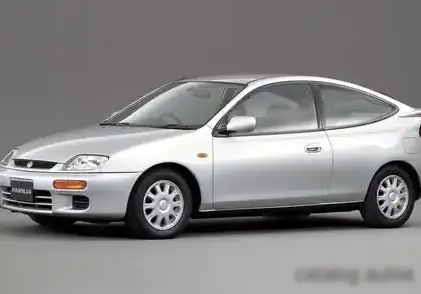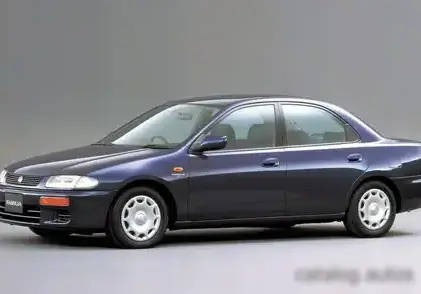
The Mazda Familia 1.6 i, producing 115 horsepower, was a key variant of the BG series Familia produced between 1994 and 1998. Positioned as a mid-range offering within the Familia lineup, it aimed to balance performance with affordability and fuel efficiency. The Familia, known as the Mazda 323 in many export markets, served as Mazda’s compact offering, competing with vehicles like the Honda Civic, Toyota Corolla, and Nissan Sentra. This generation (BG) represented a significant step forward in design and refinement for the Familia, offering a more modern aesthetic and improved driving dynamics compared to its predecessors. The 1.6 i model, with its fuel-injected engine and front-wheel-drive configuration, was particularly popular in markets where fuel economy and ease of driving were prioritized.
Technical Specifications
| Brand | Mazda |
| Model | Familia |
| Generation | Familia |
| Type (Engine) | 1.6 i (115 Hp) |
| Start of production | 1994 |
| End of production | 1998 |
| Powertrain Architecture | Internal Combustion engine |
| Body type | Sedan |
| Seats | 5 |
| Doors | 4 |
| Fuel Type | Petrol (Gasoline) |
| Power | 115 Hp @ 6500 rpm |
| Power per litre | 72 Hp/l |
| Torque | 135 Nm @ 5500 rpm |
| Torque (lb.-ft.) | 99.57 lb.-ft. @ 5500 rpm |
| Engine layout | Front, Longitudinal |
| Engine displacement | 1598 cm3 |
| Engine displacement (cu. in.) | 97.52 cu. in. |
| Number of cylinders | 4 |
| Engine configuration | Inline |
| Cylinder Bore | 78 mm |
| Cylinder Bore (in.) | 3.07 in. |
| Piston Stroke | 83.6 mm |
| Piston Stroke (in.) | 3.29 in. |
| Compression ratio | 9.4:1 |
| Number of valves per cylinder | 4 |
| Fuel injection system | Multi-port manifold injection |
| Engine aspiration | Naturally aspirated engine |
| Valvetrain | DOHC |
| Max. weight | 1040 kg |
| Max. weight (lbs.) | 2292.81 lbs. |
| Fuel tank capacity | 50 l |
| Fuel tank capacity (US gal) | 13.21 US gal |
| Fuel tank capacity (UK gal) | 11 UK gal |
| Length | 4335 mm |
| Length (in.) | 170.67 in. |
| Width | 1695 mm |
| Width (in.) | 66.73 in. |
| Height | 1420 mm |
| Height (in.) | 55.91 in. |
| Wheelbase | 2605 mm |
| Wheelbase (in.) | 102.56 in. |
| Front track | 1460 mm |
| Front track (in.) | 57.48 in. |
| Rear track | 1460 mm |
| Rear track (in.) | 57.48 in. |
| Minimum turning circle | 9.6 m |
| Minimum turning circle (ft.) | 31.5 ft. |
| Drivetrain Architecture | The Internal combustion engine (ICE) drives the front wheels of the vehicle. |
| Drive wheel | Front wheel drive |
| Front brakes | Ventilated discs |
| Rear brakes | Drum |
Powertrain & Engine Architecture
The heart of the Familia 1.6 i was the B6 engine, a 1.6-liter inline-four cylinder gasoline engine. This engine utilized a multi-port fuel injection system, contributing to improved fuel efficiency and smoother power delivery compared to earlier carburetor-equipped engines. The engine featured a double overhead camshaft (DOHC) valvetrain, operating four valves per cylinder. This configuration enhanced volumetric efficiency, allowing for increased power output at higher engine speeds. The B6 engine was known for its relatively simple design, contributing to its reliability and ease of maintenance. While not a high-performance engine, it provided adequate power for everyday driving. The engine was mounted longitudinally in the front of the vehicle, driving the front wheels. The B6 engine, a staple of Mazda’s offerings during this period, was designed with a focus on durability and cost-effectiveness. It wasn’t a particularly technologically advanced engine, but its robust construction and straightforward design contributed to its long-term reliability. The four-speed automatic transmission paired with the B6 was a conventional torque converter type, prioritizing smooth shifts over aggressive performance. It was a common transmission found in many vehicles of this era, known for its dependability but not its responsiveness.
Driving Characteristics
The 1.6 i variant of the Mazda Familia offered a comfortable and predictable driving experience. With 115 horsepower and 135 Nm (99.57 lb-ft) of torque, acceleration was adequate for merging onto highways and navigating city streets. However, it wasn’t particularly quick, and overtaking maneuvers required careful planning. Compared to the higher-output 1.8-liter versions, the 1.6 i felt noticeably less responsive. The automatic transmission, typically a four-speed unit, further dampened performance, prioritizing smooth shifts over outright acceleration. Gear ratios were tuned for fuel economy, resulting in a relatively relaxed cruising experience. The Familia’s suspension provided a good balance between ride comfort and handling, absorbing bumps effectively while maintaining reasonable body control. Steering was light and easy, making it well-suited for urban driving. The overall driving experience was geared towards comfort and ease of use, rather than sporty performance. The automatic transmission, while smooth, did contribute to a feeling of detachment from the engine, and downshifts weren’t particularly quick or decisive.
Equipment & Trim Levels
The 1.6 i trim level typically included features such as power steering, central locking, and an AM/FM radio. Interior upholstery was usually cloth, with a relatively simple dashboard layout. Air conditioning was often an optional extra, as were power windows and alloy wheels. Higher trim levels within the Familia range offered features like upgraded audio systems, leather upholstery, and sunroofs, but the 1.6 i was positioned as the more accessible entry point to the model range. The focus was on providing essential features at a competitive price point. The interior design was functional and straightforward, prioritizing practicality over luxury. The dashboard layout was clean and uncluttered, with easy-to-read gauges. The seats were comfortable, providing adequate support for long journeys. Optional extras, such as a cassette player or upgraded speakers, were available to enhance the in-car entertainment experience.
Chassis & Braking
The Familia 1.6 i utilized a front-wheel-drive chassis with independent front suspension (typically MacPherson struts) and a torsion beam rear suspension. This setup provided a good compromise between ride comfort and handling. Braking duties were handled by ventilated disc brakes at the front and drum brakes at the rear. While adequate for normal driving conditions, the rear drum brakes were a cost-saving measure and didn’t offer the same stopping power as disc brakes. The vehicle’s relatively light weight (around 1040 kg or 2292.81 lbs) helped to offset the limitations of the braking system. The suspension was tuned for comfort, providing a smooth ride over uneven surfaces. The torsion beam rear suspension was a simple and reliable design, but it didn’t offer the same level of sophistication as a fully independent rear suspension. The steering system was a conventional rack-and-pinion setup, providing precise and responsive steering feel.
Market Reception & Comparison
The Mazda Familia 1.6 i was generally well-received by automotive critics as a practical and reliable compact car. It was praised for its fuel efficiency, comfortable ride, and relatively spacious interior. However, some critics noted its lack of outright performance compared to competitors. Compared to the higher-spec Familia variants, the 1.6 i offered a more affordable entry point, but at the expense of performance and some features. Fuel economy was a strong point, making it an attractive option for budget-conscious buyers. Reliability was also a key strength, with the B6 engine proving to be durable and relatively trouble-free. In comparison to rivals like the Honda Civic and Toyota Corolla, the Familia 1.6 i offered a slightly more engaging driving experience, but it didn’t quite match the reputation for bulletproof reliability of the Japanese competitors.
Legacy
The Mazda Familia 1.6 i has maintained a reputation for reliability and affordability in the used car market. The B6 engine is known for its longevity, and parts availability remains relatively good. While not a particularly sought-after model by enthusiasts, it represents a solid and dependable choice for those seeking a practical and economical compact car. The Familia’s influence can be seen in subsequent Mazda models, which continued to prioritize driving dynamics and build quality. Today, well-maintained examples of the 1.6 i can still be found on the road, testament to the vehicle’s enduring durability. The Familia 1.6 i serves as a reminder of a time when compact cars were valued for their practicality, reliability, and affordability, rather than their performance or technological sophistication.