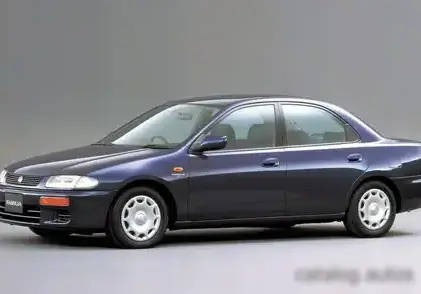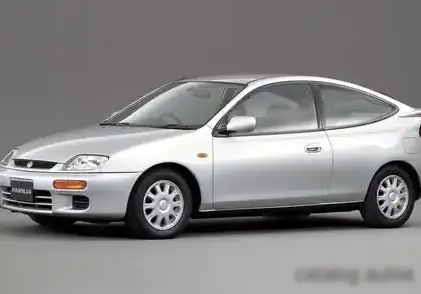
The Mazda Familia Hatchback 1.3i (76 hp) was a compact offering from Mazda, produced between 1989 and 1994. This variant occupied the entry-level position within the Familia hatchback range, serving as an affordable and economical option for buyers in various markets, particularly in Europe and Asia. It was part of the broader Familia (also known as the 323 in some regions) lineage, a model that consistently aimed to provide practical transportation with a focus on reliability and fuel efficiency. The 1.3i model was designed to appeal to buyers prioritizing cost-effectiveness over outright performance.
Technical Specifications
| Brand | Mazda |
| Model | Familia |
| Generation | Familia Hatchback |
| Type (Engine) | 1.3 i (76 Hp) |
| Start of production | 1989 |
| End of production | 1994 |
| Powertrain Architecture | Internal Combustion engine |
| Body type | Hatchback |
| Seats | 5 |
| Doors | 5 |
| Fuel Type | Petrol (Gasoline) |
| Power | 76 Hp @ 6500 rpm |
| Power per litre | 57.4 Hp/l |
| Torque | 101 Nm @ 4000 rpm / 74.49 lb.-ft. @ 4000 rpm |
| Engine layout | Front, Transverse |
| Engine Model/Code | B3 |
| Engine displacement | 1323 cm3 / 80.73 cu. in. |
| Number of cylinders | 4 |
| Engine configuration | Inline |
| Cylinder Bore | 71 mm / 2.8 in. |
| Piston Stroke | 83.6 mm / 3.29 in. |
| Compression ratio | 9:1 |
| Number of valves per cylinder | 4 |
| Fuel injection system | Multi-port manifold injection |
| Engine aspiration | Naturally aspirated engine |
| Valvetrain | DOHC |
| Fuel tank capacity | 50 l / 13.21 US gal | 11 UK gal |
| Length | 3995 mm / 157.28 in. |
| Width | 1675 mm / 65.94 in. |
| Height | 1380 mm / 54.33 in. |
| Wheelbase | 2450 mm / 96.46 in. |
| Front track | 1430 mm / 56.3 in. |
| Rear (Back) track | 1435 mm / 56.5 in. |
| Drivetrain Architecture | The Internal combustion engine (ICE) drives the front wheels of the vehicle. |
| Drive wheel | Front wheel drive |
| Front brakes | Ventilated discs |
| Rear brakes | Drum |
Powertrain & Engine Architecture
The heart of the Familia 1.3i was the B3 engine, a 1.3-liter inline-four cylinder gasoline engine. This engine utilized a double overhead camshaft (DOHC) valvetrain, operating four valves per cylinder. This configuration, while not groundbreaking, contributed to reasonable power output for its displacement. Fuel delivery was managed by a multi-port fuel injection system, a common feature for the era, improving efficiency and reducing emissions compared to carbureted engines. The B3 engine was known for its relative simplicity and durability, making it a reliable powerplant. The engine’s 9:1 compression ratio was a standard figure for naturally aspirated engines of the time, balancing performance and fuel economy. The transmission paired with the 1.3i engine was typically a four-speed automatic, chosen to provide ease of use for the target demographic. While not offering the most responsive driving experience, the automatic transmission aligned with the car’s focus on practicality and convenience.
Driving Characteristics
The 76 horsepower and 101 Nm (74.49 lb-ft) of torque produced by the 1.3i engine resulted in modest, but adequate, performance. Acceleration was not a strong point, with 0-60 mph times likely exceeding 12 seconds. The four-speed automatic transmission further tempered performance, with relatively wide gear ratios prioritizing fuel economy over spirited driving. Compared to the more powerful Familia variants, such as those equipped with larger engines, the 1.3i felt noticeably slower. However, in typical urban driving conditions, the engine provided sufficient power for everyday commuting and errands. The automatic transmission offered smooth shifts, but lacked the engagement and control of a manual gearbox. The front-wheel-drive configuration provided predictable handling, although it wasn’t particularly sporty. Overall, the driving experience was geared towards comfort and ease of use rather than performance.
Equipment & Trim Levels
The 1.3i Familia Hatchback typically represented the base trim level. Standard equipment generally included basic features such as cloth upholstery, a simple dashboard layout, and manual windows and door locks. Power steering was often included, but air conditioning was frequently an optional extra. The interior was functional and durable, prioritizing practicality over luxury. Depending on the market, features like a basic radio/cassette player might have been standard or optional. The exterior trim was also relatively basic, with steel wheels and minimal chrome accents. Optional extras could include upgraded audio systems, alloy wheels, and metallic paint finishes. The overall aim was to provide a no-frills, affordable package.
Chassis & Braking
The Familia 1.3i utilized a relatively conventional chassis design. The front suspension consisted of MacPherson struts, while the rear suspension employed a torsion beam setup. This configuration provided a comfortable ride, but wasn’t particularly sophisticated in terms of handling. The braking system featured ventilated discs on the front wheels and drum brakes on the rear. This combination was adequate for the car’s weight and performance, but lacked the stopping power of all-disc setups found on higher-spec models. The relatively narrow tires also contributed to modest grip levels. Stabilizer bars were typically fitted to the front, helping to reduce body roll during cornering.
Market Reception & Comparison
The Mazda Familia 1.3i was generally well-received as an affordable and reliable compact hatchback. Critics praised its fuel efficiency and practicality, but noted its lack of performance. Compared to other 1.3-liter hatchbacks of the era, the Familia offered a competitive level of equipment and build quality. Within the Familia lineup, the 1.3i served as the entry point, appealing to budget-conscious buyers. The larger-engined variants, such as the 1.6 and 1.8-liter models, offered significantly more performance but came at a higher price. The 1.3i’s fuel economy was a key selling point, making it an attractive option for those seeking a cost-effective daily driver. Reliability was also a strong suit, with the B3 engine proving to be durable and relatively trouble-free.
Legacy
The Mazda Familia 1.3i, while not a performance icon, holds a respectable place in the history of affordable compact cars. The B3 engine, despite its modest output, proved to be a reliable and long-lasting unit. Today, examples of the Familia 1.3i are becoming increasingly rare, but those that remain are often sought after by enthusiasts looking for a simple, reliable, and affordable classic car. The car’s straightforward mechanical design makes it relatively easy to maintain and repair. While not a collector’s item in the same vein as some more iconic models, the Familia 1.3i represents a practical and dependable offering from Mazda’s past, and a testament to the brand’s commitment to building quality vehicles.