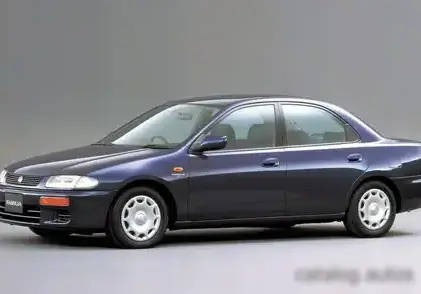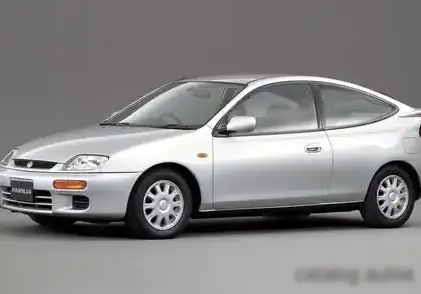
The Mazda Familia Hatchback 1.3i (85 hp) was a compact, five-door hatchback produced between 1994 and 1998. Part of the broader Familia lineage – known as the Mazda 323 in many export markets – this variant occupied the entry-level position within the hatchback range. It was primarily aimed at buyers seeking economical and practical transportation, particularly in markets where smaller, fuel-efficient vehicles were favored. This generation of Familia (often referred to internally as the BJ series) represented a significant step forward in Mazda’s design and engineering, offering improved refinement and a more modern driving experience compared to its predecessors. The 1.3i model, with its modest power output and focus on affordability, played a crucial role in establishing the Familia as a popular choice in its segment.
Technical Specifications
| Brand | Mazda |
| Model | Familia |
| Generation | Familia Hatchback |
| Type (Engine) | 1.3 i (85 Hp) |
| Start of production | 1994 |
| End of production | 1998 |
| Powertrain Architecture | Internal Combustion engine |
| Body type | Hatchback |
| Seats | 5 |
| Doors | 5 |
| Fuel Type | Petrol (Gasoline) |
| Weight-to-power ratio | 15.6 kg/Hp, 64.2 Hp/tonne |
| Weight-to-torque ratio | 12 kg/Nm, 83.1 Nm/tonne |
| Power | 85 Hp @ 6000 rpm |
| Power per litre | 64.2 Hp/l |
| Torque | 110 Nm @ 4000 rpm, 81.13 lb.-ft. @ 4000 rpm |
| Engine layout | Front, Transverse |
| Engine Model/Code | B3 |
| Engine displacement | 1323 cm3, 80.73 cu. in. |
| Number of cylinders | 4 |
| Engine configuration | Inline |
| Cylinder Bore | 71 mm, 2.8 in. |
| Piston Stroke | 83.6 mm, 3.29 in. |
| Compression ratio | 9:1 |
| Number of valves per cylinder | 4 |
| Fuel injection system | Multi-port manifold injection |
| Engine aspiration | Naturally aspirated engine |
| Valvetrain | DOHC |
| Kerb Weight | 1323 kg, 2916.72 lbs |
| Fuel tank capacity | 50 l, 13.21 US gal | 11 UK gal |
| Length | 4035 mm, 158.86 in. |
| Width | 1695 mm, 66.73 in. |
| Height | 1170 mm, 46.06 in. |
| Wheelbase | 2505 mm, 98.62 in. |
| Front track | 1460 mm, 57.48 in. |
| Rear (Back) track | 1460 mm, 57.48 in. |
| Drivetrain Architecture | The Internal combustion engine (ICE) drives the front wheels of the vehicle. |
| Drive wheel | Front wheel drive |
| Front brakes | Ventilated discs |
| Rear brakes | Drum |
Powertrain & Engine Architecture
The heart of the Familia 1.3i was the B3 engine, a 1.3-liter, inline-four cylinder gasoline engine. This engine utilized a naturally aspirated configuration and a multi-port fuel injection system, contributing to reasonable fuel efficiency. The B3 featured a double overhead camshaft (DOHC) valvetrain, operating four valves per cylinder, which helped to optimize breathing and improve power delivery, despite its relatively small displacement. The engine produced 85 horsepower at 6000 rpm and 110 Nm (81.13 lb-ft) of torque at 4000 rpm. The engine’s 9:1 compression ratio was a typical value for the time, balancing performance and fuel economy. The transmission paired with the B3 engine in this variant was a four-speed automatic. This automatic transmission was chosen to provide ease of use and accessibility for a broader range of drivers, particularly those prioritizing convenience over sporty driving dynamics.
Driving Characteristics
The Familia 1.3i Automatic offered a comfortable, if not particularly exhilarating, driving experience. The four-speed automatic transmission, while smooth, was geared towards fuel efficiency rather than rapid acceleration. Acceleration from 0 to 60 mph was estimated to be around 13-14 seconds, making it slower than the manual transmission versions or those equipped with larger engines. The gear ratios were spaced to prioritize low-end torque and smooth cruising, rather than aggressive upshifts. In real-world conditions, the 1.3i proved adequate for city driving and highway cruising, but struggled when fully loaded or attempting quick overtaking maneuvers. The suspension, tuned for comfort, absorbed bumps reasonably well, but didn’t offer the sharp handling characteristics of more performance-oriented models.
Equipment & Trim Levels
The 1.3i trim level represented the base model in the Familia hatchback range. Standard equipment typically included power steering, central locking, and basic instrumentation. Interior upholstery was usually cloth, with a simple dashboard layout. Air conditioning was often an optional extra, as were power windows and a radio/cassette player. The overall interior design was functional and durable, prioritizing practicality over luxury. Higher trim levels, such as the 1.5i or 1.8i models, offered more features, including alloy wheels, upgraded interior trim, and additional convenience items.
Chassis & Braking
The Familia 1.3i utilized a front-wheel-drive layout with independent front suspension and a torsion beam rear suspension. The front brakes were ventilated discs, providing adequate stopping power for the vehicle’s weight and performance. However, the rear brakes were drums, a cost-saving measure common in entry-level models of the time. The suspension was tuned for comfort, with relatively soft springs and dampers. Stabilizer bars were present, but were typically smaller in diameter compared to those found on higher-spec models. This setup prioritized ride quality over handling precision.
Market Reception & Comparison
The Mazda Familia 1.3i Automatic was generally well-received as an affordable and reliable city car. Critics praised its fuel efficiency and ease of driving, but noted its lack of outright performance. Compared to its siblings, such as the 1.5i or 1.8i models, the 1.3i offered significantly less power and a more basic level of equipment. However, it also came with a lower price tag, making it an attractive option for budget-conscious buyers. Fuel economy was a strong point, typically achieving around 35-40 mpg in mixed driving conditions. Reliability was also generally good, with the B3 engine proving to be durable and relatively maintenance-free.
Legacy
The Mazda Familia 1.3i Automatic, while not a performance icon, remains a fondly remembered vehicle for many owners. The B3 engine, when properly maintained, proved to be a reliable and long-lasting unit. In the used car market, these models are often sought after for their affordability and simplicity. Parts availability is generally good, and maintenance costs are relatively low. While not as desirable as higher-spec versions, the 1.3i represents a practical and economical choice for those seeking a classic Mazda hatchback. Its enduring appeal lies in its blend of affordability, reliability, and ease of use, making it a solid choice for everyday transportation.