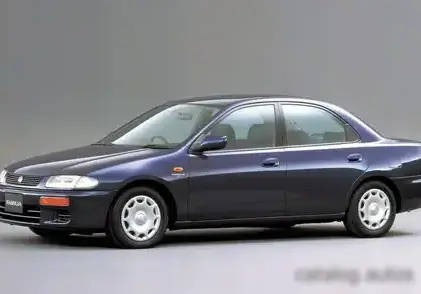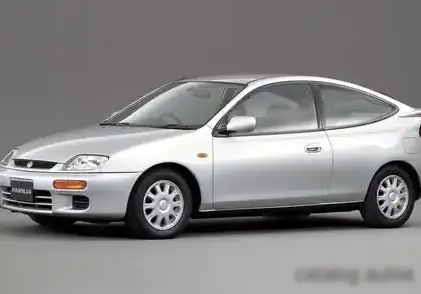
The Mazda Familia Hatchback 1.5, producing 110 horsepower, was a key variant within the broader Familia (also known as the 323 in some markets) hatchback range produced between 1989 and 1994. This generation, internally designated as the BG series, represented a significant step forward for Mazda in terms of styling, technology, and overall refinement. The 1.5-liter model occupied a middle ground in the Familia lineup, offering a balance between affordability, fuel efficiency, and acceptable performance for everyday driving. It was primarily aimed at buyers seeking a practical and reliable family vehicle, particularly in markets where smaller, fuel-efficient cars were highly valued.
Technical Specifications
| Brand | Mazda |
| Model | Familia |
| Generation | Familia Hatchback |
| Type (Engine) | 1.5 (110 Hp) |
| Start of production | 1989 |
| End of production | 1994 |
| Powertrain Architecture | Internal Combustion engine |
| Body type | Hatchback |
| Seats | 5 |
| Doors | 5 |
| Fuel Type | Petrol (Gasoline) |
| Power | 110 Hp @ 6000 rpm |
| Power per litre | 73.4 Hp/l |
| Torque | 137 Nm @ 4000 rpm |
| Torque (lb-ft) | 101.05 lb.-ft. @ 4000 rpm |
| Engine layout | Front, Transverse |
| Engine Model/Code | ZL-DE |
| Engine displacement | 1498 cm3 |
| Engine displacement (cu. in.) | 91.41 cu. in. |
| Number of cylinders | 4 |
| Engine configuration | Inline |
| Cylinder Bore | 78 mm |
| Cylinder Bore (in.) | 3.07 in. |
| Piston Stroke | 78.6 mm |
| Piston Stroke (in.) | 3.09 in. |
| Compression ratio | 9:1 |
| Number of valves per cylinder | 4 |
| Fuel injection system | Multi-port manifold injection |
| Engine aspiration | Naturally aspirated engine |
| Valvetrain | DOHC |
| Fuel tank capacity | 50 l |
| Fuel tank capacity (US gal) | 13.21 US gal |
| Fuel tank capacity (UK gal) | 11 UK gal |
| Length | 3995 mm |
| Length (in.) | 157.28 in. |
| Width | 1675 mm |
| Width (in.) | 65.94 in. |
| Height | 1380 mm |
| Height (in.) | 54.33 in. |
| Wheelbase | 2450 mm |
| Wheelbase (in.) | 96.46 in. |
| Front track | 1430 mm |
| Front track (in.) | 56.3 in. |
| Rear track | 1435 mm |
| Rear track (in.) | 56.5 in. |
| Drivetrain Architecture | Internal Combustion engine (ICE) drives the front wheels |
| Drive wheel | Front wheel drive |
| Front brakes | Ventilated discs |
| Rear brakes | Drum |
Powertrain & Engine Architecture
The heart of the Familia 1.5 was the ZL-DE engine, a 1.5-liter inline-four cylinder gasoline engine. This engine featured a double overhead camshaft (DOHC) valvetrain operating four valves per cylinder, contributing to its relatively high output for its displacement. The ZL-DE utilized multi-port fuel injection, a common technology at the time, which improved fuel atomization and combustion efficiency compared to earlier carburetor-based systems. The 9:1 compression ratio was a compromise between performance and the ability to run on the available fuel grades. The engine was transversely mounted in the front of the vehicle, driving the front wheels. While a five-speed manual transmission was available on other Familia models, the 1.5-liter version was most commonly paired with a four-speed automatic transmission. This automatic was a conventional hydraulic control unit, offering smooth but not particularly sporty shifts.
Driving Characteristics
The Familia 1.5 with the automatic transmission delivered adequate, though not exhilarating, performance. The 110 horsepower output provided sufficient power for typical urban and highway driving, but acceleration was noticeably slower than the manual transmission or higher-powered variants. The four-speed automatic transmission, while providing convenience, had relatively widely spaced gear ratios, which could result in the engine feeling strained during quick acceleration or when climbing hills. The automatic’s shift points were calibrated for fuel economy and smooth operation, prioritizing comfort over performance. Compared to the more driver-focused manual transmission versions, the automatic felt less engaging. However, it was a popular choice for buyers who preferred the ease of use and convenience of an automatic gearbox.
Equipment & Trim Levels
The 1.5-liter Familia typically came with a reasonably well-equipped standard package. Base models generally included features such as power steering, a basic audio system, cloth upholstery, and manual windows and locks. Higher trim levels, often denoted by designations like “LX” or “GLX”, added features such as alloy wheels, upgraded interior trim, a more sophisticated audio system, and optional extras like air conditioning and power windows. The interior design was functional and straightforward, prioritizing practicality and durability. Dashboard layouts were typically dark-colored, with clearly labeled controls. The hatchback body style offered good cargo versatility, with the rear seats folding down to create a larger loading area.
Chassis & Braking
The Familia Hatchback utilized a MacPherson strut front suspension and a torsion beam rear suspension. This setup provided a good balance between ride comfort and handling. The front suspension featured coil springs and a stabilizer bar to reduce body roll during cornering. The rear suspension, while simpler, was effective in providing a comfortable ride. Braking duties were handled by ventilated disc brakes at the front and drum brakes at the rear. This configuration was common for vehicles in this class at the time, offering adequate stopping power for everyday driving. The steering was rack-and-pinion, providing precise and responsive steering feel.
Market Reception & Comparison
The Mazda Familia 1.5 Automatic was generally well-received by automotive critics as a practical and reliable family car. It was praised for its fuel efficiency, comfortable ride, and spacious interior. However, some reviewers noted that the performance was somewhat underwhelming, particularly with the automatic transmission. Compared to other trims in the Familia lineup, such as the 1.6-liter or the more powerful versions, the 1.5-liter offered a more affordable entry point but at the expense of performance. It competed with other small hatchbacks of the era, such as the Toyota Corolla, Honda Civic, and Nissan Sentra, offering a similar level of practicality and reliability.
Legacy
The ZL-DE engine and the Familia BG series as a whole are generally regarded as reliable and durable. The engine is known for its longevity, and many examples are still on the road today. The four-speed automatic transmission, while not the most advanced, is also relatively robust. In the used car market, the Familia 1.5 Automatic represents a good value for buyers seeking an affordable and dependable compact hatchback. Maintenance costs are generally low, and parts availability is still reasonable. The Familia BG series helped solidify Mazda’s reputation for building well-engineered and reliable vehicles, paving the way for future successes in the compact car segment.