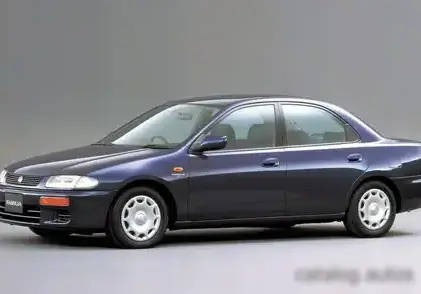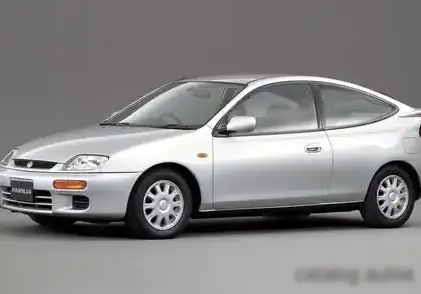
The Mazda Familia Hatchback 1.5 i (91 hp) was a popular subcompact car produced between 1989 and 1994. Representing the third generation of the Familia, this hatchback variant played a significant role in Mazda’s lineup, particularly in markets outside of North America where the Familia nameplate was more widely recognized. This specific 1.5-liter engine and trim level served as a practical and economical entry point into the Familia range, offering a balance between fuel efficiency and everyday usability. It was positioned as a mainstream offering, appealing to buyers seeking reliable transportation rather than outright performance.
Technical Specifications
| Brand | Mazda |
| Model | Familia |
| Generation | Familia Hatchback |
| Type (Engine) | 1.5 i (91 Hp) |
| Start of production | 1989 |
| End of production | 1994 |
| Powertrain Architecture | Internal Combustion engine |
| Body type | Hatchback |
| Seats | 5 |
| Doors | 5 |
| Fuel Type | Petrol (Gasoline) |
| Power | 91 Hp @ 6500 rpm |
| Power per litre | 60.7 Hp/l |
| Torque | 122 Nm @ 4000 rpm |
| Torque (lb.-ft.) | 89.98 lb.-ft. @ 4000 rpm |
| Engine layout | Front, Transverse |
| Engine Model/Code | B5 |
| Engine displacement | 1498 cm3 |
| Engine displacement (cu. in.) | 91.41 cu. in. |
| Number of cylinders | 4 |
| Engine configuration | Inline |
| Cylinder Bore | 78 mm |
| Cylinder Bore (in.) | 3.07 in. |
| Piston Stroke | 78.6 mm |
| Piston Stroke (in.) | 3.09 in. |
| Compression ratio | 9:1 |
| Number of valves per cylinder | 4 |
| Fuel injection system | Multi-port manifold injection |
| Engine aspiration | Naturally aspirated engine |
| Valvetrain | DOHC |
| Fuel tank capacity | 50 l |
| Fuel tank capacity (US gal) | 13.21 US gal |
| Fuel tank capacity (UK gal) | 11 UK gal |
| Length | 3995 mm |
| Length (in.) | 157.28 in. |
| Width | 1675 mm |
| Width (in.) | 65.94 in. |
| Height | 1380 mm |
| Height (in.) | 54.33 in. |
| Wheelbase | 2450 mm |
| Wheelbase (in.) | 96.46 in. |
| Front track | 1430 mm |
| Front track (in.) | 56.3 in. |
| Rear track | 1435 mm |
| Rear track (in.) | 56.5 in. |
| Drivetrain Architecture | Internal Combustion engine (ICE) drives the front wheels |
| Drive wheel | Front wheel drive |
| Front brakes | Ventilated discs |
| Rear brakes | Drum |
Powertrain & Engine Architecture
The heart of the Familia 1.5 i was the B5 engine, a 1.5-liter inline-four cylinder gasoline engine. This engine featured a double overhead camshaft (DOHC) valvetrain operating four valves per cylinder, contributing to improved breathing and efficiency. The B5 utilized a multi-port fuel injection system, delivering fuel directly to each intake port for precise fuel metering. The 9:1 compression ratio was a typical value for naturally aspirated engines of the era, balancing performance and fuel economy. The engine produced 91 horsepower at 6500 rpm and 122 Nm (89.98 lb-ft) of torque at 4000 rpm. The Familia 1.5 i was typically equipped with a four-speed automatic transmission. This transmission was designed for smooth, comfortable shifts, prioritizing ease of use over sporty responsiveness. The automatic transmission’s gear ratios were geared towards fuel efficiency and relaxed cruising.
Driving Characteristics
The 1.5 i automatic Familia offered a comfortable, if not particularly exhilarating, driving experience. Acceleration was adequate for everyday driving, but the 91 hp output meant it wasn’t a particularly quick vehicle. The automatic transmission, while smooth, did detract from the engine’s available power, resulting in a noticeable delay in response compared to the available five-speed manual transmission. The gear ratios were optimized for fuel economy, meaning the engine often operated at lower rpm during cruising. Compared to other Familia variants, such as those equipped with larger engines or manual transmissions, the 1.5 i automatic was the least performance-oriented option. It was geared towards drivers who prioritized ease of use and fuel efficiency over sporty handling or quick acceleration.
Equipment & Trim Levels
The Familia 1.5 i typically came with a fairly basic level of equipment, reflecting its position as an entry-level model. Standard features generally included cloth upholstery, a basic stereo system, and manual windows and door locks. Air conditioning was often an optional extra. Interior trim was functional and durable, prioritizing practicality over luxury. Higher trim levels of the Familia offered features such as power windows, central locking, and upgraded stereo systems. However, the 1.5 i model was generally offered with a more limited range of options to keep the price competitive.
Chassis & Braking
The Familia Hatchback utilized a front-wheel-drive layout with an independent suspension system at the front and a semi-independent torsion beam suspension at the rear. The front suspension featured MacPherson struts, while the rear torsion beam provided a compact and cost-effective solution. Braking was handled by ventilated disc brakes at the front and drum brakes at the rear. This configuration was common for vehicles in this class during the late 1980s and early 1990s. The braking system provided adequate stopping power for everyday driving, but lacked the performance of more advanced braking systems found on higher-end vehicles.
Market Reception & Comparison
The Mazda Familia 1.5 i was generally well-received as a practical and reliable subcompact car. Critics praised its fuel efficiency and comfortable ride, but noted its lack of outright performance. Compared to other trims in the Familia lineup, the 1.5 i automatic offered the lowest price point, making it an attractive option for budget-conscious buyers. Fuel economy was a key selling point, and the 1.5 i typically achieved respectable gas mileage for its time. Reliability was also a strong suit, with the B5 engine proving to be a durable and long-lasting unit. However, the automatic transmission was sometimes criticized for its sluggishness and lack of responsiveness.
Legacy
The Mazda Familia 1.5 i (91 hp) remains a relatively common sight on used car markets, particularly in regions where the Familia was widely sold. The B5 engine is known for its durability and relatively low maintenance costs. While not a particularly collectible model, the Familia 1.5 i is appreciated by enthusiasts for its simplicity, reliability, and affordability. Parts availability is generally good, and the car is relatively easy to maintain. The Familia 1.5 i represents a solid example of a well-engineered and practical subcompact car from the late 1980s and early 1990s, offering a dependable and economical transportation solution for many years.