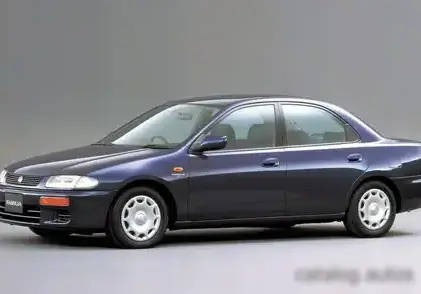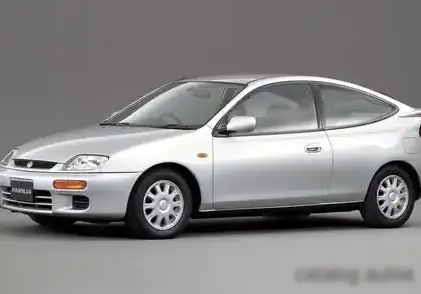
The Mazda Familia Hatchback 1.5i (97 hp) was a compact hatchback produced between 1994 and 1998, primarily aimed at the Japanese domestic market and select export regions. Representing the fifth generation of the Familia, this variant occupied an important position in Mazda’s lineup as an affordable and practical family vehicle. It was part of the broader Familia range, which included sedan and wagon body styles, and served as a stepping stone for Mazda’s evolving design and engineering philosophies. The 1.5i trim, with its 97 horsepower engine, was positioned as the entry-level offering in the hatchback range, prioritizing fuel efficiency and ease of use over outright performance.
Technical Specifications
| Brand | Mazda |
| Model | Familia |
| Generation | Familia Hatchback |
| Type (Engine) | 1.5 i (97 Hp) |
| Start of production | 1994 |
| End of production | 1998 |
| Powertrain Architecture | Internal Combustion engine |
| Body type | Hatchback |
| Seats | 5 |
| Doors | 5 |
| Fuel Type | Petrol (Gasoline) |
| Weight-to-power ratio | 13.6 kg/Hp, 73.3 Hp/tonne |
| Weight-to-torque ratio | 10 kg/Nm, 99.8 Nm/tonne |
| Power | 97 Hp @ 5500 rpm |
| Power per litre | 65.1 Hp/l |
| Torque | 132 Nm @ 4000 rpm, 97.36 lb.-ft. @ 4000 rpm |
| Engine layout | Front, Transverse |
| Engine Model/Code | Z5-DE |
| Engine displacement | 1489 cm3, 90.86 cu. in. |
| Number of cylinders | 4 |
| Engine configuration | Inline |
| Cylinder Bore | 75.3 mm, 2.96 in. |
| Piston Stroke | 83.6 mm, 3.29 in. |
| Compression ratio | 9:1 |
| Number of valves per cylinder | 4 |
| Fuel injection system | Multi-port manifold injection |
| Engine aspiration | Naturally aspirated engine |
| Valvetrain | DOHC |
| Kerb Weight | 1323 kg, 2916.72 lbs |
| Fuel tank capacity | 50 l, 13.21 US gal | 11 UK gal |
| Length | 4035 mm, 158.86 in. |
| Width | 1695 mm, 66.73 in. |
| Height | 1170 mm, 46.06 in. |
| Wheelbase | 2505 mm, 98.62 in. |
| Front track | 1460 mm, 57.48 in. |
| Rear (Back) track | 1460 mm, 57.48 in. |
| Drivetrain Architecture | The Internal combustion engine (ICE) drives the front wheels of the vehicle. |
| Drive wheel | Front wheel drive |
| Front brakes | Ventilated discs |
| Rear brakes | Drum |
Powertrain & Engine Architecture
The heart of the Familia 1.5i was the Z5-DE engine, a 1.5-liter inline-four cylinder gasoline engine. This engine utilized a multi-port fuel injection system, delivering fuel directly to each intake port for improved combustion efficiency. The engine featured a double overhead camshaft (DOHC) valvetrain, operating four valves per cylinder, which contributed to its relatively high output for its displacement. The 9:1 compression ratio was a typical value for naturally aspirated engines of the era, balancing performance and fuel economy. The engine was transversely mounted in the front of the vehicle, driving the front wheels. The transmission paired with the Z5-DE in this variant was a four-speed automatic. This automatic transmission was chosen to provide ease of use and convenience, appealing to a broader range of drivers, particularly those prioritizing comfort over sporty driving dynamics. While specific gear ratios varied slightly depending on the year and market, the transmission was generally tuned for smooth shifts and fuel efficiency.
Driving Characteristics
The Familia 1.5i Automatic offered a comfortable and predictable driving experience. With 97 horsepower and 132 Nm (97.36 lb-ft) of torque, acceleration was adequate for everyday driving, but not particularly brisk. The four-speed automatic transmission, while smooth, did contribute to a slightly less responsive feel compared to the available five-speed manual transmission. The automatic’s gear ratios were optimized for fuel economy, meaning that the engine often operated at lower RPMs during cruising. This resulted in a quieter cabin experience but could sometimes feel strained when attempting to overtake or climb hills. Compared to the higher-output versions of the Familia, such as those equipped with larger engines, the 1.5i Automatic prioritized fuel efficiency and ease of driving over outright performance. The suspension was tuned for comfort, providing a relatively soft ride quality, although this could result in some body roll during cornering.
Equipment & Trim Levels
The 1.5i trim level of the Familia Hatchback was generally considered the base model, but still offered a reasonable level of standard equipment. Typically, it included features such as power steering, central locking, and basic audio system. Interior upholstery was usually cloth, with a simple and functional dashboard layout. Optional extras available for the 1.5i included air conditioning, power windows, and upgraded audio systems. Higher trim levels, such as the ‘S’ or ‘GL’ variants, added features like alloy wheels, more luxurious interior trim, and additional convenience items. The 1.5i was targeted towards budget-conscious buyers and families who prioritized practicality and affordability.
Chassis & Braking
The Familia Hatchback utilized a front-wheel-drive chassis with independent suspension at the front and a torsion beam rear suspension. The front suspension consisted of MacPherson struts, while the rear employed a simpler torsion beam setup to reduce cost and complexity. Braking was comprised of ventilated discs on the front wheels and drum brakes on the rear. This configuration was common for vehicles in this class during the mid-1990s. The braking system provided adequate stopping power for everyday driving, but lacked the performance of more advanced systems found on higher-end vehicles. Stabilizer bars were typically included on both the front and rear axles to reduce body roll during cornering.
Market Reception & Comparison
The Mazda Familia 1.5i Automatic was generally well-received as a practical and affordable family car. Critics praised its fuel efficiency, comfortable ride, and ease of use. However, some reviewers noted that its performance was somewhat lacking compared to competitors and higher-trim Familia models. In terms of fuel economy, the 1.5i Automatic offered competitive figures for its class, typically achieving around 30-35 mpg in mixed driving conditions. Reliability was generally good, with the Z5-DE engine proving to be a durable and dependable unit. Compared to the manual transmission version of the 1.5i, the automatic offered less driver engagement but greater convenience. Against rivals like the Toyota Corolla and Honda Civic, the Familia 1.5i offered a compelling value proposition, particularly in markets where Mazda had a strong brand presence.
Legacy
The Mazda Familia 1.5i Automatic, while not the most powerful or technologically advanced version of the Familia, remains a fondly remembered vehicle for many owners. The Z5-DE engine, when properly maintained, has proven to be a reliable and long-lasting powertrain. In the used car market, these Familia hatchbacks are often sought after for their affordability, practicality, and relatively low running costs. While finding parts may become increasingly challenging as the vehicle ages, the Familia’s simple mechanical design makes it relatively easy to repair and maintain. The Familia 1.5i Automatic represents a significant chapter in Mazda’s history, showcasing the company’s commitment to building affordable and reliable vehicles for the masses.