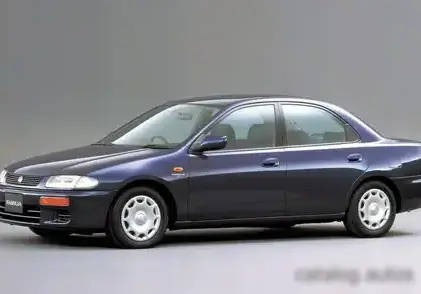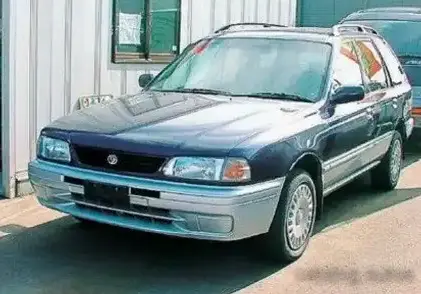
The Mazda Familia Wagon 1.6i (85 hp) was a practical and popular station wagon produced between 1989 and 1994. Part of the broader Mazda Familia lineage – known as the 323 in many export markets – this variant occupied a key position in Mazda’s lineup, offering a balance of affordability, fuel efficiency, and cargo space. It was primarily aimed at families and individuals needing a versatile vehicle for everyday use. The Familia Wagon, in general, represented Mazda’s commitment to providing reliable and functional transportation, and the 1.6i model was a cornerstone of that strategy during its production run.
Technical Specifications
| Brand | Mazda |
| Model | Familia |
| Generation | Familia Wagon |
| Type (Engine) | 1.6 i (85 Hp) |
| Start of production | 1989 |
| End of production | 1994 |
| Powertrain Architecture | Internal Combustion engine |
| Body type | Station wagon (estate) |
| Seats | 5 |
| Doors | 5 |
| Fuel Type | Petrol (Gasoline) |
| Power | 85 Hp @ 5500 rpm |
| Power per litre | 53.2 Hp/l |
| Torque | 123 Nm @ 2500 rpm / 90.72 lb.-ft. @ 2500 rpm |
| Engine layout | Front, Transverse |
| Engine Model/Code | E5 |
| Engine displacement | 1597 cm3 / 97.45 cu. in. |
| Number of cylinders | 4 |
| Engine configuration | Inline |
| Number of valves per cylinder | 4 |
| Fuel injection system | Multi-port manifold injection |
| Engine aspiration | Naturally aspirated engine |
| Valvetrain | OHC |
| Fuel tank capacity | 50 l / 13.21 US gal | 11 UK gal |
| Length | 4220 mm / 166.14 in. |
| Width | 1645 mm / 64.76 in. |
| Height | 1410 mm / 55.51 in. |
| Minimum turning circle | 11 m / 36.09 ft. |
| Drivetrain Architecture | The Internal combustion engine (ICE) drives the front wheels of the vehicle. |
| Drive wheel | Front wheel drive |
| Front brakes | Ventilated discs |
| Rear brakes | Drum |
Powertrain & Engine Architecture
The heart of the Familia Wagon 1.6i was the E5 engine, a 1.6-liter inline-four cylinder gasoline engine. This engine utilized a single overhead camshaft (OHC) valvetrain, operating four valves per cylinder. The E5 engine was known for its relative simplicity and durability, characteristics valued in a family-oriented vehicle. Fuel delivery was managed by a multi-port fuel injection system, contributing to improved fuel efficiency and smoother operation compared to earlier carburetor-equipped engines. The 85 horsepower output at 5500 rpm and 123 Nm (90.72 lb-ft) of torque at 2500 rpm were typical figures for engines of this displacement and era. The engine was transversely mounted in the front of the vehicle, driving the front wheels. While not a performance powerhouse, the E5 engine provided adequate power for everyday driving and hauling loads. The transmission paired with this engine was a four-speed automatic, designed for ease of use and convenience. This automatic transmission, while offering smooth shifts, did contribute to slightly lower fuel economy and acceleration compared to the available five-speed manual transmission.
Driving Characteristics
The Familia Wagon 1.6i with the automatic transmission offered a comfortable, if not particularly sporty, driving experience. Acceleration was adequate for merging onto highways and navigating city streets, but it wasn’t designed for quick bursts of speed. The automatic transmission’s gear ratios were optimized for fuel economy and smooth cruising, rather than aggressive performance. Compared to the manual transmission version, the automatic resulted in a noticeable decrease in responsiveness. The suspension, tuned for comfort, absorbed bumps and road imperfections reasonably well, providing a stable ride. Steering was light and easy, making it maneuverable in tight spaces. The overall driving experience was geared towards practicality and ease of use, making it a suitable choice for drivers prioritizing comfort and convenience over performance.
Equipment & Trim Levels
The 1.6i trim level of the Familia Wagon typically included features considered standard for the time. These included cloth upholstery, a basic AM/FM radio, and manual windows and door locks. Power steering was often included, enhancing the driving experience. Depending on the market and optional packages, features like air conditioning, upgraded audio systems, and alloy wheels could be added. The interior was functional and straightforward, prioritizing durability and ease of cleaning. The dashboard layout was simple and intuitive, with clearly labeled controls. The Familia Wagon was not positioned as a luxury vehicle, so the interior appointments were modest but practical.
Chassis & Braking
The Familia Wagon utilized a front-wheel-drive chassis with an independent front suspension and a semi-independent rear suspension. The front suspension typically consisted of MacPherson struts, while the rear suspension employed a torsion beam setup. This configuration provided a good balance of ride comfort and handling. Braking duties were handled by ventilated disc brakes on the front wheels and drum brakes on the rear wheels. This combination was common for vehicles in this class during the late 1980s and early 1990s. The braking system was adequate for normal driving conditions, but it lacked the stopping power of more modern braking systems. A stabilizer bar was typically fitted to the front suspension to reduce body roll during cornering.
Market Reception & Comparison
The Mazda Familia Wagon 1.6i was generally well-received by critics and consumers alike. It was praised for its practicality, fuel efficiency, and reliability. However, the automatic transmission was sometimes criticized for its lack of responsiveness compared to the manual version. Compared to other station wagons in its class, such as the Toyota Corolla Wagon and the Nissan Sunny Wagon, the Familia Wagon offered a competitive combination of features and price. The 1.6i engine provided a good balance of power and fuel economy, making it a popular choice for families. The automatic transmission appealed to drivers who preferred the convenience of not having to shift gears manually.
Legacy
The Mazda Familia Wagon 1.6i has proven to be a relatively reliable vehicle over the long term. The E5 engine is known for its durability, and the automatic transmission, while not the most sophisticated, has generally held up well. Today, these wagons are becoming increasingly rare, but they are still sought after by enthusiasts and collectors. Parts availability can be a challenge, but many components are still available through aftermarket suppliers. The Familia Wagon 1.6i represents a bygone era of practical and affordable family transportation, and it remains a fondly remembered vehicle for many who owned one.