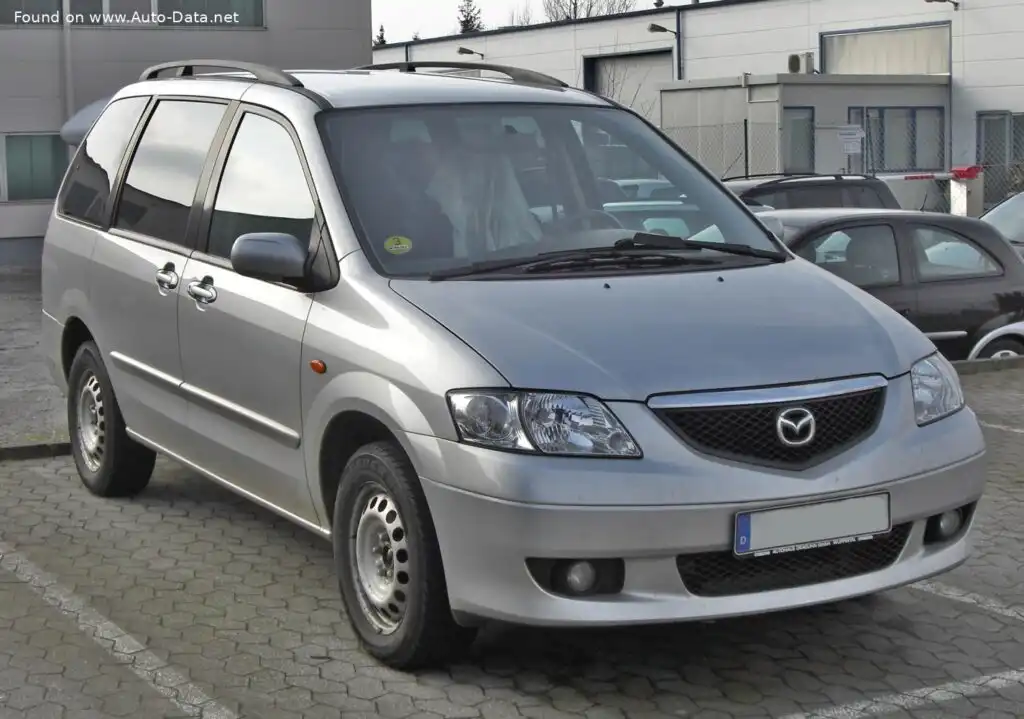
The Mazda MPV first generation (LV), produced from 1996 to 1999, represented Mazda’s entry into the increasingly popular minivan segment. While the MPV was sold in North America and other markets, the 2.5 TD variant with 115 horsepower was primarily aimed at European and Asian markets where diesel engines were favored for their fuel efficiency and torque. This model occupied a middle ground in the MPV lineup, offering a balance between affordability and practicality for families needing a spacious seven-passenger vehicle. It served as a competitor to vehicles like the Toyota Previa and Volkswagen Sharan, offering a unique rear-wheel drive layout in a segment dominated by front-wheel drive minivans.
Technical Specifications
| Brand | Mazda |
| Model | MPV |
| Generation | MPV I (LV) |
| Type (Engine) | 2.5 TD (115 Hp) |
| Start of production | 1996 |
| End of production | 1999 |
| Powertrain Architecture | Internal Combustion engine |
| Body type | Minivan |
| Seats | 7 |
| Doors | 4 |
| Fuel consumption (combined) | 8.9 l/100 km (26.4 US mpg, 31.7 UK mpg, 11.2 km/l) |
| Fuel Type | Diesel |
| Acceleration 0 – 100 km/h | 16.4 sec |
| Acceleration 0 – 62 mph | 16.4 sec |
| Acceleration 0 – 60 mph | 15.6 sec |
| Maximum speed | 165 km/h (102.53 mph) |
| Weight-to-power ratio | 15.4 kg/Hp (64.8 Hp/tonne) |
| Weight-to-torque ratio | 6.4 kg/Nm (156.1 Nm/tonne) |
| Power | 115 Hp @ 3400 rpm |
| Power per litre | 46 Hp/l |
| Torque | 277 Nm @ 2000 rpm (204.3 lb.-ft. @ 2000 rpm) |
| Engine layout | Front, Longitudinal |
| Engine Model/Code | WL11 |
| Engine displacement | 2499 cm3 (152.5 cu. in.) |
| Number of cylinders | 4 |
| Engine configuration | Inline |
| Cylinder Bore | 93 mm (3.66 in.) |
| Piston Stroke | 92 mm (3.62 in.) |
| Compression ratio | 19.8:1 |
| Number of valves per cylinder | 3 |
| Fuel injection system | Precombustion chamber injection |
| Engine aspiration | Turbocharger |
| Valvetrain | OHC |
| Engine oil capacity | 6.8 l (7.19 US qt | 5.98 UK qt) |
| Coolant | 7.5 l (7.93 US qt | 6.6 UK qt) |
| Kerb Weight | 1775 kg (3913.21 lbs.) |
| Max. weight | 2370 kg (5224.96 lbs.) |
| Max load | 595 kg (1311.75 lbs.) |
| Trunk (boot) space – minimum | 282 l (9.96 cu. ft.) |
| Fuel tank capacity | 74 l (19.55 US gal | 16.28 UK gal) |
| Length | 4670 mm (183.86 in.) |
| Width | 1825 mm (71.85 in.) |
| Height | 1750 mm (68.9 in.) |
| Wheelbase | 2805 mm (110.43 in.) |
| Front track | 1525 mm (60.04 in.) |
| Rear (Back) track | 1540 mm (60.63 in.) |
| Drivetrain Architecture | The Internal combustion engine (ICE) drives the rear wheels of the vehicle. |
| Drive wheel | Rear wheel drive |
| Number of gears and type of gearbox | 5 gears, manual transmission |
| Front suspension | Wishbone |
| Rear suspension | Coil spring |
| Front brakes | Ventilated discs |
| Rear brakes | Ventilated discs |
| Assisting systems | ABS (Anti-lock braking system) |
| Steering type | Steering rack and pinion |
| Power steering | Hydraulic Steering |
| Tires size | 215/65 R15 |
| Wheel rims size | 15 |
Powertrain & Engine Architecture
The heart of the MPV 2.5 TD is the WL11 engine, a 2.5-liter inline-four cylinder diesel. This engine utilized a precombustion chamber injection system, a common technology in diesel engines of the era, designed to improve combustion efficiency and reduce noise. The turbocharger significantly boosted power output, bringing it to 115 horsepower at 3400 rpm and a respectable 277 Nm (204.3 lb.-ft.) of torque at 2000 rpm. The engine featured an overhead camshaft (OHC) valvetrain with three valves per cylinder. The five-speed manual transmission was the only gearbox option available with this engine, providing a direct connection to the rear wheels. The longitudinal engine placement, coupled with rear-wheel drive, was an unusual configuration for a minivan, offering a different driving experience compared to the more common front-wheel drive layouts.
Driving Characteristics
The 2.5 TD engine, while not exceptionally powerful, provided adequate performance for the MPV, especially considering its size and weight. Acceleration from 0 to 100 km/h (0-62 mph) took around 16.4 seconds. The turbocharger helped to mitigate turbo lag, delivering a usable surge of power in the mid-range. The rear-wheel drive configuration contributed to a more balanced feel, particularly when fully loaded. Compared to the gasoline-powered MPV variants, the 2.5 TD offered significantly better fuel economy, making it a practical choice for long-distance travel. However, it lacked the outright acceleration of the higher-powered gasoline engines. The five-speed manual transmission allowed for precise control, but the gear ratios were tuned for fuel efficiency rather than sporty performance.
Equipment & Trim Levels
The 2.5 TD trim level of the Mazda MPV typically included features such as power windows, central locking, and air conditioning as standard equipment. Interior upholstery was generally cloth, with options for upgraded materials available. The dashboard layout was functional and straightforward, prioritizing practicality over luxury. Optional extras included a sunroof, upgraded audio system, and alloy wheels. The MPV was designed with family use in mind, offering a flexible seating arrangement with the ability to fold or remove seats to maximize cargo space. Safety features included ABS (Anti-lock Braking System) as standard.
Chassis & Braking
The MPV’s chassis featured a wishbone suspension at the front and a coil spring suspension at the rear. This setup provided a comfortable ride, although it wasn’t particularly sporty. The MPV 2.5 TD was equipped with ventilated disc brakes on all four wheels, providing adequate stopping power for its weight class. The rear-wheel drive layout necessitated a more robust rear suspension to handle the increased load. Stabilizer bars were included to reduce body roll during cornering.
Market Reception & Comparison
The Mazda MPV 2.5 TD was generally well-received in markets where diesel engines were popular. Critics praised its fuel efficiency, spacious interior, and unique rear-wheel drive layout. However, some reviewers noted its relatively slow acceleration compared to gasoline-powered minivans. Compared to other MPV trims, the 2.5 TD offered the best fuel economy but the lowest performance. It appealed to buyers who prioritized practicality and running costs over outright speed. The reliability of the WL11 engine was generally considered good, although maintenance costs could be higher than those of gasoline engines due to the complexity of the diesel fuel injection system.
Legacy
The Mazda MPV 2.5 TD, while not a high-volume seller, holds a unique place in the minivan market. Its rear-wheel drive layout and diesel engine option set it apart from its competitors. Today, these vehicles are relatively rare and sought after by enthusiasts who appreciate their distinctive character. The WL11 engine, when properly maintained, can provide long-term reliability. However, finding parts for these older diesel engines can be challenging. The MPV 2.5 TD remains a testament to Mazda’s willingness to experiment with different configurations and cater to diverse market demands.