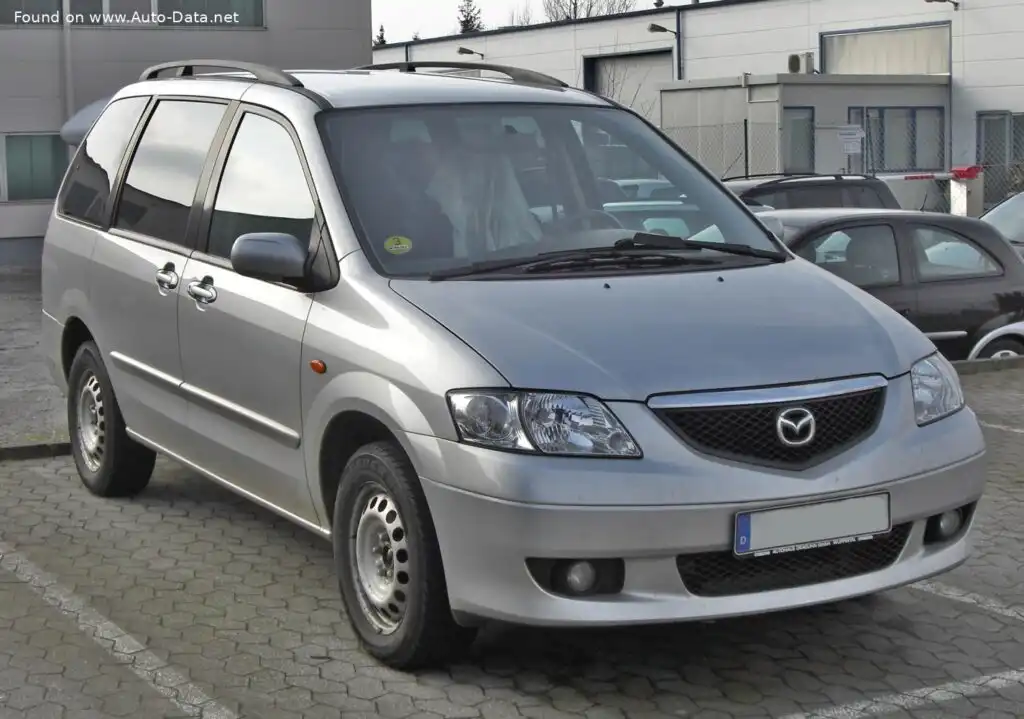
The Mazda MPV first generation (LV), produced from 1990 to 1999, represented Mazda’s entry into the increasingly popular minivan segment. This initial iteration of the MPV was notable for its rear-wheel-drive layout, a configuration relatively uncommon among its front-wheel-drive competitors, particularly in North America where it was primarily marketed. The 3.0i V6 variant, equipped with a 3.0-liter V6 engine producing 154 horsepower, occupied a position as the top-tier offering within the MPV lineup, aimed at buyers seeking more performance and refinement than the base four-cylinder models. It was a significant vehicle for Mazda, expanding their product range and appealing to families needing space and versatility.
Technical Specifications
| Brand | Mazda |
| Model | MPV |
| Generation | MPV I (LV) |
| Type (Engine) | 3.0 i V6 (154 Hp) |
| Start of production | 1990 |
| End of production | 1999 |
| Powertrain Architecture | Internal Combustion engine |
| Body type | Minivan |
| Seats | 7 |
| Doors | 4 |
| Fuel consumption (combined) | 11.7 l/100 km (20.1 US mpg, 24.1 UK mpg, 8.5 km/l) |
| Fuel Type | Petrol (Gasoline) |
| Maximum speed | 170 km/h (105.63 mph) |
| Weight-to-power ratio | 11.9 kg/Hp, 84.1 Hp/tonne |
| Weight-to-torque ratio | 8 kg/Nm, 125.6 Nm/tonne |
| Power | 154 Hp @ 5000 rpm |
| Power per litre | 52.1 Hp/l |
| Torque | 230 Nm @ 4000 rpm (169.64 lb.-ft. @ 4000 rpm) |
| Engine layout | Front, Longitudinal |
| Engine displacement | 2954 cm3 (180.26 cu. in.) |
| Number of cylinders | 6 |
| Engine configuration | V-engine |
| Cylinder Bore | 90 mm (3.54 in.) |
| Piston Stroke | 77.4 mm (3.05 in.) |
| Compression ratio | 8.5:1 |
| Number of valves per cylinder | 3 |
| Fuel injection system | Multi-port manifold injection |
| Engine aspiration | Naturally aspirated engine |
| Valvetrain | OHC |
| Kerb Weight | 1831 kg (4036.66 lbs.) |
| Max. weight | 2356 kg (5194.09 lbs.) |
| Max load | 525 kg (1157.43 lbs.) |
| Trunk (boot) space – minimum | 335 l (11.83 cu. ft.) |
| Trunk (boot) space – maximum | 1060 l (37.43 cu. ft.) |
| Fuel tank capacity | 74 l (19.55 US gal | 16.28 UK gal) |
| Length | 4465 mm (175.79 in.) |
| Width | 1826 mm (71.89 in.) |
| Height | 1694 mm (66.69 in.) |
| Wheelbase | 2805 mm (110.43 in.) |
| Front track | 1525 mm (60.04 in.) |
| Rear (Back) track | 1540 mm (60.63 in.) |
| Drivetrain Architecture | The Internal combustion engine (ICE) drives the rear wheels of the vehicle. |
| Drive wheel | Rear wheel drive |
| Number of gears and type of gearbox | 5 gears, manual transmission |
| Front suspension | Wishbone |
| Rear suspension | Coil spring |
| Front brakes | Ventilated discs |
| Rear brakes | Disc |
| Assisting systems | ABS (Anti-lock braking system) |
| Steering type | Steering rack and pinion |
| Power steering | Hydraulic Steering |
| Tires size | 215/65 R15 |
| Wheel rims size | 15 |
Powertrain & Engine Architecture
The heart of the 3.0i V6 MPV was the JE series 3.0-liter V6 engine. This engine, utilizing a 60-degree V-angle, was designed for smooth operation and reasonable power output. It featured a single overhead camshaft (OHC) design per cylinder bank, operating three valves per cylinder (two intake, one exhaust). The engine employed multi-port fuel injection, delivering fuel directly to each intake port for improved combustion efficiency. The 8.5:1 compression ratio was a compromise between performance and the fuel quality available in various markets. Paired with this engine was a 5-speed manual transmission, providing drivers with direct control over the rear wheels. The longitudinal engine placement, necessitated by the rear-wheel-drive layout, contributed to a more balanced weight distribution compared to front-wheel-drive minivans.
Driving Characteristics
The 154 horsepower and 230 Nm (169.64 lb-ft) of torque provided by the 3.0L V6 offered a noticeable step up in performance compared to the base 2.2L four-cylinder engine. While not a sports car, the MPV 3.0i V6 provided adequate acceleration for highway merging and passing maneuvers. The rear-wheel-drive configuration offered a different driving feel than the more common front-wheel-drive minivans, with a more traditional car-like handling balance. The 5-speed manual transmission allowed drivers to maximize engine power and control, although the gear ratios were tuned more for fuel efficiency and comfortable cruising than outright performance. Compared to the four-cylinder models, the V6 offered a smoother and quieter driving experience, particularly at higher speeds.
Equipment & Trim Levels
The 3.0i V6 MPV typically came with a more comprehensive list of standard features than the lower trims. These often included power windows and locks, air conditioning, and an upgraded sound system. Interior upholstery was typically cloth, although leather options were available. Dashboard configurations were relatively simple, focusing on functionality rather than elaborate styling. Optional extras could include a sunroof, upgraded audio systems, and alloy wheels. The V6 trim was positioned as the premium offering, appealing to buyers willing to pay extra for more comfort, convenience, and performance.
Chassis & Braking
The MPV’s chassis utilized an independent wishbone suspension in the front, providing a comfortable ride and reasonable handling. The rear suspension employed a coil spring setup. Braking duties were handled by ventilated discs in the front and solid discs in the rear. Anti-lock braking system (ABS) was standard on the 3.0i V6, enhancing safety by preventing wheel lockup during hard braking. The steering system was a rack-and-pinion setup with hydraulic power assistance, providing responsive and precise steering feel. The 215/65 R15 tires offered a good balance of ride comfort and grip.
Market Reception & Comparison
The Mazda MPV, particularly the 3.0i V6 variant, received generally positive reviews for its spacious interior, comfortable ride, and unique rear-wheel-drive layout. Critics noted that the rear-wheel-drive configuration provided a more car-like driving experience compared to front-wheel-drive competitors. However, some reviewers pointed out that the MPV’s fuel economy was not as competitive as some of its rivals. Compared to the base four-cylinder models, the V6 offered significantly improved performance and refinement, but at a higher price point. The V6 was often seen as a good value for buyers seeking a spacious and comfortable minivan with a bit more power.
Legacy
The first-generation Mazda MPV, and specifically the 3.0i V6 variant, holds a unique place in minivan history due to its rear-wheel-drive layout. While the second-generation MPV switched to a front-wheel-drive configuration, the first generation remains a favorite among enthusiasts who appreciate its distinctive driving characteristics. The JE series V6 engine proved to be relatively reliable, although regular maintenance is crucial for long-term durability. Today, well-maintained examples of the MPV 3.0i V6 are becoming increasingly collectible, appealing to those seeking a classic minivan with a unique personality. Parts availability can be a challenge, but a dedicated community of owners and online resources help to keep these vehicles on the road.