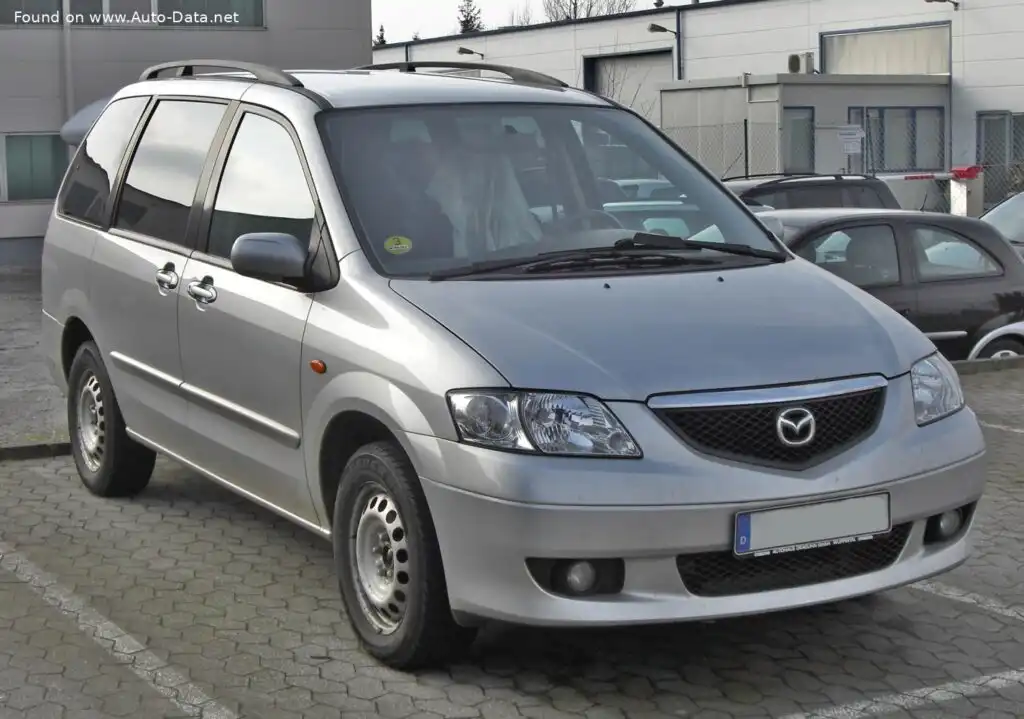
The Mazda MPV II (LW) 3.0i V6 24V, produced from 2002 to 2006, represented a significant evolution in Mazda’s minivan offerings. Positioned as a more upscale and performance-oriented option within the second-generation MPV lineup, this variant aimed to appeal to families seeking a blend of practicality, comfort, and a more engaging driving experience. The LW series MPV was primarily marketed in North America and select international markets, offering a compelling alternative to established players like the Honda Odyssey and Toyota Sienna. This specific 3.0-liter V6 engine and five-speed automatic transmission combination occupied the top trim level for the MPV during its production run.
Technical Specifications
| Brand | Mazda |
| Model | MPV |
| Generation | MPV II (LW) |
| Type (Engine) | 3.0 i V6 24V (203 Hp) |
| Start of production | 2002 |
| End of production | 2006 |
| Powertrain Architecture | Internal Combustion engine |
| Body type | Minivan |
| Seats | 7 |
| Doors | 5 |
| Fuel consumption (urban) | 15 l/100 km (15.7 US mpg) |
| Fuel consumption (extra urban) | 9.5 l/100 km (24.8 US mpg) |
| Fuel Type | Petrol (Gasoline) |
| Acceleration 0 – 100 km/h | 12 sec |
| Acceleration 0 – 62 mph | 12 sec |
| Acceleration 0 – 60 mph | 11.4 sec |
| Maximum speed | 200 km/h (124.27 mph) |
| Weight-to-power ratio | 8.4 kg/Hp |
| Weight-to-torque ratio | 6.3 kg/Nm |
| Power | 203 Hp @ 6200 rpm |
| Torque | 271 Nm @ 3000 rpm (199.88 lb.-ft. @ 3000 rpm) |
| Engine layout | Front, Transverse |
| Engine Model/Code | AJ |
| Engine displacement | 2967 cm3 (181.06 cu. in.) |
| Number of cylinders | 6 |
| Engine configuration | V-engine |
| Cylinder Bore | 89 mm (3.5 in.) |
| Piston Stroke | 79.5 mm (3.13 in.) |
| Compression ratio | 10:1 |
| Number of valves per cylinder | 4 |
| Fuel injection system | Multi-port manifold injection |
| Engine aspiration | Naturally aspirated engine |
| Valvetrain | DOHC |
| Engine oil capacity | 5.7 l (6.02 US qt | 5.02 UK qt) |
| Coolant capacity | 10.6 l (11.2 US qt | 9.33 UK qt) |
| Kerb Weight | 1710 kg (3769.9 lbs.) |
| Trunk (boot) space – minimum | 294 l (10.38 cu. ft.) |
| Trunk (boot) space – maximum | 2745 l (96.94 cu. ft.) |
| Fuel tank capacity | 75 l (19.81 US gal | 16.5 UK gal) |
| Length | 4750 mm (187.01 in.) |
| Width | 1830 mm (72.05 in.) |
| Height | 1745 mm (68.7 in.) |
| Wheelbase | 2840 mm (111.81 in.) |
| Front track | 1545 mm (60.83 in.) |
| Rear track | 1545 mm (60.83 in.) |
| Drivetrain Architecture | Front wheel drive |
| Number of gears | 5 |
| Gearbox type | Automatic transmission |
| Front suspension | Spring Strut |
| Rear suspension | Coil spring |
| Front brakes | Ventilated discs |
| Rear brakes | Drum |
| Assisting systems | ABS (Anti-lock braking system) |
| Steering type | Steering rack and pinion |
| Tires size | 215/60 R16 |
| Wheel rims size | 16 |
Powertrain & Engine Architecture
The heart of the MPV II 3.0i was Mazda’s AJ engine, a 3.0-liter, 60-degree V6. This engine featured a double overhead camshaft (DOHC) valvetrain with four valves per cylinder, contributing to its relatively high output for its displacement. The AJ engine utilized multi-port fuel injection, delivering fuel directly into the intake ports. The 24-valve configuration and a 10:1 compression ratio helped to achieve a power output of 203 horsepower at 6200 rpm and 271 Nm (199.88 lb-ft) of torque at 3000 rpm. This engine was known for its smooth operation and relatively refined character. The engine was transversely mounted in the front of the vehicle, driving the front wheels. Paired with the AJ V6 was a five-speed automatic transmission, providing smooth shifts and adequate responsiveness for everyday driving. This transmission was specifically tuned to balance fuel efficiency with the engine’s power delivery.
Driving Characteristics
The 3.0-liter V6 and automatic transmission combination offered a noticeable step up in performance compared to the base 2.3-liter four-cylinder engine option. While not a sports car, the MPV II 3.0i provided sufficient power for confident highway merging, passing maneuvers, and carrying a full load of passengers and cargo. Acceleration from 0 to 60 mph was achieved in approximately 11.4 seconds, and the top speed was electronically limited to 124.27 mph. The automatic transmission, while generally smooth, wasn’t particularly sporty, prioritizing comfort and ease of use over aggressive shifting. The gear ratios were optimized for fuel economy and relaxed cruising, rather than maximizing acceleration. Compared to a manual transmission equipped MPV, the automatic offered less driver engagement but greater convenience, particularly in urban driving conditions.
Equipment & Trim Levels
The 3.0i V6 trim typically included a comprehensive list of standard features. These generally included power windows, power locks, power mirrors, air conditioning, a CD player, and cloth upholstery. Higher-end options often included leather upholstery, a sunroof, upgraded audio systems, and alloy wheels. Safety features such as anti-lock brakes (ABS) were standard. The interior design was functional and family-oriented, with ample storage compartments and comfortable seating for seven passengers. The third-row seats could be folded flat into the floor, maximizing cargo space when not in use.
Chassis & Braking
The MPV II utilized a front-engine, front-wheel-drive layout. The front suspension consisted of a MacPherson strut setup, while the rear suspension employed a coil spring arrangement. This configuration provided a comfortable ride quality, although handling was not as sharp as some competitors. The braking system featured ventilated discs on the front wheels and drum brakes on the rear. ABS was standard, enhancing braking performance and stability, especially in adverse conditions. The steering was rack-and-pinion, providing reasonably precise control.
Market Reception & Comparison
The Mazda MPV II 3.0i V6 was generally well-received by automotive critics. It was praised for its spacious interior, comfortable ride, and refined engine. However, some reviewers noted that the automatic transmission could feel somewhat sluggish, and the handling wasn’t as engaging as some other minivans. Fuel economy was average for its class, with combined city/highway figures around 19 mpg. Compared to the base 2.3-liter MPV, the 3.0i offered a significant performance boost, but at a higher price point. It competed directly with the Honda Odyssey, Toyota Sienna, and Dodge Caravan, offering a unique blend of features and driving dynamics.
Legacy
The Mazda MPV II 3.0i V6, while not a high-volume seller, has developed a following among enthusiasts who appreciate its blend of practicality and performance. The AJ V6 engine is generally considered to be a reliable powerplant, although regular maintenance is crucial. Common issues include oil leaks and occasional sensor failures. In the used car market, these MPVs are often sought after by families looking for a spacious and comfortable vehicle with a more upscale feel. Parts availability is generally good, although some specific trim-related components may be harder to find. The MPV II 3.0i V6 represents a unique chapter in Mazda’s minivan history, offering a compelling alternative to the mainstream options of the early 2000s.