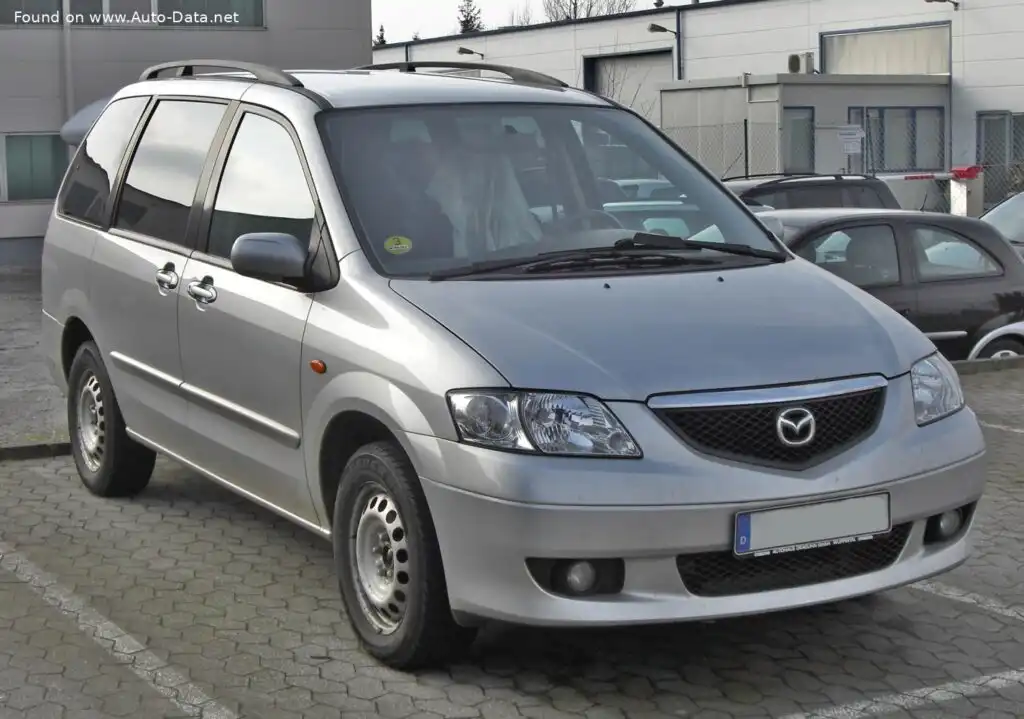
The Mazda MPV III 2.3, produced from 2007 to 2016, represents the third generation of Mazda’s popular minivan. This iteration of the MPV was primarily aimed at the Asian market, particularly Japan, where minivan designs with sliding doors and flexible seating configurations were highly favored. While not officially sold in the United States during this generation, the MPV III offered a blend of practicality, comfort, and Mazda’s signature driving dynamics. The 2.3-liter variant, producing 163 horsepower, occupied a middle ground in the MPV III lineup, offering a balance between performance and fuel efficiency. It served as a popular choice for families seeking a spacious and reliable vehicle.
Technical Specifications
| Brand | Mazda |
| Model | MPV |
| Generation | MPV III |
| Type (Engine) | 2.3 (163 Hp) |
| Start of production | 2007 |
| End of production | 2016 |
| Powertrain Architecture | Internal Combustion engine |
| Body type | Minivan |
| Seats | 7 |
| Doors | 5 |
| Fuel Type | Petrol (Gasoline) |
| Power | 163 Hp @ 6500 rpm |
| Power per litre | 72.1 Hp/l |
| Torque | 203 Nm @ 3500 rpm / 149.73 lb.-ft. @ 3500 rpm |
| Engine layout | Front, Transverse |
| Engine displacement | 2261 cm3 / 137.97 cu. in. |
| Number of cylinders | 4 |
| Engine configuration | Inline |
| Cylinder Bore | 87.5 mm / 3.44 in. |
| Piston Stroke | 94 mm / 3.7 in. |
| Compression ratio | 9.7:1 |
| Number of valves per cylinder | 4 |
| Fuel injection system | Multi-port manifold injection |
| Engine aspiration | Naturally aspirated engine |
| Valvetrain | DOHC |
| Fuel tank capacity | 75 l / 19.81 US gal | 16.5 UK gal |
| Length | 4870 mm / 191.73 in. |
| Width | 1850 mm / 72.83 in. |
| Height | 1685 mm / 66.34 in. |
| Wheelbase | 2950 mm / 116.14 in. |
| Front track | 1610 mm / 63.39 in. |
| Rear (Back) track | 1605 mm / 63.19 in. |
| Drivetrain Architecture | The Internal combustion engine (ICE) drives the front wheels of the vehicle. |
| Drive wheel | Front wheel drive |
| Front suspension | Independent coil spring |
| Rear suspension | Independent coil spring |
| Front brakes | Ventilated discs |
| Rear brakes | Disc |
| Steering type | Steering rack and pinion |
| Tires size | 215/55 R18 |
| Wheel rims size | 18 |
Powertrain & Engine Architecture
The heart of the MPV III 2.3 is Mazda’s 2.3-liter inline-four cylinder engine. This engine, internally designated with various codes depending on the specific market, is a naturally aspirated powerplant utilizing multi-port fuel injection. The engine features a double overhead camshaft (DOHC) valvetrain with four valves per cylinder, contributing to its respectable power output for its displacement. The 9.7:1 compression ratio strikes a balance between efficiency and performance. The engine’s design prioritizes smooth operation and reliability over outright performance, aligning with the MPV’s role as a family vehicle. Power is delivered to the front wheels via a four-speed automatic transmission, a common choice for minivans prioritizing ease of use over sporty driving dynamics. While a five-speed manual transmission was available in some markets, the four-speed automatic was the more prevalent option for the 2.3-liter engine.
Driving Characteristics
The MPV III 2.3 with the four-speed automatic transmission offers a comfortable and predictable driving experience. Acceleration is adequate for everyday driving, with 0-60 mph times estimated around 10-11 seconds. The automatic transmission is tuned for smooth shifts and prioritizes fuel economy over aggressive downshifting. Compared to the more powerful 2.5-liter engine option available in some markets, the 2.3-liter feels less strained during highway overtaking maneuvers. However, the 2.3-liter’s lighter weight and slightly better fuel economy make it a practical choice for urban driving. The gear ratios are optimized for low-end torque, providing sufficient power for navigating city streets and carrying a full load of passengers. The steering is light and precise, making the MPV easy to maneuver in tight spaces.
Equipment & Trim Levels
The MPV III 2.3 typically came equipped with a range of standard features, including air conditioning, power windows and locks, and a basic audio system. Higher trim levels added features such as alloy wheels, a sunroof, and upgraded interior upholstery. Interior materials were generally durable and practical, reflecting the vehicle’s family-oriented purpose. The seating configuration was a key selling point, with seven seats arranged in a 2-3-2 layout. The second-row seats often featured a sliding function for increased legroom and access to the third row. Optional extras included a navigation system, rear entertainment system, and leather upholstery. The dashboard layout was functional and straightforward, with easy-to-read gauges and intuitive controls.
Chassis & Braking
The MPV III utilizes an independent coil spring suspension on both the front and rear axles, providing a comfortable ride quality. The suspension is tuned to absorb bumps and irregularities in the road, minimizing vibrations transmitted to the cabin. Front brakes are ventilated discs, offering good stopping power, while rear brakes are solid discs. The steering system employs a rack and pinion setup, providing precise and responsive steering feel. The MPV III 2.3 typically came equipped with 215/55 R18 tires, offering a good balance between grip and ride comfort. Stabilizer bars are present on both axles to reduce body roll during cornering.
Market Reception & Comparison
The Mazda MPV III 2.3 was generally well-received in its target markets, praised for its spacious interior, comfortable ride, and Mazda’s reputation for reliability. Critics noted that the 2.3-liter engine, while adequate, wasn’t as powerful as some of its competitors. However, its fuel economy was competitive, and its smooth automatic transmission made it a pleasant vehicle to drive. Compared to other minivans in the segment, such as the Toyota Alphard or Honda Odyssey, the MPV III offered a more driver-focused experience, reflecting Mazda’s commitment to sporty handling. The MPV III 2.3’s reliability was generally considered good, with few major mechanical issues reported.
Legacy
The Mazda MPV III 2.3 remains a popular choice in the used car market, particularly in regions where it was originally sold. Its reputation for reliability and practicality has ensured its continued demand. The 2.3-liter engine, while not a powerhouse, has proven to be durable and relatively easy to maintain. Parts availability is generally good, and the MPV III’s simple mechanical design makes it accessible to independent mechanics. While it may not offer the latest technology or features found in modern minivans, the MPV III 2.3 represents a well-rounded and dependable vehicle that continues to provide years of service to its owners.