
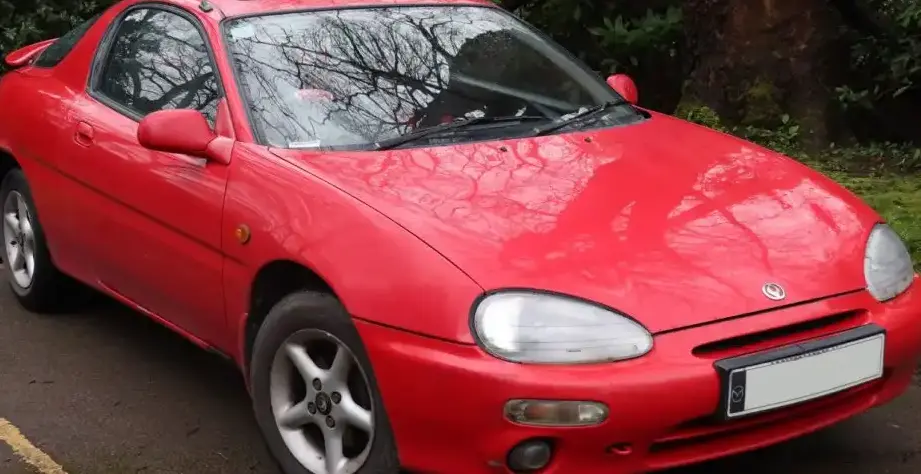
The Mazda MX-3 (EC) 1.8 i V6, produced between 1994 and 2000, represents a unique offering within the compact coupe segment. Positioned as a slightly more upscale and performance-oriented variant of the MX-3 line, the 1.8 i V6 distinguished itself with its unusual V6 engine in a front-wheel-drive configuration. It was primarily marketed in Europe and Japan, offering a blend of sporty styling and relatively accessible performance. The MX-3, overall, aimed to bridge the gap between affordable compacts and more expensive sports cars, appealing to buyers seeking a stylish and engaging driving experience.
Technical Specifications
| Brand | Mazda |
| Model | MX-3 |
| Generation | MX-3 (EC) |
| Type (Engine) | 1.8 i V6 (129 Hp) |
| Start of production | 1994 |
| End of production | 2000 |
| Powertrain Architecture | Internal Combustion engine |
| Body type | Coupe |
| Seats | 4 |
| Doors | 2 |
| Fuel consumption (urban) | 13.5 l/100 km (17.4 US mpg, 20.9 UK mpg, 7.4 km/l) |
| Fuel consumption (extra urban) | 7.1 l/100 km (33.1 US mpg, 39.8 UK mpg, 14.1 km/l) |
| Fuel Type | Petrol (Gasoline) |
| Acceleration 0 – 100 km/h | 8.5 sec |
| Acceleration 0 – 62 mph | 8.5 sec |
| Acceleration 0 – 60 mph | 8.1 sec |
| Maximum speed | 230 km/h (142.92 mph) |
| Weight-to-power ratio | 8.9 kg/Hp, 112.7 Hp/tonne |
| Weight-to-torque ratio | 7.3 kg/Nm, 137.1 Nm/tonne |
| Power | 129 Hp @ 6000 rpm |
| Power per litre | 69.9 Hp/l |
| Torque | 157 Nm @ 5000 rpm (115.8 lb.-ft. @ 5000 rpm) |
| Engine layout | Front, Transverse |
| Engine displacement | 1845 cm3 (112.59 cu. in.) |
| Number of cylinders | 6 |
| Engine configuration | V-engine |
| Cylinder Bore | 75 mm (2.95 in.) |
| Piston Stroke | 69.6 mm (2.74 in.) |
| Compression ratio | 9.2:1 |
| Number of valves per cylinder | 4 |
| Fuel injection system | Multi-port manifold injection |
| Engine aspiration | Naturally aspirated engine |
| Valvetrain | DOHC |
| Kerb Weight | 1145 kg (2524.29 lbs.) |
| Max. weight | 1540 kg (3395.12 lbs.) |
| Max load | 395 kg (870.83 lbs.) |
| Trunk (boot) space – minimum | 289 l (10.21 cu. ft.) |
| Fuel tank capacity | 50 l (13.21 US gal | 11 UK gal) |
| Length | 4220 mm (166.14 in.) |
| Width | 1695 mm (66.73 in.) |
| Height | 1310 mm (51.57 in.) |
| Wheelbase | 2455 mm (96.65 in.) |
| Front track | 1460 mm (57.48 in.) |
| Rear (Back) track | 1465 mm (57.68 in.) |
| Drivetrain Architecture | The Internal combustion engine (ICE) drives the front wheels of the vehicle. |
| Drive wheel | Front wheel drive |
| Number of gears and type of gearbox | 5 gears, manual transmission |
| Front suspension | Wishbone |
| Rear suspension | Spring Strut |
| Front brakes | Ventilated discs |
| Rear brakes | Disc |
| Assisting systems | ABS (Anti-lock braking system) |
| Steering type | Steering rack and pinion |
| Power steering | Hydraulic Steering |
| Tires size | 205/55 R15 |
| Wheel rims size | 15 |
INTRODUCTION
The Mazda MX-3 1.8 i V6, launched in 1994, was a distinctive coupe that aimed to offer a more refined and powerful alternative within the MX-3 range. It was built on Mazda’s EC platform, shared with other models like the 323/Protegé. The MX-3 line, in general, was intended to appeal to a younger demographic seeking a sporty and stylish vehicle. The 1.8 i V6 variant, with its unique engine, represented the top-of-the-line offering, providing a noticeable performance upgrade over the smaller-displacement four-cylinder models. Production continued until 2000, with the model primarily finding success in European and Japanese markets.
Powertrain & Engine Architecture
The heart of the MX-3 1.8 i V6 is its 1.8-liter (1845 cc) V6 engine, designated as the K8-DE. This engine is notable for being one of the smallest V6 engines ever produced, and its compact size was achieved through a 60-degree V-angle. It features a double overhead camshaft (DOHC) valvetrain with four valves per cylinder, and utilizes multi-port fuel injection. The engine produces 129 horsepower at 6000 rpm and 157 Nm (115.8 lb-ft) of torque at 5000 rpm. The engine code K8-DE is specific to this configuration. The engine’s relatively high-revving nature and smooth power delivery were key characteristics. The standard transmission for this variant was a 5-speed manual, although a 4-speed automatic transmission was also available, albeit less common. The automatic transmission, while offering convenience, did impact acceleration and fuel economy compared to the manual.
Driving Characteristics
The MX-3 1.8 i V6 offered a noticeably more engaging driving experience than its four-cylinder counterparts. The V6 engine provided a smoother and more responsive power delivery, making it enjoyable for both city driving and highway cruising. The 0-60 mph time of around 8.1 seconds (manual transmission) was respectable for its class in the mid-1990s. The manual transmission allowed for greater control and maximized the engine’s potential, while the automatic, though less sporty, provided a comfortable and convenient driving experience. The front-wheel-drive layout offered predictable handling, although it wasn’t as balanced as a rear-wheel-drive setup. The suspension, tuned for a balance between comfort and handling, provided a reasonably compliant ride without excessive body roll.
Equipment & Trim Levels
The 1.8 i V6 typically came with a higher level of standard equipment compared to the base MX-3 models. Standard features often included power windows, power steering, central locking, and an upgraded audio system. Interior upholstery was typically cloth, with options for leather available. Dashboard configuration was relatively simple and functional, with a focus on driver ergonomics. Optional extras included air conditioning, alloy wheels, and a sunroof. The trim level often dictated the availability of these options, with higher trims offering more features as standard.
Chassis & Braking
The MX-3 1.8 i V6 utilized a front independent suspension with wishbones and a rear independent suspension with a spring strut setup. This suspension configuration aimed to provide a good balance between ride comfort and handling. Braking duties were handled by ventilated discs on the front wheels and solid discs on the rear. An Anti-lock Braking System (ABS) was standard, enhancing safety and control during hard braking. The chassis was relatively lightweight, contributing to the car’s nimble handling characteristics. Stabilizer bars were fitted to both the front and rear axles to reduce body roll during cornering.
Market Reception & Comparison
The MX-3 1.8 i V6 received generally positive reviews from automotive critics. It was praised for its stylish design, smooth V6 engine, and engaging driving experience. However, some critics noted that the interior was somewhat basic compared to competitors. Compared to the base MX-3 models with four-cylinder engines, the 1.8 i V6 offered a significant performance upgrade, but at a higher price point. Fuel economy was also slightly lower due to the larger engine. Compared to other coupes in its class, such as the Honda Civic Coupe or Toyota Celica, the MX-3 offered a unique combination of style, performance, and affordability. The automatic transmission version was often criticized for diminishing the sporty feel of the car.
Legacy
The Mazda MX-3 1.8 i V6, while not a massive sales success, has gained a following among enthusiasts. The K8-DE V6 engine, despite its small size, is known for its reliability and smooth operation when properly maintained. Finding parts can sometimes be a challenge due to the car’s age and relatively limited production numbers. Today, well-maintained examples of the MX-3 1.8 i V6 are becoming increasingly collectible, appealing to those seeking a unique and affordable classic coupe. The powertrain, while not particularly powerful by modern standards, remains a capable and enjoyable unit, and its compact size and relatively simple design contribute to its long-term durability.
