Technical Specifications
| Brand | Mazda |
| Model | MX-5 |
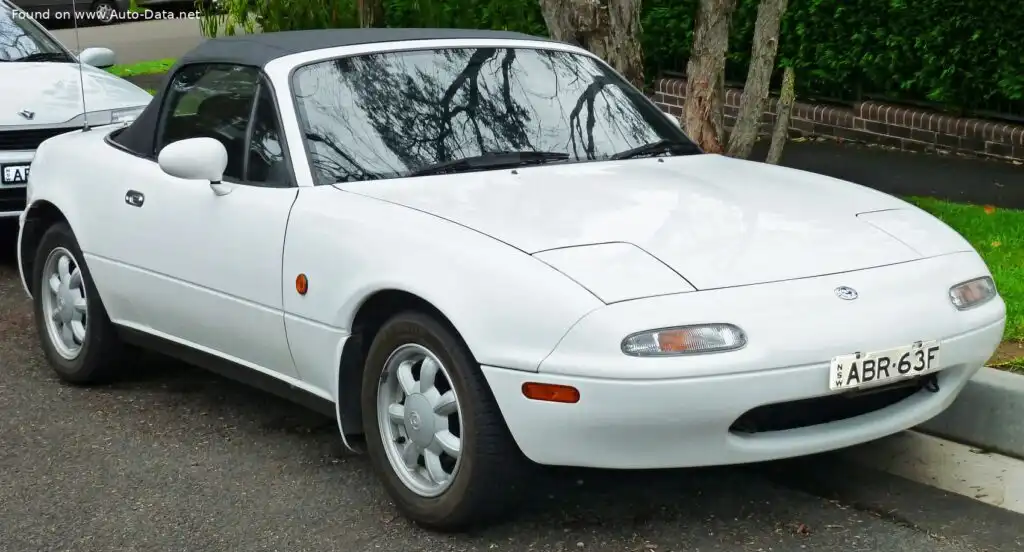
| Generation | MX-5 I (NA) |
| Type (Engine) | 1.8 (130 Hp) |
| Start of production | 1994 |
| End of production | 1998 |
| Powertrain Architecture | Internal Combustion engine |
| Body type | Roadster |
| Seats | 2 |
| Doors | 2 |
| Fuel consumption (combined) | 8.7 l/100 km |
| Fuel consumption (US mpg) | 27 US mpg |
| Fuel consumption (UK mpg) | 32.5 UK mpg |
| Fuel consumption (km/l) | 11.5 km/l |
| Fuel Type | Petrol (Gasoline) |
| Acceleration 0 – 100 km/h | 8.2 sec |
| Acceleration 0 – 62 mph | 8.2 sec |
| Acceleration 0 – 60 mph | 7.8 sec |
| Maximum speed | 197 km/h (122.41 mph) |
| Weight-to-power ratio | 7.6 kg/Hp |
| Weight-to-torque ratio | 6.5 kg/Nm |
| Power | 130 Hp @ 6500 rpm |
| Power per litre | 70.7 Hp/l |
| Torque | 152 Nm @ 5000 rpm (112.11 lb.-ft. @ 5000 rpm) |
| Engine layout | Front, Longitudinal |
| Engine displacement | 1840 cm3 (112.28 cu. in.) |
| Number of cylinders | 4 |
| Engine configuration | Inline |
| Cylinder Bore | 83 mm (3.27 in.) |
| Piston Stroke | 85 mm (3.35 in.) |
| Compression ratio | 9.4:1 |
| Number of valves per cylinder | 4 |
| Fuel injection system | Multi-port manifold injection |
| Engine aspiration | Naturally aspirated engine |
| Valvetrain | DOHC |
| Kerb Weight | 990 kg (2182.58 lbs.) |
| Max. weight | 1230 kg (2711.69 lbs.) |
| Max load | 240 kg (529.11 lbs.) |
| Trunk (boot) space – minimum | 135 l (4.77 cu. ft.) |
| Fuel tank capacity | 48 l (12.68 US gal | 10.56 UK gal) |
| Length | 3975 mm (156.5 in.) |
| Width | 1675 mm (65.94 in.) |
| Height | 1230 mm (48.43 in.) |
| Wheelbase | 2265 mm (89.17 in.) |
| Front track | 1410 mm (55.51 in.) |
| Rear (Back) track | 1430 mm (56.3 in.) |
| Drivetrain Architecture | Rear wheel drive |
| Drive wheel | Rear wheel drive |
| Number of gears and type of gearbox | 5 gears, manual transmission |
| Front suspension | Double wishbone |
| Rear suspension | Double wishbone |
| Front brakes | Ventilated discs |
| Rear brakes | Disc |
| Assisting systems | ABS (Anti-lock braking system) |
| Steering type | Steering rack and pinion |
| Power steering | Hydraulic Steering |
| Tires size | 185/60 R14 82 H |
| Wheel rims size | 5.5J x 14 ET 40 |
The introduction of the 1.8-liter engine in the MX-5 NA in 1994 was a pivotal moment for the model. While the original 1.6-liter engine was charming, it was often considered underpowered, particularly in the North American market. The larger displacement engine, utilizing the engine code BP, addressed this concern, providing a noticeable increase in both horsepower and torque. This engine was available with either a 5-speed manual transmission or a 4-speed automatic transmission. The 1.8-liter model continued through the end of the NA generation in 1997 (1998 in some markets), solidifying the MX-5’s reputation as a fun-to-drive, affordable sports car.
Powertrain & Engine Architecture
The 1.8-liter BP engine is a naturally aspirated, inline-four cylinder engine with a displacement of 1840cc. It features a double overhead camshaft (DOHC) valvetrain with four valves per cylinder. The engine utilizes multi-port fuel injection, contributing to improved fuel efficiency and throttle response. The BP engine is known for its relatively simple design and robust construction. The 4-speed automatic transmission paired with the 1.8L engine was a Jatco unit, chosen for its compact size and reliability. While not known for its sporty performance, it provided a comfortable and convenient driving experience. The automatic transmission featured electronically controlled torque converter lock-up for improved fuel economy at highway speeds. The engine’s 9.4:1 compression ratio was a compromise between performance and reliability, allowing it to run on readily available gasoline grades.
Driving Characteristics
The 1.8-liter MX-5 with the automatic transmission offered a more relaxed driving experience compared to the manual transmission variants or the higher-output versions. While the automatic transmission dulled the sporty edge somewhat, it made the MX-5 more accessible to a wider range of drivers. Acceleration from 0-60 mph took around 7.8 seconds, which was respectable for the time, but noticeably slower than the manual transmission version. The automatic transmission’s gear ratios were optimized for fuel economy and smooth cruising, rather than aggressive acceleration. The power delivery was linear, with a usable torque band that made it easy to drive in everyday traffic. However, drivers seeking a more engaging experience often preferred the control offered by the manual transmission.
Equipment & Trim Levels
The 1.8-liter MX-5 typically came standard with features such as power steering, disc brakes on all four wheels, and an anti-lock braking system (ABS). Interior appointments included cloth upholstery, a leather-wrapped steering wheel, and basic instrumentation. Optional extras included a power-operated convertible top, air conditioning, a Bose sound system, and alloy wheels. Trim levels varied depending on the market, but generally, the 1.8-liter model was positioned as a step up from the base 1.6-liter, offering more standard features and a more refined driving experience. The automatic transmission was often paired with a more comfort-oriented trim package.
Chassis & Braking
The MX-5 NA utilized a lightweight, rear-wheel-drive chassis designed for nimble handling. The suspension consisted of double wishbones at both the front and rear, providing excellent control and responsiveness. The 1.8-liter models generally featured slightly thicker stabilizer bars compared to the 1.6-liter versions to manage the increased power. Braking duties were handled by ventilated discs at the front and solid discs at the rear, providing adequate stopping power for the car’s weight and performance. The hydraulic power steering offered precise and communicative steering feel, enhancing the driving experience.
Market Reception & Comparison
The 1.8-liter MX-5 was well-received by automotive critics, who praised its improved performance and refinement compared to the 1.6-liter model. The automatic transmission was often criticized for detracting from the car’s sporty character, but it was acknowledged as a practical option for drivers who preferred convenience over outright performance. Compared to the manual transmission version, the 1.8-liter automatic offered slightly lower fuel economy, but the difference was not significant. Reliability was generally excellent, with the BP engine proving to be a durable and long-lasting powerplant. The 1.8-liter model offered a compelling alternative to other small roadsters and sports cars of the era, such as the BMW Z3 and the Toyota MR2.
Legacy
The Mazda MX-5 NA 1.8-liter remains a popular choice among enthusiasts and collectors today. The BP engine is known for its reliability and relatively simple maintenance requirements. Well-maintained examples command a premium in the used car market. The 1.8-liter automatic, while not the most sought-after variant, offers a unique and enjoyable driving experience for those who appreciate its blend of comfort and performance. The MX-5 NA, in all its forms, is widely regarded as a landmark vehicle that helped to revive the affordable roadster segment and continues to inspire automotive designers and engineers.