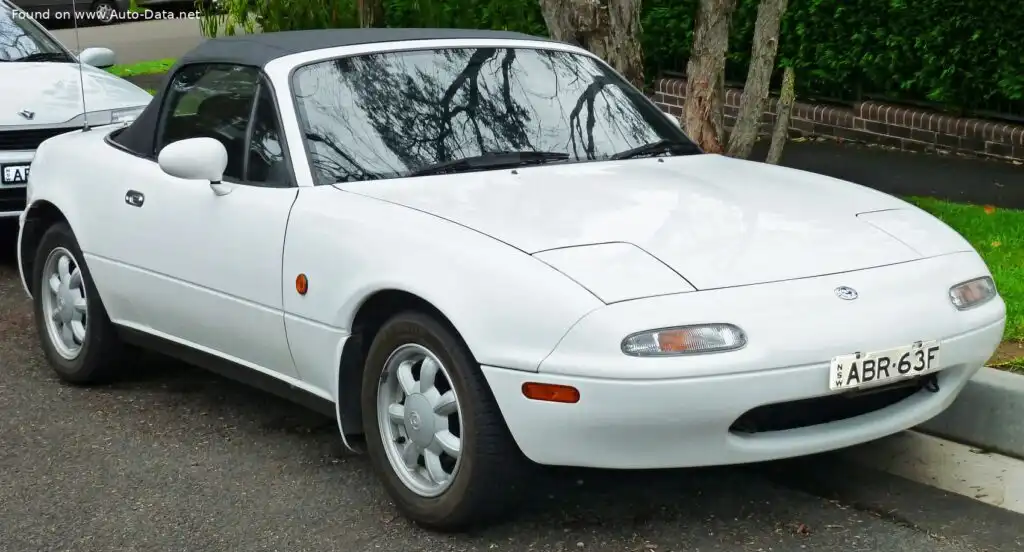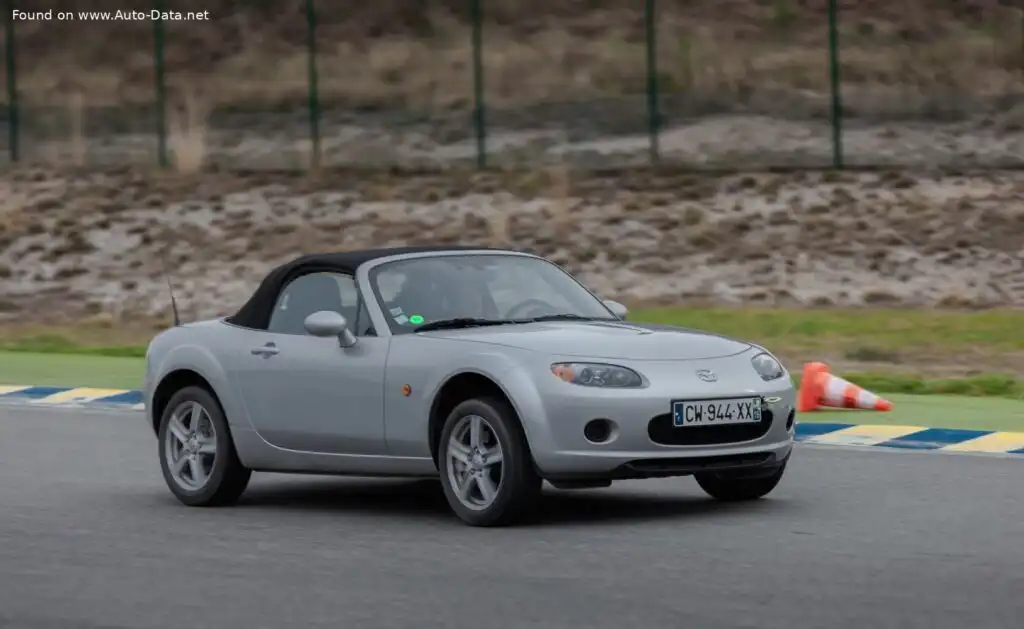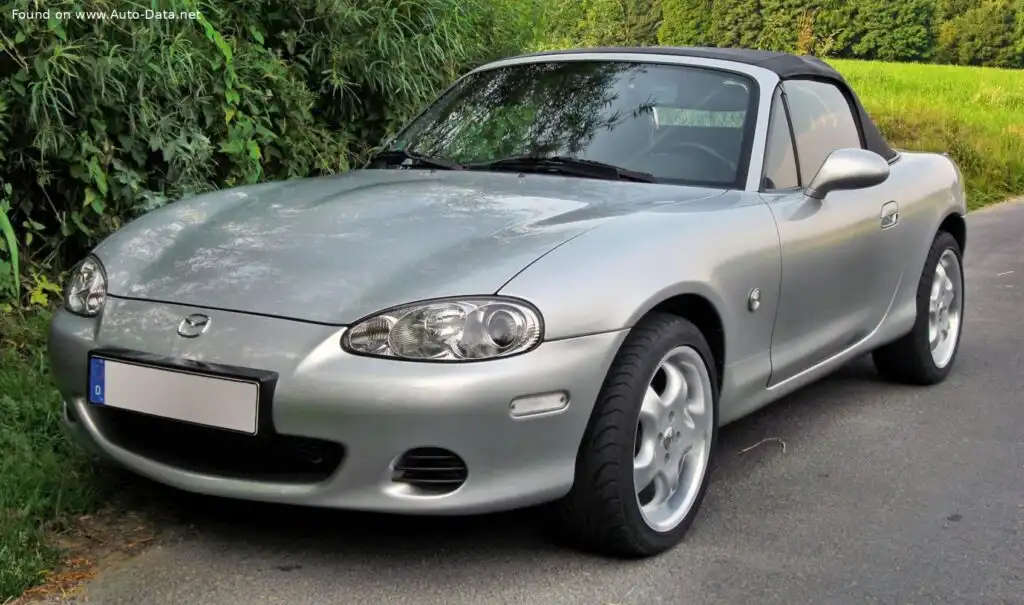
The Mazda MX-5 NB, produced between 1998 and 2005, marked the second generation of Mazda’s celebrated roadster. The 1.6 i 16V variant, delivering 110 horsepower, served as the entry point into the NB lineup in many European and Asian markets. While not the most powerful version available, it offered an accessible and engaging driving experience, prioritizing affordability and fuel efficiency within the MX-5’s core philosophy of lightweight, rear-wheel-drive fun. This model played a crucial role in maintaining the MX-5’s popularity as the world’s best-selling two-seater sports car.
Technical Specifications
| Brand | Mazda |
| Model | MX-5 |
| Generation | MX-5 II (NB) |
| Type (Engine) | 1.6 i 16V (110 Hp) |
| Start of production | 1998 |
| End of production | 2005 |
| Powertrain Architecture | Internal Combustion engine |
| Body type | Roadster |
| Seats | 2 |
| Doors | 2 |
| Fuel consumption (urban) | 10.8 l/100 km (21.8 US mpg) |
| Fuel consumption (extra urban) | 6.6 l/100 km (35.6 US mpg) |
| Fuel consumption (combined) | 8.1 l/100 km (29 US mpg) |
| Fuel Type | Petrol (Gasoline) |
| Acceleration 0 – 100 km/h | 9.7 sec |
| Acceleration 0 – 62 mph | 9.7 sec |
| Acceleration 0 – 60 mph | 9.2 sec |
| Maximum speed | 191 km/h (118.68 mph) |
| Weight-to-power ratio | 9.4 kg/Hp |
| Weight-to-torque ratio | 7.7 kg/Nm |
| Power | 110 Hp @ 6500 rpm |
| Torque | 134 Nm @ 5000 rpm (98.83 lb.-ft. @ 5000 rpm) |
| Engine layout | Front, Longitudinal |
| Engine displacement | 1598 cm3 (97.52 cu. in.) |
| Number of cylinders | 4 |
| Engine configuration | Inline |
| Cylinder Bore | 78 mm (3.07 in.) |
| Piston Stroke | 83.6 mm (3.29 in.) |
| Compression ratio | 9.4:1 |
| Number of valves per cylinder | 4 |
| Fuel injection system | Multi-port manifold injection |
| Engine aspiration | Naturally aspirated engine |
| Valvetrain | DOHC |
| Kerb Weight | 1035 kg (2281.78 lbs.) |
| Max. weight | 1255 kg (2766.8 lbs.) |
| Max load | 220 kg (485.02 lbs.) |
| Trunk (boot) space – minimum | 145 l (5.12 cu. ft.) |
| Fuel tank capacity | 50 l (13.21 US gal | 11 UK gal) |
| Length | 3975 mm (156.5 in.) |
| Width | 1680 mm (66.14 in.) |
| Height | 1225 mm (48.23 in.) |
| Wheelbase | 2265 mm (89.17 in.) |
| Front track | 1405 mm (55.31 in.) |
| Rear (Back) track | 1430 mm (56.3 in.) |
| Minimum turning circle | 9.7 m (31.82 ft.) |
| Drivetrain Architecture | Rear wheel drive |
| Number of gears | 5 gears, manual transmission |
| Front suspension | Double wishbone |
| Rear suspension | Coil spring |
| Front brakes | Ventilated discs |
| Rear brakes | Disc |
| Assisting systems | ABS (Anti-lock braking system) |
| Steering type | Steering rack and pinion |
| Power steering | Hydraulic Steering |
| Tires size | 185/60 R14 82 H |
| Wheel rims size | 5.5J x 14 ET 40 |
The NB MX-5, launched in 1998, represented a significant evolution of the original NA model. While retaining the core principles of lightweight and rear-wheel drive, the NB featured a more refined interior, improved safety features, and a slightly more powerful engine. The 1.6L 16V engine, producing 110 horsepower, was a popular choice, particularly in Europe and Asia, where it offered a balance between performance and affordability. It positioned itself as the entry-level trim, appealing to buyers seeking a fun-to-drive roadster without the higher price tag of the 1.8L variants. The NB generation continued the MX-5’s legacy as a benchmark for affordable sports cars.
Powertrain & Engine Architecture
The heart of the 1.6 i 16V MX-5 is the B6ZE engine, a 1.6-liter inline-four cylinder powerplant. This engine utilizes a naturally aspirated configuration with multi-port fuel injection. The ‘ZE’ designation indicates a specific iteration of the B6 engine family, optimized for the NB MX-5. The engine features a double overhead camshaft (DOHC) valvetrain, operating 16 valves (four per cylinder) to enhance breathing and improve power delivery. The compression ratio of 9.4:1 was a compromise between performance and the ability to run on readily available fuel grades. The 1.6L engine was typically paired with a 5-speed manual transmission, although a 4-speed automatic transmission was also available. The automatic transmission, while offering convenience, did impact acceleration and fuel economy compared to the manual. The automatic’s gear ratios were geared more towards economy than outright performance, resulting in a less engaging driving experience.
Driving Characteristics
The 1.6L engine, coupled with the relatively lightweight chassis of the MX-5 NB (around 2282 lbs), provided a lively and engaging driving experience. While not brutally fast, the 110 horsepower was sufficient for spirited driving on winding roads. Acceleration from 0-60 mph took approximately 9.2 seconds, and top speed was around 119 mph. The 5-speed manual transmission allowed drivers to fully exploit the engine’s powerband, while the automatic, though less engaging, offered smooth shifts. The rear-wheel-drive layout contributed to the MX-5’s balanced handling and predictable cornering behavior. Compared to the 1.8L models, the 1.6L felt less urgent in its acceleration, but its lighter weight and nimble handling made it a rewarding car to drive. The shorter gearing in the manual transmission helped to keep the engine in its optimal power range, while the automatic’s taller gearing prioritized fuel efficiency.
Equipment & Trim Levels
The 1.6L MX-5 NB typically came with a fairly basic level of equipment, reflecting its position as the entry-level model. Standard features generally included power steering, ventilated front disc brakes, and a basic audio system. Interior upholstery was typically cloth, and the dashboard featured a simple, functional design. Optional extras included air conditioning, alloy wheels, a limited-slip differential, and a more sophisticated audio system. Higher trim levels, such as the ‘Sport’ or ‘Limited’ editions, added more features as standard, but the base 1.6L model focused on providing a pure driving experience without unnecessary frills. The interior plastics were durable but utilitarian, reflecting the car’s focus on affordability.
Chassis & Braking
The MX-5 NB retained the double wishbone front suspension and coil spring rear suspension setup of the NA model, providing excellent handling characteristics. The suspension was tuned for a balance between comfort and responsiveness. The 1.6L models typically featured ventilated disc brakes at the front and solid disc brakes at the rear. Anti-lock braking system (ABS) was standard, enhancing safety. The relatively light weight of the 1.6L variant meant that the braking system was generally adequate for its performance level. Stabilizer bars were fitted front and rear to reduce body roll during cornering. The suspension geometry was optimized for neutral handling, making the car predictable and easy to control.
Market Reception & Comparison
The 1.6L MX-5 NB received generally positive reviews from automotive critics. It was praised for its engaging handling, responsive steering, and overall fun-to-drive character. However, some critics noted that the 1.6L engine felt underpowered compared to the 1.8L variants. Fuel economy was a strong point, with the 1.6L achieving around 29 US mpg in combined driving. In terms of reliability, the 1.6L engine proved to be robust and dependable, although regular maintenance was essential. Compared to the 1.8L models, the 1.6L offered a more affordable entry point into MX-5 ownership, making it a popular choice for first-time sports car buyers. The 1.8L models offered more power and torque, but at a higher price point and with a slightly heavier curb weight.
Legacy
The 1.6L MX-5 NB remains a popular choice among enthusiasts today. Its simple, reliable engine and engaging driving dynamics make it a rewarding car to own and drive. Parts availability is generally good, and maintenance costs are relatively low. While not as collectible as some of the higher-performance MX-5 variants, the 1.6L NB offers a compelling combination of affordability, reliability, and driving pleasure. It continues to represent the core values of the MX-5: lightweight, rear-wheel drive, and a pure, unadulterated driving experience. Well-maintained examples are increasingly sought after by those looking for an affordable and enjoyable classic roadster.